【For Employers】Highly Skilled Professional (HSP) Visa Applications for Foreign Employees
Last Updated:

- What Is the Highly Skilled Professional Visa? Key Basics HR Needs to Know
- Why Foreign Employees Want to Obtain Highly Skilled Professional Status
- What Is the Highly Skilled Professional Visa? Overview of the Scheme
- Three Categories of Highly Skilled Professional
- Types of Highly Skilled Professional Status (Category 1, Category 2, J-Skip)
- Employer Benefits — Three Key Preferential Measures
- Differences Between HSP and Engineer/Specialist in Humanities/International Services
- Differences Between HSP (Type 2) and Permanent Residency
- Common Employer Requests for HSP Visa Applications
- Process from Consultation to Visa Approval / Screening Timeline
- Required Documents for HSP Applications
- HSP Visa Q&A
- An employee has requested to switch to HSP status — What should the company do?
- Are there benefits for employers when an employee holds an HSP visa?
- What documents must employers prepare for an HSP application?
- Is the application submitted by the employee, or can the company apply on their behalf?
- If an employee resigns after obtaining HSP status, are there procedures the employer must follow?
- ACROSEED’s Visa Application Support Service
1. What Is the Highly Skilled Professional Visa? Key Basics HR Needs to Know
Have you ever had a foreign employee suddenly say, “I’d like to switch to a Highly Skilled Professional visa,” and found yourself unsure how to respond?
The Highly Skilled Professional visa is not only important for the employee’s own career development, but also has a direct impact on your company’s talent acquisition and retention. However, for a busy HR team, researching the制度 from scratch can be a significant burden.
This page organizes only what HR really needs to know, in a structured way.
We explain, from an HR perspective and in practical terms, the differences from a standard work visa (Engineer/Specialist in Humanities/International Services), the benefits for the employer, key points when guiding employees internally, and the overall application flow.
Once you understand the system, it will greatly support long-term retention and talent management for your foreign employees. We hope this page will be useful for your company’s foreign talent strategy.
1. Why Foreign Employees Want to Obtain Highly Skilled Professional Status
The Highly Skilled Professional visa is often initiated by the employee, who approaches HR saying they would like to “change” or “apply” for this status. Behind this request are not just the desire to “upgrade” their visa, but several very concrete benefits that directly affect their life plans and career in Japan.
Main Reasons Foreign Employees Seek Highly Skilled Professional Status
- Earlier access to permanent residency
If certain conditions are met, they can apply for permanent residency in a much shorter period than usual, making it easier to build a long-term life in Japan. - Better credit profile for housing loans and other financing
Having a clear pathway toward permanent residency can improve how financial institutions assess them for mortgages and other loans, contributing to greater overall stability. - Expanded options for family members and spouse’s employment
The制度 offers preferential measures such as the possibility of bringing parents to Japan or employing domestic helpers, which makes it easier to support the family’s life in Japan. - Reduced uncertainty about future stay and visa renewals
The maximum period of stay can be extended up to five years, and the status can lead on to Highly Skilled Professional (ii) and then permanent residency, reducing anxiety around frequent renewals. - A way to concretely express, “I want to work in Japan long term”
A request to obtain Highly Skilled Professional status is a clear sign that the employee is thinking about their career and life in Japan over the mid-to-long term, and for the employer it is also a strong indicator of high commitment and intention to stay.
In short, behind a request for Highly Skilled Professional status is a positive intention to work and live in Japan in a stable, long-term way. If HR and General Affairs understand this perspective, it becomes much easier to communicate with employees when they raise this topic.
2. What Is the Highly Skilled Professional Visa? Overview of the Scheme
The Highly Skilled Professional visa is a status of residence created to attract foreign professionals with advanced knowledge and skills who can contribute to Japan’s economic, academic, and industrial development. Compared to standard work visas (such as Engineer/Specialist in Humanities/International Services), it is best understood as a “preferential” status that assumes a higher level of expertise and income.
A key feature is that applicants are evaluated using a points-based system that takes into account education, work experience, income, research achievements, and other factors. When the total score reaches a certain threshold (70 points or more), the applicant is recognized as a Highly Skilled Professional and receives the following types of benefits:
- Longer maximum period of stay (in principle, up to 5 years)
- Relaxed requirements for permanent residency (shortened required length of stay)
- Broader work authorization for spouses
- Possibility to bring parents or domestic helpers under certain conditions
- Greater flexibility to engage in multiple activities (for example, research and entrepreneurship in parallel)
From an employer’s perspective, this system allows foreign professionals with advanced skills to work in Japan in a more long-term and stable manner, making it a useful tool for talent strategy.
3. Three Categories of Highly Skilled Professional
The Highly Skilled Professional status is divided into three categories depending on the employee’s role and job content. For HR, it is essential to first identify which category (i, ii or iii) the employee falls into.
1. Highly Skilled Professional (i) (Advanced Academic Research Activities)
This category mainly covers research and education activities at universities and research institutions. Typical examples include university faculty, post-doctoral researchers, and researchers at corporate R&D centers.
・Research
・Supervision of research
・Education/teaching
・Management of businesses related to the above activities
2. Highly Skilled Professional (ii) (Advanced Specialized/Technical Activities)
Many professional employees working in private companies fall into this category. It covers work that requires specialized knowledge in the natural sciences or humanities, as well as related business activities.
・Work requiring specialized knowledge or skills in the natural or human sciences
・Management of businesses related to the above activities
3. Highly Skilled Professional (iii) (Advanced Business Management Activities)
This category is intended for individuals whose primary role is the management or administration of a business, such as executives and senior management.
・Management of businesses such as trading companies and other enterprises
・Administration of such businesses (e.g., as a company officer)
・Management of businesses related to the above activities
When applying for Highly Skilled Professional status, the first step is to determine which of these three categories the employee’s role fits into, and then proceed to calculate the applicable points.
4. Types of Highly Skilled Professional Status (Category 1, Category 2, J-Skip)
There are three main frameworks within the Highly Skilled Professional制度: Category 1, Category 2, and the Special Highly Skilled Professional制度 known as “J-Skip.” From an HR standpoint, it is sufficient to understand their key features and how they affect the company.
1. Highly Skilled Professional (1)
This is the standard form of Highly Skilled Professional status. The individual must fall under one of the three activity types (i, ii, or iii) and obtain a score of 70 points or more.
- Period of stay: typically 1, 3, or 5 years
- Benefits: relaxed permanent residency requirements, broader work permission for spouses, possibility of bringing parents or domestic helpers, etc.
- Typical holders: researchers, specialized professionals, executives, and corporate officers
2. Highly Skilled Professional (2)
This status is available after a certain period of activity under Highly Skilled Professional (1) (in principle, three years or more). It provides effectively unlimited period of stay and allows a broader range of activities compared to Category 1.
- Period of stay: unlimited
- Scope of activities: in addition to activities permitted under Category 1, a wide range of activities corresponding to other work-related statuses of residence
- Benefit for employers: easier to plan long-term employment, promotion, and appointment to key positions
3. Special Highly Skilled Professional制度 (J-Skip)
J-Skip allows candidates to obtain Highly Skilled Professional (1) status without going through the standard points calculation, based on a combination of high academic background, relevant experience, and high income. It is designed as a fast-track route for top-tier talent who meet certain criteria.
- Master’s degree or higher + annual income of approx. JPY 20 million or more
- Long-term relevant work experience + annual income of approx. JPY 20 million or more
- Management/administrative experience + annual income of approx. JPY 40 million or more
Talent who qualify under J-Skip are highly competitive in the labor market. Understanding this制度 helps HR design stronger offer packages and more attractive hiring/relocation schemes for such candidates.
2. Employer Benefits — Key Preferential Measures for Highly Skilled Professionals
Preferential Measures for Highly Skilled Professional (Type 1)
1. Permission for Multiple Activities
Ordinarily, foreign nationals may only engage in activities permitted under a single approved status of residence. HSP holders, however, are permitted to engage in multiple activities across different categories — for example, conducting academic research at a university while also operating a related business.
2. Five-Year Period of Stay
HSP holders are granted a uniform five-year period of stay — the maximum allowed under current law.
※ This period is renewable.
3. Relaxed Permanent Residency Requirements
Normally, permanent residency requires at least 10 years of continuous residence in Japan. HSP holders become eligible after only 3 years, and those with 80 points or more may apply after just 1 year.
4. Spouse Employment
Typically, spouses of foreign nationals must meet academic or professional requirements to obtain statuses such as “Instructor” or “Engineer/Specialist in Humanities/International Services.” Spouses of HSP holders are permitted to work in these activities even without fulfilling such requirements.
5. Permission for Parents to Accompany (Under Specific Conditions)
In principle, parents of foreign nationals with work-related visas are not permitted to accompany them. However, under specific conditions, parents (including adoptive parents) of an HSP holder or their spouse may be granted entry and residence in Japan.
1) When caring for a child under the age of 7 (including adopted children) of the HSP holder or spouse
2) When assisting a pregnant HSP holder or pregnant spouse
1. Household annual income of at least 8 million yen
2. Parents must reside with the HSP holder
3. Only one parent from either the HSP holder’s or the spouse’s side may accompany
6. Permission to Employ a Domestic Helper (Under Specific Conditions)
Ordinarily, only certain visa holders (e.g., Business Manager, Legal/Accounting Services) may bring a foreign domestic helper. HSP holders may also employ a foreign domestic helper if the specified requirements are met.
2.Preferential Measures for Highly Skilled Professional (Type 2)
1. In addition to the benefits listed above, Type 2 holders may engage in almost all activities permitted under work-related statuses of residence.
2. The period of stay is unlimited.
3.Preferential Measures for Special Highly Skilled Professionals (J-Skip)
1. Households with an annual income of 30 million yen or more may employ up to two foreign domestic helpers (no household circumstance requirements apply — see note).
2. Spouses may engage in employment beyond the 28-hour weekly limit in categories such as “Research,” “Education,” “Engineer/Specialist in Humanities/International Services,” and “Entertainer,” as well as “Professor,” “Artist,” “Religious Activities,” “Journalist,” and “Skilled Labor,” without meeting academic or professional requirements.
3. Use of priority lanes at major airports upon entry and departure.
※ This removes conditions such as having a child under 13, a spouse unable to manage household duties due to illness, or prior continuous employment of the domestic helper overseas for at least one year.
3. Differences Between Highly Skilled Professional and Engineer/Specialist in Humanities/International Services
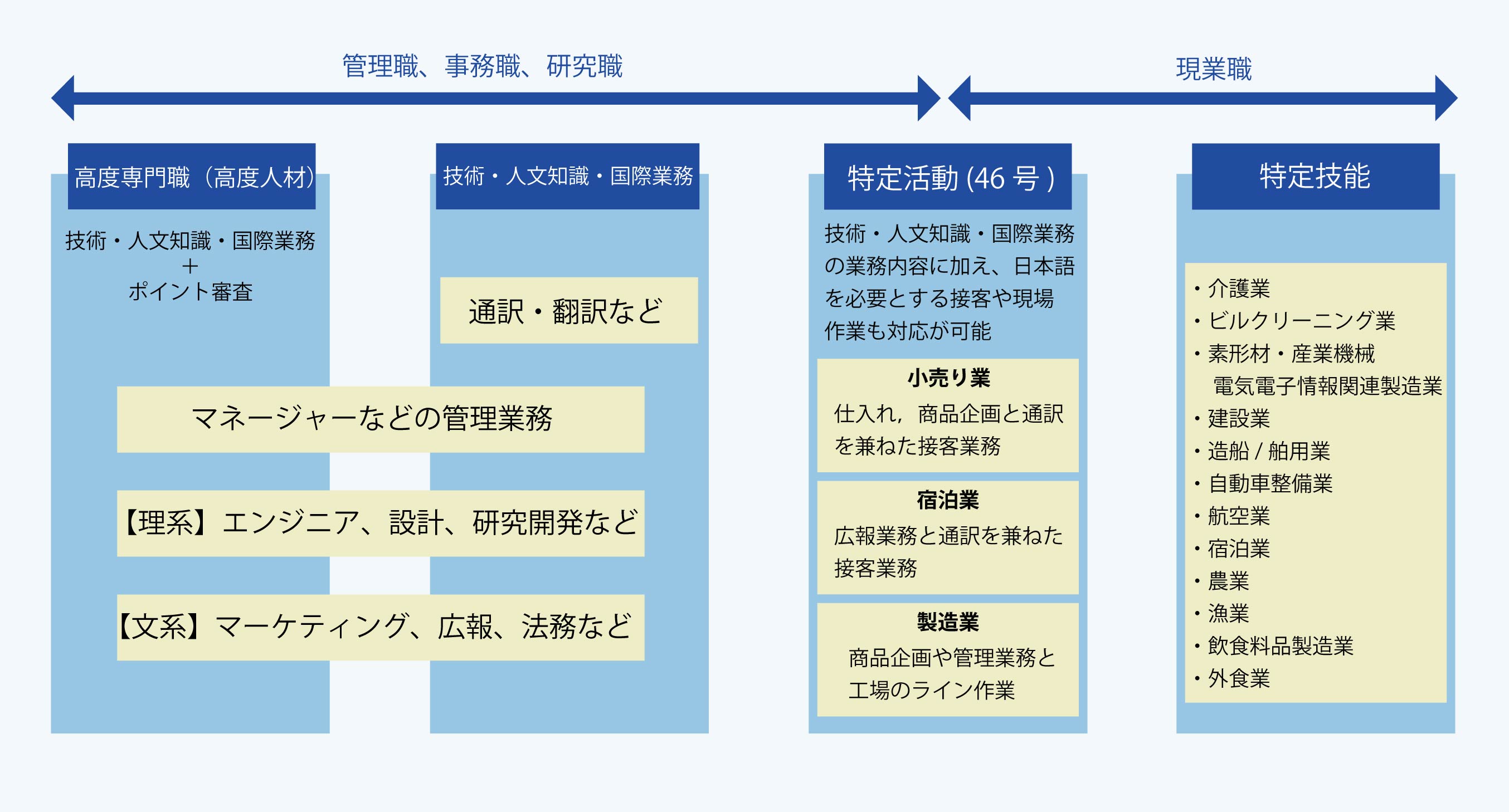
The “Engineer/Specialist in Humanities/International Services” (E/H/I) status is the most common among Japan’s 16 work-related visa categories.
This status covers a wide range of managerial, administrative, and professional positions, such as:
Engineering, IT, scientific research, architecture, product development, etc.
Corporate sales, marketing, planning/PR, accounting/finance, management positions, etc.
Translation/interpretation, language instruction, overseas trade, design/product development with international perspectives, etc.
When the HSP visa is based on “Engineer/Specialist in Humanities” activities, the scope of work is generally similar. However, for “International Services” — such as interpretation/translation — there are important restrictions.
Interpreters and translators usually qualify under the E/H/I category. However, the review criteria for HSP Type 1 (ii) specifically exclude “International Services.” As a result, interpreters and translators are generally ineligible for HSP Type 1 (ii), making this a notable exception.
“International Services” refers to work requiring cultural knowledge or sensitivity. For example, interpretation or translation related to the foreign national’s native language usually qualifies as International Services, without academic or work experience requirements.
There is one exception: If an interpreter/translator has graduated from a university program in the relevant field, or completed a recognized Japanese vocational school program and earned the title of “Specialist,” then such work is classified under “Humanities” and may qualify for HSP Type 1 (ii).
4. Differences Between Highly Skilled Professional (Type 2) and Permanent Residency
Many foreign professionals considering the HSP visa also evaluate whether applying for Permanent Residency may be more advantageous. HSP Type 2 and Permanent Resident status share similarities, but there are key distinctions employers should understand.
| Highly Skilled Professional (Type 2) | Permanent Resident | |
|---|---|---|
| 1. Period of Stay | Unlimited | Unlimited |
| 2. Authorized Activities | Almost all work-related activities permitted | No restrictions — all activities permitted |
| 3. Accompanying Parents | Permitted As long as HSP status is maintained |
Generally not permitted Possible under “Designated Activities,” but difficult to obtain |
| 4. Accompanying Domestic Helper | Permitted As long as HSP status is maintained |
Generally not permitted |
| 5. Guarantor for Special Permission to Stay | Not permitted | Permitted |
| 6. Guarantor for Permanent Residency Applications | Not permitted | Permitted |
| 7. Eligibility for Mortgage Loans | Generally not permitted | Permitted |
In summary, Permanent Resident status generally offers broader advantages than HSP Type 2. However, if the employee wishes to live with parents in Japan or employ a domestic helper, Type 2 may be the more suitable option. For most others seeking long-term stability, Permanent Residency is preferable.
5. Common Employer Requests for Highly Skilled Professional Visa Applications
Changing an employee’s status from Engineer/Specialist in Humanities/International Services to Highly Skilled Professional
Requests from foreign employees — particularly highly skilled engineers — to change their status to HSP are becoming increasingly common.
One major incentive is that HSP holders may apply for Permanent Residency after 5 years, instead of the standard 10 years, and in some cases after only 3 or 1 year. This makes HSP status highly attractive for those aiming for long-term residence in Japan.
Although the HSP visa was only introduced in 2015 and remains relatively new, ACROSEED has already supported numerous cases of status changes from E/H/I to HSP, as well as direct recruitment of overseas talent under HSP. We have also assisted employees in successfully obtaining Permanent Residency through HSP preferential measures. Employers can consult with us confidently, knowing we have extensive practical experience.
Holding a regular work visa but seeking to apply for Permanent Residency via the HSP points system
Normally, regular work visa holders must reside in Japan for 5 years before applying for Permanent Residency.
However, if the applicant scores 70 points or more under the HSP system, they may be eligible to apply after just 3 years — or even 1 year — without formally switching to HSP status.
To schedule a consultation, please contact us at TEL: 03-6272-6755 or by email.
6. Process and Processing Times for Highly Skilled Professional Visa Applications
1. Inviting Talent from Overseas (Certificate of Eligibility Application)
When hiring talent from overseas, the standard procedure begins with obtaining a Certificate of Eligibility (CoE) from the Immigration Services Agency, followed by a visa application at a Japanese embassy or consulate abroad.
The CoE application is submitted by the sponsoring company, a relative in Japan, or a licensed immigration professional (administrative scrivener) to the Immigration Services Agency with jurisdiction over the company’s office or the applicant’s intended place of residence.
Once issued, the CoE is sent to the applicant overseas. By presenting the CoE with other required documents at a Japanese embassy or consulate, the visa is typically issued smoothly.
Standard CoE processing usually takes 1–3 months. However, for Highly Skilled Professionals, priority processing is available, and reviews are typically completed within 10 days.
The visa application at the overseas mission generally takes around one week.
-
1
- Free Consultation
- We assess approval prospects and identify any potential issues. Consultations are available via phone, email, or online (Zoom, Skype, Line, WeChat), as well as in person. Please contact us initially by phone or email.
-
2
- Service Engagement
- Upon confirmation, we execute a service agreement and commence work after receiving payment.
-
3
- Preparation of Application Documents
- We prepare all documentation to maximize approval likelihood. The employer reviews and signs the completed application package.
-
4
- Submission to Immigration
- On your behalf, ACROSEED submits the CoE application (target processing time: within 10 days).
-
5
- Issuance of Certificate of Eligibility
- Once approved, Immigration sends the CoE to ACROSEED by mail.
-
6
- Forwarding to the Applicant Overseas
- We send the CoE to the applicant abroad via EMS or another secure method.
-
7
- Visa Issuance at Japanese Embassy
- The applicant applies for the visa at the local embassy/consulate. In most cases, the visa is issued within 1–2 weeks (*1).
-
8
- Entry into Japan
- Upon arrival, Immigration grants the corresponding status of residence at entry (*2).
*1 A brief interview may be conducted, and in rare cases, the visa may be denied.
*2 The CoE is valid for 90 days. If entry is not made within this period, the CoE becomes invalid.
2. Changing Status of Residence (Within Japan)
For employees already in Japan, a Change of Status of Residence application is filed. Standard processing takes 1–2 months, but for Highly Skilled Professionals, priority review is available, typically completed within 5 business days.
-
1
- Free Consultation
- We assess eligibility, identify issues, and provide guidance. Consultations are available by phone, email, online, or in person.
-
2
- Service Engagement
- Agreement is executed, and the process begins after payment.
-
3
- Preparation of Application Documents
- We prepare and assemble documents tailored to maximize approval. The employer confirms and signs them before submission.
-
4
- Submission to Immigration
- ACROSEED submits the application on behalf of the company. Priority reviews for HSP are typically completed within 5 days.
-
5
- Approval and Residence Card Update
- Approval notice is received, and we handle residence card endorsement procedures.
-
6
- Return of Documents
- Updated residence card and passport are returned, concluding the process.
7. Required Documents
1. For Certificate of Eligibility Applications
When inviting overseas talent eligible for HSP status, the following documents must be submitted, in addition to the points calculation table and supporting evidence:
| Status of Residence | Main Corresponding Activities |
|---|---|
| HSP Type 1 (i) | Professor, Research, Education |
| HSP Type 1 (ii) | Engineer/Specialist in Humanities/International Services, Intra-Company Transferee, Artist, Journalist, Legal/Accounting Services, etc. |
| HSP Type 1 (iii) | Business Manager |
These are general examples; final eligibility is determined case by case.
・Photograph (4 cm × 3 cm)
・Self-addressed envelope with postage
・Supporting documents relevant to the status of residence (e.g., Engineer/Specialist in Humanities, Business Manager, Professor)
・Points calculation table
・Evidence for each points item
2. For Change of Status Applications
・Points calculation table
・Evidence for each points item
8. Highly Skilled Professional Visa — Q&A for Employers
- An employee has requested to change to HSP status — What steps should the company take?
- If the employee is currently under a work-related visa (e.g., Engineer/Specialist in Humanities/International Services), a Change of Status application must be filed.
Although the application is submitted by the employee, company support is required. This includes providing an employment contract, detailed job description, company profile, and proof of work record. These documents are essential for Immigration to evaluate the applicant’s points and eligibility.
For SMEs, preparing these documents may be burdensome. Engaging a visa support agency ensures accuracy and reduces administrative workload. - Does switching to an HSP visa benefit the company?
- Yes. The HSP visa, prioritized by the Japanese government, offers employees benefits such as shortened permanent residency timelines (1–3 years), spouse employment, and parental accompaniment. These incentives enhance retention and employee satisfaction.
Many companies now encourage employees to pursue HSP status as part of HR retention strategies, particularly for highly skilled or multilingual staff. Supporting such applications can also enhance competitiveness in global recruitment. - What documents must employers prepare for HSP applications?
- Key employer documents include:
- Updated employment contract (duties and salary)
- Company profile (registry, brochure, financial statements)
- Job description
- Proof of employment record
- Proof of salary/tax documents
Missing or unclear documentation can delay or result in denial. Agencies often provide templates and review support to streamline preparation. - Who submits the HSP application — the employee or the company?
- By default, the employee submits the application. However, companies may engage a licensed administrative scrivener to act as proxy, which is particularly effective for employers managing multiple foreign staff. This ensures consistency, reduces errors, and saves HR resources.
- If an HSP employee resigns, what must the company do?
- If employment ends due to resignation or dismissal, the employer must file a “Contract Termination Notification” with the Immigration Services Agency within 14 days (Immigration Control Act, Article 19-16).
Failure to report can negatively affect the company’s credibility in future applications. Timely compliance is strongly recommended.
- [Translators/Interpreters and HSP Eligibility]
Our company employs a translator who wishes to apply for HSP Type 1 (ii). Their score exceeds 70 points. Is this possible? - [Mid-Career Hiring of HSP Holders]
We plan to hire a foreign national already holding HSP Type 1 (ii) at another company. Can they start work immediately without filing with Immigration? - [Priority Processing for HSP Applications]
If we apply for HSP Type 1 (ii) this month, can the employee start working from next month? - [Side Jobs for HSP Holders]
Can employees with HSP Type 1 (ii) engage in side jobs, and if so, under what restrictions?
9. ACROSEED’s Highly Skilled Professional Visa Support Services
1. Service Overview

ACROSEED provides end-to-end support for companies sponsoring Highly Skilled Professional visas with the Immigration Services Agency of Japan.
Our goal is to maximize approval rates and ensure a smooth, stress-free process for HR teams and employees alike.
We handle:
・Changing an existing employee’s status to HSP
With over 30 years of experience and a proven track record, ACROSEED reduces HR workload by preparing accurate documentation, ensuring compliance, and providing reliable communication with Immigration authorities.
Eligibility is difficult to determine
→ We provide a pre-assessment of eligibility based on role, salary, and industry.Document preparation is burdensome
→ We offer templates for company documents (employment contracts, job descriptions) and assist with preparation.No internal staff with visa expertise
→ We manage the entire process — preparation, submission, follow-up, and approval — ensuring smooth and compliant outcomes.Start by sharing your hiring plans with us. Our specialists will assess your case and provide tailored solutions.
2. Services Included
1. Inviting Talent from Overseas
1. Advice on Employment Start Schedule
2. Guidance for Candidates
(Support with points calculation, document instructions, and scheduling)3. Visa Application Procedures
(Application preparation, proxy submission, receipt of results, and residence card endorsement)4. Post-Application Support
(Status checks, examiner communication, and additional documents)5. International Document Shipping
Direct EMS shipment of the CoE to the applicant abroad.2. Change of Status (Within Japan)
1. Preparation for Visa Application
(Support with points calculation and required documentation)2. Proxy Application Submission
(No need for the employee or employer to visit Immigration directly)3. Approval and Completion
(Progress monitoring, receipt of approval, and residence card endorsement)We also handle tailored cases depending on your company’s needs. Please feel free to contact us for consultation.
3.Why Choose ACROSEED
- Established in 1986, with an industry-leading record of over 40,000 visa applications
- Trusted by more than 1,000 corporate clients
- No travel expenses – nationwide service at a flat rate
- Services available in English and Chinese
- ISO 27001 certified – ensuring strict compliance
40,000 Visa Applications Since 1986 – One of Japan’s Most Experienced Providers

ACROSEED has specialized in immigration services since 1990, when legal reforms allowed administrative scriveners to handle immigration procedures. As of March 2025, we have processed over 40,000 visa applications.
We currently handle 3,000–4,000 visa cases annually, with immigration visits twice a week to stay current on screening trends and regulation changes.
By choosing ACROSEED, you benefit from the most up-to-date insights and extensive hands-on experience in the industry.

Our Track Record
ACROSEED’s track record in corporate services, publications, media coverage, and seminars
Trusted by Over 1,000 Corporate Clients

ACROSEED’s dedicated corporate team handles all visa-related and licensing procedures associated with foreign employee hiring.
We offer two distinct service types:
・As a welfare benefit service for foreign employees
We customize our support based on your company’s structure, challenges, and employment needs, referencing real-world examples.
Our services are trusted by a wide range of clients, from publicly listed corporations to small and mid-sized businesses.

Case Studies
We present case studies of companies that actively promote the employment of foreign nationals by utilizing ACROSEED’s services.
Nationwide Flat-Rate Service with No Travel Costs

Our office is based in Nagatacho, Chiyoda-ku, Tokyo, but we serve immigration offices across Japan with no additional travel costs.
We also offer online consultations via Zoom or Skype, allowing face-to-face communication from any location.
English and Chinese Language Support

Our bilingual staff can communicate directly with foreign employees in English or Chinese.
We assist with application explanations, status tracking, and employee coordination — reducing the burden on HR teams and improving the applicant experience.
ISO 27001 Certified for Information Security Compliance

ISO 27001 is the international standard for information security management (ISMS).
ACROSEED was an early adopter of this certification in our field, demonstrating our commitment to secure and compliant client service.
This gives even highly regulated, publicly listed companies the confidence to trust us as their immigration partner.
4. Highly Skilled Professional Visa Application Fees (excluding tax)
・Fees vary depending on the specific service, volume, and application details. We provide free estimates and detailed explanations of our services—please contact us for more information.
*ACROSEED’s services are available nationwide.
| Certificate of Eligibility Application (Inviting from overseas) |
Approx. 120,000 JPY |
|---|---|
| Change of Status of Residence Application | Approx. 120,000 JPY |
| Extension of Period of Stay Application | Approx. 80,000 JPY |
| Permanent Residency Application Using Highly Skilled Professional Points | Approx. 120,000 JPY |
If you are considering ongoing outsourcing, please also see the following page:
Outsource Visa Applications and Status of Residence Management
From hiring to termination, ACROSEED—well-versed in all aspects of foreign employee management—provides strong support for HR managers. We customize our services to address your company’s specific challenges.

Why ACROSEED is Trusted by Corporations
Explore Client Case Studies
Contact Us / Free Consultation
Since our establishment in 1986, we have been supporting companies hiring foreign nationals with visa applications and immigration consulting for nearly 40 years.
We offer consultations by phone, email, online meeting, or in person at our office.
English support is also available.