Application Support for Registered Support Organization (RSO) Status
Last Updated:
- What is a Registered Support Organization?
- Requirements for Registered Support Organizations
- Overview of the Type 1 Specified Skilled Worker Support Plan
- Determining Support Service Fees
- Registration Process
- Required Documentation
- Post-Registration Obligations
- Our Registered Support Organization Application Services
If your company is considering employing foreign nationals under the Specified Skilled Worker (SSW) program, please also refer to the following page:
Specified Skilled Worker Visa Application Service
The Specified Skilled Worker (SSW) visa allows companies to hire foreign talent in labor-intensive sectors where employment was previously restricted under the Immigration Control and Refugee Recognition Act.
1. What Is a Registered Support Organization (RSO)?

When employing foreign nationals under the Specified Skilled Worker (SSW) program, the accepting organization (SSW-affiliated organization) is legally required to create and implement a “Support Plan” to ensure that foreign workers can perform their duties and live in Japan smoothly.
① A valid employment contract with the foreign worker (e.g., remuneration equal to or greater than that of Japanese employees in comparable roles)
② Legal compliance of the organization (e.g., no immigration or labor law violations within the past five years)
③ A system to provide appropriate support services (e.g., assistance available in a language the worker can understand)
④ A comprehensive support plan (e.g., orientation for daily life, workplace guidance, etc.)
Because these support obligations cover a wide range of areas—including legal, social, and practical support—it may be difficult for companies to handle all responsibilities internally.
A Registered Support Organization (RSO) is an entity registered with the Commissioner of the Immigration Services Agency of Japan, authorized to provide such support services on behalf of accepting organizations.
An RSO must be capable of implementing all elements of the Type 1 Specified Skilled Worker Support Plan. Partial outsourcing does not qualify for registration.
An RSO must carry out services directly and may not sub-contract them.
An RSO must be formally registered with the Commissioner of the Immigration Services Agency.
Registration is valid for five years and must be renewed upon expiration.

2. Requirements for Becoming a Registered Support Organization (RSO)

Eligibility Requirements
Appoint a Support Manager and at least one Support Staff Member
Meet at least one of the following criteria:
① The applicant (individual or entity) has, within the past two years, experience in employing mid- to long-term foreign residents (limited to those with work-permitted statuses).
② The applicant has, within the past two years, provided professional consultation services to foreign nationals on a paid basis.
③ The appointed Support Manager or staff has at least two years of experience within the past five years providing lifestyle consultation or support services to mid- to long-term foreign residents.
④ Alternatively, the applicant is recognized as having equivalent capacity to provide support services appropriately.
Additional Requirements
- Ability to provide support and information in a language the foreign worker can fully understand
- No cases within the past year, attributable to the organization, of SSW or Technical Intern trainees going missing
- No direct or indirect charging of support service fees to foreign workers
- No fraudulent or grossly inappropriate conduct related to immigration or labor laws within the past five years
Grounds for Refusal of Registration
Applications for RSO registration will be denied if any of the following apply:
1. Conviction resulting in imprisonment or higher penalties
2. Fines for violations of immigration or labor-related laws
3. Fines under organized crime or criminal law regulations
4. Fines for violations of employer obligations under social or labor insurance laws
5. Less than five years since revocation of previous RSO registration
6. Acts of fraud or gross misconduct related to immigration or labor laws within the past five years
7. Involvement of organized crime members in management or business control
8. Individuals lacking legal capacity (e.g., minors without legal authority, bankrupt without reinstatement, etc.)
9. Foreign workers going missing within the past year due to reasons attributable to the applicant
3. Overview of the Type 1 Specified Skilled Worker (SSW) Support Plan
Under the Type 1 Specified Skilled Worker Support Plan, accepting organizations must provide nine categories of mandatory support services to ensure that foreign workers can adapt smoothly to employment and daily life in Japan.
1. Pre-Arrival Guidance

The accepting organization or contracted RSO must conduct pre-arrival guidance before submitting the SSW visa application.
This session must cover critical information, including:
- Employment contract terms, working conditions, and job responsibilities
- Planned activities in Japan and related immigration procedures
- Confirmation of no unfair deposits, penalties, or guarantee fees
- Agreement on personal expenses (with a detailed breakdown)
- Costs covered by the accepting organization as part of SSW support
- Reception and assistance upon arrival in Japan, including housing arrangements
- Systems for workplace and daily life consultation
- Names and contact details of assigned support staff
Pre-arrival guidance must be conducted face-to-face or via video conference—not solely through documents or email—and in a language the worker fully understands.
Optional information, such as climate, clothing, items to bring, and estimated initial expenses, may also be included. The organization should establish a system to answer questions even before the worker arrives.
A signed “Pre-Arrival Guidance Confirmation Form” is required.
2. Pick-Up and Drop-Off at Entry and Exit

As part of mandatory support, the accepting organization must provide safe and reliable transportation when the foreign worker enters or leaves Japan:
- From the airport to the residence or workplace upon arrival
- From the residence to the airport (including departure procedures) upon leaving
Costs must be borne by the accepting organization. Public transportation is generally recommended for legal compliance, rather than private vehicles requiring transport permits. This support does not cover temporary home visits during employment.
3. Assistance with Housing and Service Contracts

1. Housing Support
The organization must assist in securing appropriate housing, accompany workers to real estate agencies, and, if necessary, act as guarantor or arrange rent guarantee services. Company-provided housing is acceptable. Living space must meet the minimum requirement of 7.5 m² per person.
2. Support for Service Contracts
Mandatory support includes assistance with bank account opening, mobile phone contracts, and utilities setup. Similar support should be provided when changing or cancelling contracts. If these contracts are already in place (e.g., when switching from Technical Intern to SSW), additional support may not be required.
4. Life Orientation

Foreign workers must receive orientation covering essential topics such as daily life, workplace rules, disaster preparedness, public safety, transportation laws, healthcare access, and workers’ rights. This must be conducted in a language they fully understand and last at least eight hours. A signed confirmation form is mandatory.
Additional guidance should include interpreting services at hospitals, how to access emergency alerts, and recommendations on private health insurance.
A “Life Orientation Confirmation Form” is required.
5. Provision of Japanese Language Learning Opportunities

Support may include introductions to community Japanese classes, online learning resources, in-house training, financial assistance for tuition or textbooks, and preparation for Japanese language proficiency tests. To avoid excessive burden on the worker, the cost should be borne by the accepting organization.
6. Handling Consultations and Complaints

Mandatory support for Specified Skilled Workers (SSW) regarding consultations and complaints includes the following obligations:
Timely and Appropriate Response
Employers or RSOs must respond promptly and appropriately to consultations or complaints concerning employment, daily life, or social integration, and provide the necessary advice or guidance.
Guidance and Accompaniment to Authorities
Depending on the issue, accompany the worker or provide guidance to the appropriate authority, such as the Immigration Services Agency or the Labor Standards Inspection Office, to complete required procedures.
Language Support
Consultations and complaints must always be handled in a language that the foreign worker can fully understand.
Optional Support Measures
Employers are encouraged to establish an internal consultation desk, designate dedicated contact staff, and provide advance information on available external consultation points.
Workers’ Accident Compensation Insurance
Ensure that workers and their families are informed about the workers’ accident compensation insurance system and are provided assistance with necessary procedures in case of accident or illness.
When handling complaints, confidentiality must be protected, and workers must not be disadvantaged or treated unfairly as a result of raising concerns.
Ideally, consultation channels should be available on multiple days of the week, including holidays and outside of standard working hours.
If arranging a professional interpreter is difficult, translation devices or colleagues may be used; however, securing a qualified interpreter is strongly recommended for accuracy.
Even after an SSW worker leaves the company, as long as the employment contract remains valid, consultations and complaints must continue to be addressed.
All records of consultations and complaints must be carefully documented and retained. In cases involving applications to authorities, the accepting organization must assist with document preparation and cover associated costs.
Create a “Consultation Record” and attach it to the “Support Implementation Status Report.”
7. Promoting Interaction with Japanese Nationals

Support for promoting interaction between foreign SSW workers and Japanese nationals may include:
・Providing information on local government or volunteer-organized exchange events
・Introducing community associations and assisting workers with joining or participating in events
・Accompanying workers to events and explaining relevant rules and procedures
Employers should consider granting paid leave or adjusting work schedules to enable participation in such events and encourage opportunities for interaction throughout the year.
The purpose of this support is to prevent isolation, foster understanding of Japanese culture, and build mutual trust and integration between foreign workers and local communities.
8. Job Change Support

If an employment contract with an SSW worker is terminated for reasons attributable to the employer, such as restructuring or bankruptcy, the organization is obligated to provide the following support:
Providing Information on New Employers
Gather and provide information about potential new accepting organizations through industry associations or related companies.
Guidance to Hello Work and Job Placement Assistance
Accompany workers to Public Employment Security Offices (Hello Work) or licensed employment agencies and provide active job search support.
Preparation of Recommendation Letters
Prepare recommendation letters reflecting the worker’s preferences, skill level, and Japanese language proficiency to facilitate career counseling and referrals.
Job Referrals
When permitted, introduce workers to potential employers directly.
Granting Paid Leave for Job Search
Provide paid leave to allow workers to engage in job-hunting activities.
Information on Administrative Procedures
Offer guidance on procedures such as enrollment in National Health Insurance or National Pension following termination of employment.
If the employer is unable to provide ongoing support (e.g., due to bankruptcy), a successor must be secured to fulfill these obligations. Support must continue until the worker secures new employment. If termination is employer-driven, this must be documented in the Support Implementation Status Report.
Prepare a “Job Change Support Report” and attach it to the “Support Implementation Status Report.”
9. Conducting Interviews and Reporting

The accepting organization is required to provide the following support:
Regular Face-to-Face Interviews
Supervisors (managers or workplace representatives) must conduct direct, face-to-face interviews with the foreign worker at least once every three months. Interviews must be carried out in person by the designated support manager or support staff. Outsourcing this duty to third parties is generally not permitted, although interpreters or subject matter specialists may attend if necessary.
Reporting Legal Violations
If violations of labor laws (e.g., the Labor Standards Act) are identified, they must be reported to the appropriate administrative authorities. For violations of the Immigration Control Act or issues related to passports or residence cards, reports must be submitted to the Regional Immigration Services Bureau.
To encourage workers to report concerns directly, employers should proactively provide contact details for relevant authorities.
“Supervisor” refers to the individual authorized to instruct the foreign worker. Interviews must be conducted face-to-face to ensure effective communication, though a pre-interview questionnaire may be used to confirm topics in advance.
All interviews must be documented in writing, and reports should be submitted together with the necessary notification documents.
Prepare a “Regular Interview Report” and attach it to the “Support Implementation Status Report.”
4. Setting Fees for Support Services
Support service fees may be freely determined for each contract with an SSW-affiliated organization.
Fees may be set on a per-service basis or offered as a fixed monthly package.
In practice, many RSOs combine fixed-rate services with ad hoc fee structures.
Example Fee Models
(1) Fixed-Rate Services| 1. Provision of Japanese language learning opportunities | Monthly: 20,000 – 50,000 yen |
|---|---|
| 2. Handling consultations and complaints | |
| 3. Promoting interaction with Japanese nationals | |
| 4. Conducting interviews and reporting |
5. Application Process for RSO Registration
Obtaining an RSO registration certificate typically takes around four months. During this review period, you may not operate as an RSO, so early preparation is highly recommended.
-
1
- Free Initial Consultation
- We will confirm whether any disqualifying conditions apply. Consultations may be conducted by phone, email, or online (Skype, Zoom, Line, WeChat), as well as in person. Please contact us first by phone or email.
-
2
- Engaging Our Services
- If you decide to proceed, we will enter into a service agreement and commence work upon receipt of payment.
-
3
- Collecting Required Documents
- After confirming decisions (support manager, support staff, directors involved in operations, etc.), we will gather the necessary submission documents, such as the company registry, articles of incorporation, and residence records of directors.
-
4
- Preparing Application Materials
- We will prepare all required documents in a way that minimizes your administrative workload.
-
5
-
6
6. Required Documents for Registration
1. Documents to Prepare
・Certified copy of company registry (issued within the last 3 months)
・Copy of articles of incorporation
・Residence record of directors (issued within the last 3 months)
※ ACROSEED can obtain the company registry and residence records on your behalf.
・ACROSEED fee: 2,000 yen per document (excl. tax)
・Government fees: approx. 500–1,000 yen per document
・Postage: approx. 120 yen for two documents
2. Documents Required for Registration
・Fee payment slip (28,400 yen)
・RSO registration application form
・RSO outline
・RSO pledge form
・Support manager appointment acceptance and pledge form
・Support manager’s CV
・Support staff appointment acceptance and pledge form
・Support staff’s CV
・Explanation of RSO support service fees
7. Obligations After Registration
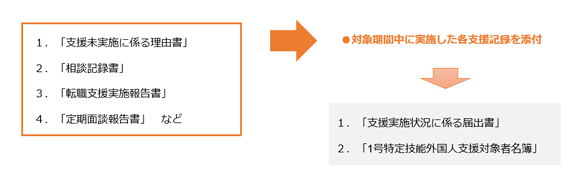
An RSO must submit a “Support Implementation Status Report” every three months to the Regional Immigration Services Bureau with jurisdiction over the address of the SSW-affiliated organization.
Q1: January 1 – March 31 ⇒ Submit by April 14
Q2: April 1 – June 30 ⇒ Submit by July 14
Q3: July 1 – September 30 ⇒ Submit by October 14
Q4: October 1 – December 31 ⇒ Submit by January 14
8. Registered Support Organization (RSO) Application Agency Service
1. Service Overview

This is a comprehensive application agency service for registration as a Registered Support Organization (RSO) with the Immigration Services Agency of Japan.
We handle all necessary procedures for corporations and staffing/recruitment companies wishing to register as RSOs.
Our goal is to minimize the administrative burden on clients and ensure a smooth approval process.
2. Services Included
- Guidance on required documents and preparation of application materials
- Submission of the application to the Immigration Services Bureau on your behalf
- Monitoring application status during the review period and handling requests for additional documents
- Free re-application support in the event of a denial
3.Why Choose ACROSEED
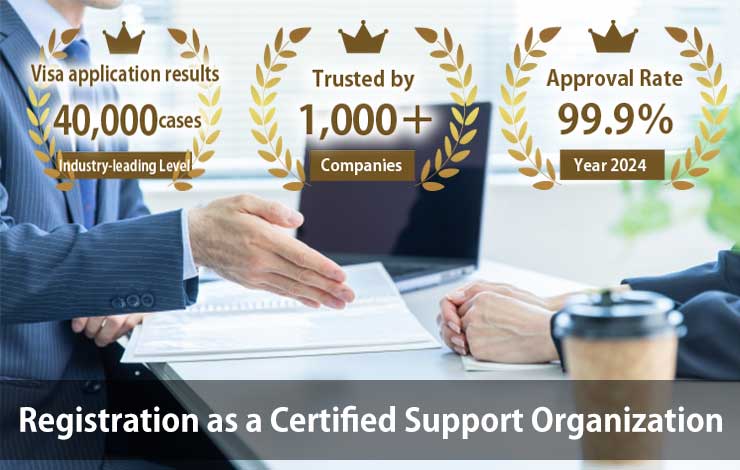
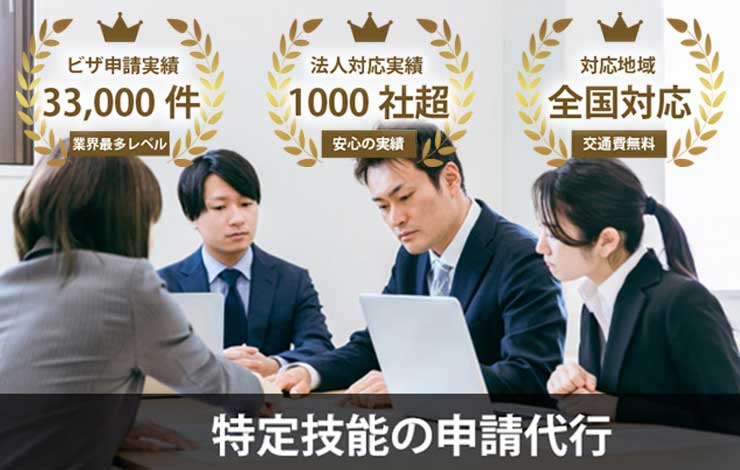
- Established in 1986, with an industry-leading record of over 40,000 visa applications
- Trusted by more than 1,000 corporate clients
- No travel expenses – nationwide service at a flat rate
- Services available in English and Chinese
- ISO 27001 certified – ensuring strict compliance
40,000 Visa Applications Since 1986 – One of Japan’s Most Experienced Providers

ACROSEED has specialized in immigration services since 1990, when legal reforms allowed administrative scriveners to handle immigration procedures. As of March 2025, we have processed over 40,000 visa applications.
We currently handle 3,000–4,000 visa cases annually, with immigration visits twice a week to stay current on screening trends and regulation changes.
By choosing ACROSEED, you benefit from the most up-to-date insights and extensive hands-on experience in the industry.

Our Track Record
ACROSEED’s track record in corporate services, publications, media coverage, and seminars
Trusted by Over 1,000 Corporate Clients

ACROSEED’s dedicated corporate team handles all visa-related and licensing procedures associated with foreign employee hiring.
We offer two distinct service types:
・As a welfare benefit service for foreign employees
We customize our support based on your company’s structure, challenges, and employment needs, referencing real-world examples.
Our services are trusted by a wide range of clients, from publicly listed corporations to small and mid-sized businesses.
Case Studies
We present case studies of companies that actively promote the employment of foreign nationals by utilizing ACROSEED’s services.
Nationwide Flat-Rate Service with No Travel Costs

Our office is based in Nagatacho, Chiyoda-ku, Tokyo, but we serve immigration offices across Japan with no additional travel costs.
We also offer online consultations via Zoom or Skype, allowing face-to-face communication from any location.
English and Chinese Language Support

Our bilingual staff can communicate directly with foreign employees in English or Chinese.
We assist with application explanations, status tracking, and employee coordination — reducing the burden on HR teams and improving the applicant experience.
ISO 27001 Certified for Information Security Compliance

ISO 27001 is the international standard for information security management (ISMS).
ACROSEED was an early adopter of this certification in our field, demonstrating our commitment to secure and compliant client service.
This gives even highly regulated, publicly listed companies the confidence to trust us as their immigration partner.
4. RSO Application Agency Fees (excluding tax)
・There are no additional fees based on client circumstances.
・ACROSEED’s services are available nationwide. Clients located outside the Tokyo area can also use our services at the same rates listed below.
・Payment by Visa or MasterCard is available.

1. New RSO Registration Application Agency
| RSO Application Agency Service | 150,000 yen (excluding tax) |
|---|---|
| Revenue stamp fee | 28,400 yen (payable to the Immigration Services Agency) |
2. RSO Renewal Application Agency
| RSO Application Agency Service | 100,000 yen (excluding tax) |
|---|---|
| Revenue stamp fee | 11,100 yen (payable to the Immigration Services Agency) |
・This service is not contingency-based.
・If the application is denied, we will identify the reason, make the necessary corrections, and re-apply free of charge once (limited to one re-application).

Why ACROSEED is Trusted by Corporations
Explore Client Case Studies
Contact Us / Free Consultation
Since our establishment in 1986, we have been supporting companies hiring foreign nationals with visa applications and immigration consulting for nearly 40 years.
We offer consultations by phone, email, online meeting, or in person at our office.
English support is also available.