Work Visa Application Support|Corporate Services for Employers Hiring Foreign Nationals
Last Updated:

- Overview of Work Visa Applications for Employers
- What is a Work Visa?
- Standard Hiring Process for Foreign Nationals
- Key Requirements for Obtaining a Work Visa
- Critical Points of Attention for HR Managers
- Three Common Scenarios Where a Work Visa is Required
- Step-by-Step Application Procedures
- Legal Methods for Employing Foreign Nationals
- Hiring Flow and Timeline Management
- Pre-Hire Compliance Checks
- Points to Note in the Visa Process
- Post-Hiring HR Procedures
- Ensuring Long-Term Employment Compliance
- Work Visa Q&A for Employers
- Required Documentation
- Application-to-Approval Timeline
- Common Causes of Visa Denials
- Legal Risks Employers Must Understand
- Hiring Multiple Foreign Employees
- Scheduling and Workflow Management
- Choosing the Correct Visa Type (e.g., difference from “Engineer/Specialist in Humanities/International Services”)
- Work Visa Acquisition Process
- Advantages of Outsourcing to ACROSEED
- Service Fees for Work Visa Applications
Work Visa Application Support (For Individual Clients)
If you are an individual applicant, please see this dedicated page.
1. Overview of Work Visa Applications for Employers Hiring Foreign Nationals
1. What is a Work Visa?
In order for a foreign national to legally work in Japan, an application must be submitted to the Immigration Services Agency for a work-eligible residence status. The main visa categories relevant to corporate employers include:
(1) “Engineer / Specialist in Humanities / International Services” – white-collar positions in science, engineering, humanities, and business
(2) “Highly Skilled Professional” – advanced professionals who meet strict point-based criteria
(3) “Intra-Company Transferee” – employees transferred within multinational groups
(4) “Skilled Labor” – such as chefs, foreign product repair specialists, sports instructors, or carpenters with specialized expertise
(5) “Designated Activities” – special cases including internships or certain short-term roles
Other categories exist (e.g., “Legal/Accounting Services,” “Medical Services”), but the above five are most relevant for general corporate employers hiring foreign staff.
2. Standard Hiring Process for Foreign Employees
3. Key Requirements for Obtaining a Work Visa
For HR managers, successful visa approval requires careful attention to three critical areas:
1. Eligibility under the Immigration Control Act
The employee’s role must fall within permitted categories. For example, the “Engineer / Specialist in Humanities / International Services” visa covers three activity types:
2. Roles requiring knowledge of humanities and social sciences
3. Roles requiring cultural awareness or specialized foreign language skills
Accurate classification is essential to avoid rejection.
2. Compliance with Landing Permission Criteria
Most work visas require proof that the employee meets statutory “landing permission criteria.” Applications will be rejected if these are not met, so HR must confirm eligibility before extending an offer.
3. Relevance of Academic Background
Immigration evaluates whether the candidate’s field of study is relevant to the proposed job duties. University graduates are generally assessed flexibly, while vocational school graduates face stricter scrutiny. A stronger link between education and duties improves approval chances.
4. Critical Points of Attention for HR Managers
The requirements above are also common pitfalls for employers during the application process.
1. Job Duty Restrictions
Foreign employees can work only within the scope defined by their visa. They cannot freely change positions across categories, unlike Japanese employees. HR must confirm compliance before approving internal transfers.
2. Hiring Standards
If an applicant fails to meet legal requirements, the visa cannot be issued. Extending an offer without confirming eligibility risks non-compliance and operational disruption.
3. Application Timeline
Foreign nationals cannot start employment until their residence card is issued with “permission to work.” For example, if the start date is April 1, the visa must be secured before that date. HR must plan recruitment schedules backwards from start dates to allow sufficient processing time.
5. Three Common Scenarios for Obtaining a Work Visa
Corporate work visa applications in Japan typically fall into the following three scenarios:
1. Hiring from Overseas
When hiring a foreign national residing overseas (e.g., referrals from a global subsidiary or partner), the Japanese employer must first obtain a Certificate of Eligibility (COE). Employers should also establish internal policies on covering travel expenses, family visa support, and relocation costs before proceeding.

Certificate of Eligibility (COE) Application
In most cases, companies inviting foreign employees from overseas must file a COE application with the Immigration Services Agency in Japan.
2. Hiring Foreign Nationals Already in Japan
When employing a foreign national already living in Japan with a valid work visa, HR managers must carefully check whether the existing visa is still valid for the new position, especially in cases of employer change or altered job duties.

Visa Procedures for Mid-Career Hires
Even if a candidate already holds a valid work visa, employers should confirm the visa category and expiration date before hiring.
3. Hiring International Students as New Graduates
For international students with a “Student” visa, a change to a work visa must be completed upon graduation. Employers should clarify in advance whether the procedure and costs will be handled by the company or the individual.

Work Visa Application for International Students
The hiring of foreign graduates is steadily increasing in Japan, particularly among large corporations competing for global talent.
6. Work Visa Application Procedures
1. Certificate of Eligibility (COE) Application
The COE certifies that a candidate meets the requirements for a work visa. It is required to invite foreign nationals from abroad. Once issued, the COE allows for faster visa issuance at Japanese embassies or consulates overseas.
Certificate of Eligibility Application
In most overseas hiring cases, this application is the first step before the employee enters Japan.
2. Certificate of Authorized Employment
This certificate confirms that the employee’s duties fall within the scope of their residence status under the Immigration Control Act. Although not mandatory, it provides assurance for mid-career hires that their visa renewal will likely be approved.

Certificate of Authorized Employment Application
This certificate verifies that the foreign employee’s duties align with visa requirements, reducing renewal risks.
3. Change of Visa Status
If the employee’s current visa does not match the planned duties, a “Change of Status of Residence” application must be filed. For example, a holder of an “Intra-Company Transferee” visa joining an unrelated employer must switch to an “Engineer / Specialist in Humanities / International Services” visa. The same applies to international students transitioning from a “Student” visa after graduation.

Application for Change of Status of Residence
This application is necessary when an employee moves into a new category of activities under the Immigration Control Act.
7. Methods of Employing Foreign Nationals
Beyond standard full-time hiring, companies may employ foreign nationals through various frameworks depending on business needs.
1. Full-Time Employment
The most common method. Employers must issue a contract, sponsor the visa, and build HR systems for onboarding and retention.
2. Temporary Staffing
Though costlier, staffing agencies manage recruitment and visa procedures. Choose agencies well-versed in immigration law to avoid compliance risks.
3. Technical Intern Training Program
This government program allows foreign workers to gain skills in designated industries for up to five years. However, it is highly regulated and has been criticized for compliance violations.
4. Hiring Nikkei (People of Japanese Descent)
Nikkei workers, such as those from Brazil or Peru, often hold “Designated Activities” visas permitting employment in various industries, including unskilled labor. They represent a critical workforce in certain sectors.
5. Internships
Arranged through agreements between foreign universities and Japanese companies, internships provide practical experience while promoting future recruitment opportunities.
Foreign Student Internships and Short-Term Work
Internships help reduce hiring mismatches and enhance employability awareness among foreign students.
6. Working Holiday Program
This bilateral program allows young people from partner countries to stay in Japan while working temporarily to fund their travel. Stays are usually 6–12 months, with restrictions in certain industries.
8. Hiring Workflow for Foreign Employees
1. Hiring International Students as New Graduates
Visa timing is critical. In most cases, the status change to a work visa must be completed by April 1. Offers are usually made in November, with applications filed from December through January.
Even if filed in December, approvals are often delayed until March, as a diploma is required. HR managers hiring multiple graduates should anticipate workload peaks during this period.
| Oct–Nov | Interviews and job offers |
|---|---|
 | |
| December | Work visa applications submitted |
| |
| March (following year) | Diploma issued, visa approval and endorsement |
| |
| April (following year) | Employment begins |
2. Mid-Career Hires (Job Changes)
Most mid-career hires already possess a work visa. At hiring, HR must check the visa type and expiration to confirm employability. Four common patterns apply:
If the same role continues (e.g., programmer to programmer), no immediate action is required until the visa renewal date.
If the new duties differ substantially from the previous role (e.g., interpreter/translator to sales), obtaining this certificate mitigates the risk of denial at the next renewal.
If the visa category does not match the new duties, apply for a status change—for example, from “Intra-Company Transferee” to “Engineer / Specialist in Humanities / International Services.”
If hiring a Highly Skilled Professional, they must either reapply under your company or change to another visa type. Points are recalculated at each employer, so previous eligibility does not guarantee approval.
9. Pre-Hire Compliance Checks
1. Visa Type and Expiration
Before onboarding, confirm visa type and expiry by reviewing the candidate’s passport and residence card. Skipping this step risks employing someone without valid authorization.
2. Residence Card
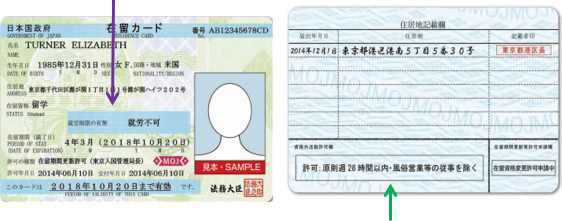
The residence card serves as ID for mid- to long-term foreign residents. It records visa category, permitted activities, and is required for daily contracts such as housing or mobile services.
3. Mandatory Reporting
Foreign employees must report changes (e.g., employer, marital status) within 14 days. Failure to do so can result in visa cancellation and deportation.
4. Visa Notifications
The most common case is employer change. If the employee failed to report a past resignation, a new visa application may be refused. Confirm this during recruitment.
10. Key Compliance Risks in the Visa Process
1. False Declarations
Never misclassify duties (e.g., calling a sales role “translator” for easier approval). Increasingly, Immigration treats such cases as illegal employment facilitation by the company.
2. Visa Refusal
Denials generally occur due to:
1. Applicant fails statutory criteria
2. Employer compliance issues
3. Employee misconduct or history
Visa refusal significantly impacts employability. HR must decide whether to reapply or terminate employment, while ensuring proper offboarding compliance.
3. Scheduling Risks
Visas must be approved by the intended start date. For graduates, delays risk missing April intake and postponing to September—requiring costly adjustments.
11. Post-Hiring Employer Obligations
1. Notification of Employment Status
Employers must notify Hello Work by the 10th of the following month. Failure can result in administrative guidance or fines up to JPY 300,000.
2. Residence Card Notifications
Changes in employment must be reported within 14 days. Employers should confirm or assist employees in filing this notification.
3. Resident Registration
Foreign employees relocating or newly arriving must register residency at the municipal office. HR should proactively guide employees unfamiliar with the system.
12. Toward Continued and Compliant Employment
1. Establishing Internal Policies
Companies should define clear policies on visa renewals and support, including:
・Who covers renewal fees (JPY 6,000 revenue stamp)
・Whether application time counts as paid leave
・Whether application outcomes must be reported to HR
・Whether procedures are handled by the employee, HR, or outsourced professionals
Unclear policies often cause disputes. Formalize and communicate procedures internally.
2. Managing Visa Expiration
Do not leave expiry management solely to employees. Even a one-day overstay can trigger detention and deportation. HR must monitor visa deadlines in partnership with employees.
2. Work Visa Q&A for Employers
ACROSEED processes over 4,000 visa applications annually, including numerous corporate work visa cases. Below are answers to frequently asked questions from HR managers and employers:
- What documents are required when applying for a work visa?
- The main documents companies must submit include:
① Employment contract (clearly outlining duties and terms)
② Certified company registry (Tokibo Tohon)
③ Financial statements or company brochure
④ Materials explaining business activities (pamphlets, websites, etc.)
⑤ Statement of hiring rationale (why a foreign national is required, with specifics)From the candidate: résumé/CV, graduation certificate, employment history, and a copy of the residence card, among others.
Exact requirements vary depending on the status category (e.g., Engineer/Specialist in Humanities/International Services, Specified Skilled Worker) and the individual’s background. Engaging a professional reduces the risk of deficiencies and delays.
- How long does the approval process take?
- Typical processing takes 1–3 months, depending on applicant background, application quality, and Immigration workload.
For initial applications from overseas (COE), expect about 2–3 months. For Change of Status cases within Japan, 1–2 months is common.
Delays often result from incomplete documentation or unclear alignment between duties and visa category. Professional preparation helps streamline the process.
- What are the main reasons for work visa refusals?
- Common reasons fall into three categories:
① Job duties do not align with the visa category (e.g., applying under “Engineer/Specialist in Humanities/International Services” for unskilled labor)
② The candidate’s academic or professional background does not meet statutory criteria (e.g., lacking a university-equivalent degree)
③ Issues on the employer side (unclear job descriptions, insufficient financials, or poor compliance track record)Generic or vague “hiring rationale” statements raise red flags. Strong logic supported by evidence is critical. At ACROSEED, we prepare applications tailored to the company’s actual operations and role requirements to maximize approval rates.
- What legal risks should employers be aware of when hiring foreign nationals?
- The most significant risk is facilitating unauthorized employment.
This includes employing individuals without proper status, or continuing employment after visa expiry. Penalties may include imprisonment of up to three years or fines of up to JPY 3 million.
Assigning duties outside the scope of an employee’s status is also illegal (e.g., assigning clerical tasks to someone approved as an “Interpreter/Translator”).
Mitigate these risks through consistent residence card checks, confirming activity permissions, and implementing ongoing internal compliance training.
- How should we proceed when hiring multiple foreign nationals at once?
- Each application must be filed individually, but company documents (registry, financials, brochures) can be reused for efficiency.
When multiple cases are submitted simultaneously, clearly distinguish each employee’s role and specialization—especially within the same department. Avoid using identical templates for “hiring rationale”; tailor them to each candidate.
The more cases submitted, the more critical documentation quality and consistency become. Outsourcing to professionals helps manage this effectively.
- How should HR manage the schedule from hiring to visa issuance?
- Always plan backwards from the desired start date.
For COE: allow approximately 1.5–2 months for issuance, plus 1–2 weeks for mailing and visa stamping abroad before entry to Japan.
For Change of Status in Japan (e.g., student to work visa), allow at least one month for review. Starting preparations 2–3 months in advance is recommended.
Build in time for internal approvals and company seals. If outsourcing, use a shared progress tracker to ensure schedule alignment.
- How do we choose the correct visa type? How does it differ from “Engineer/Specialist in Humanities/International Services”?
- Visa status must always reflect the actual job duties.
The most widely used status is “Engineer/Specialist in Humanities/International Services,” which covers: (i) technical roles (IT, design), (ii) humanities roles (accounting, planning), and (iii) international services (translation, overseas sales).
By contrast, “Specified Skilled Worker” and “Technical Intern Training” are industry-specific categories (e.g., food service, caregiving, construction) with very different eligibility and compliance requirements.
Choosing the wrong status risks denial. We recommend the optimal category based on duties, corporate structure, and candidate background, then build a tailored application accordingly.
3. Work Visa Acquisition Process
1. Certificate of Eligibility (COE) — Hiring from Overseas
The following outlines the process for obtaining a COE through the Immigration Services Agency when hiring employees from abroad:
-
1
- Free Consultation
- We assess the likelihood of approval and identify potential issues. Consultations are available by phone, email, Zoom, Skype, Line, or WeChat. Please contact us initially by phone or email.
-
2
- Service Engagement
- Once the service agreement is signed and payment confirmed, we begin preparing the case.
-
3
- Application Preparation
- We prepare documentation designed to maximize approval, drawing on decades of experience. Finalized forms are reviewed and signed by your company.
-
4
- Submission to Immigration
- Our certified administrative scriveners submit the application. Processing typically takes 1–3 months.
-
5
- COE Issuance
- Once approved, Immigration issues the COE and mails it to ACROSEED.
-
6
- Sending the COE Abroad
- Your company forwards the COE to the candidate via EMS or courier service.
-
7
- Visa Application at the Embassy
- The candidate applies for the work visa at the nearest Japanese embassy/consulate using the COE. Processing usually takes 1–2 weeks.
-
8
- Entry to Japan
- Upon arrival, the visa is presented at immigration control, and the approved status of residence is granted. (Note: COE is valid for 90 days from issuance and becomes invalid if unused.)
2. Change of Status of Residence — Hiring Already-Resident Foreign Nationals
The following outlines the process when changing status at the Immigration Services Agency for candidates already in Japan:
-
1
- Application Preparation
- We gather and prepare all documents required for a Change of Status of Residence application.
-
2
- Submission to Immigration
- If no issues arise, processing generally completes in 1–2 months.
-
3
- Result Notification
- Immigration sends a result notification postcard to the applicant.
-
4
4. Benefits of Choosing ACROSEED
- Established in 1986, with an industry-leading record of over 40,000 visa applications
- Trusted by more than 1,000 corporate clients
- No travel expenses – nationwide service at a flat rate
- Services available in English and Chinese
- ISO 27001 certified – ensuring strict compliance
40,000 Visa Applications Since 1986 – One of Japan’s Most Experienced Providers

ACROSEED has specialized in immigration services since 1990, when legal reforms allowed administrative scriveners to handle immigration procedures. As of March 2025, we have processed over 40,000 visa applications.
We currently handle 3,000–4,000 visa cases annually, with immigration visits twice a week to stay current on screening trends and regulation changes.
By choosing ACROSEED, you benefit from the most up-to-date insights and extensive hands-on experience in the industry.

Our Track Record
ACROSEED’s track record in corporate services, publications, media coverage, and seminars
Trusted by Over 1,000 Corporate Clients

ACROSEED’s dedicated corporate team handles all visa-related and licensing procedures associated with foreign employee hiring.
We offer two distinct service types:
・As a welfare benefit service for foreign employees
We customize our support based on your company’s structure, challenges, and employment needs, referencing real-world examples.
Our services are trusted by a wide range of clients, from publicly listed corporations to small and mid-sized businesses.
Case Studies
We present case studies of companies that actively promote the employment of foreign nationals by utilizing ACROSEED’s services.
Nationwide Flat-Rate Service with No Travel Costs

Our office is based in Nagatacho, Chiyoda-ku, Tokyo, but we serve immigration offices across Japan with no additional travel costs.
We also offer online consultations via Zoom or Skype, allowing face-to-face communication from any location.
English and Chinese Language Support

Our bilingual staff can communicate directly with foreign employees in English or Chinese.
We assist with application explanations, status tracking, and employee coordination — reducing the burden on HR teams and improving the applicant experience.
ISO 27001 Certified for Information Security Compliance

ISO 27001 is the international standard for information security management (ISMS).
ACROSEED was an early adopter of this certification in our field, demonstrating our commitment to secure and compliant client service.
This gives even highly regulated, publicly listed companies the confidence to trust us as their immigration partner.
5. Employment Visa Application Service Fees for Companies Hiring Foreign Nationals (Tax Excluded)
・The fees below are approximate and may vary depending on the specific service, application volume, and details. We offer free consultations and quotations, so please feel free to contact us.
*ACROSEED’s services are available nationwide.
| Application for Certificate of Eligibility (Inviting from overseas) |
Approx. ¥100,000 |
|---|---|
| Application for Change of Status of Residence | Approx. ¥100,000 |
| Application for Extension of Period of Stay | Approx. ¥80,000 |
If you are considering continuous outsourcing of visa procedures, please also refer to the page below.

Outsourcing Visa Applications and Residence Status Management
From recruitment to retirement of foreign employees, ACROSEED, with extensive expertise in employment of foreign nationals, will strongly support your HR operations. We will customize our services to resolve your company’s challenges effectively.

Why Many Corporations Choose ACROSEED
View Service Case Studies
Contact Us for a Free Consultation
Since 1986, we have specialized in visa applications for foreign nationals and provided consulting services to companies employing foreign staff for nearly four decades.
Consultations are available by phone, email, online, or in-person. English support is also available.