2025 Guide to Hiring New Graduate Foreign Nationals: Visa Categories & Application Procedures
Last Updated:

- Overview of Hiring Procedures for New Graduate Foreign Nationals
- Employer Procedures for Hiring Foreign New Graduates
- Challenges in Recruiting International Students in Japan
- Visa Application Procedures and Timeline for Hiring Foreign Graduates
- Hiring Foreign Graduates from Japanese Universities or Vocational Schools
- Hiring Foreign Graduates from Overseas Institutions
- Estimated Processing Times for Visa Applications
- Types of Residence Status for Hiring Foreign New Graduates
- Engineer / Specialist in Humanities / International Services
- Highly Skilled Professional
- Specified Skilled Worker (Category No. 46)
- Specified Skilled Worker
- Required Documents for Visa Application
- Hiring Timeline for Foreign New Graduates
- Common Reasons for Visa Rejection
- Risks and Penalties for Immigration Law Violations by Employers
- FAQ: Hiring Foreign New Graduates
- Can the foreign employee handle their visa application themselves, or should HR manage the process?
- Our visa change application was rejected after hiring. Are we required to cancel the employment offer?
- The visa application is still under review as of the employee’s start date. How should the company proceed?
- ACROSEED’s Visa Support Services

[Free Download | Must-Have] Complete Guide to Hiring and Visa Procedures for New Foreign Graduates (8 pages)
Tailored for April 2026 hires. This comprehensive PDF is designed for HR professionals, covering how to choose the right visa status, application schedules, and the latest updates — all in one practical reference. Download instantly.
1. Overview of Hiring Procedures for Foreign New Graduates
1. Employer Procedures When Hiring Foreign New Graduates

When hiring foreign nationals as new graduates, employers must complete not only the standard recruitment procedures applicable to Japanese nationals, but also immigration-related procedures with the Immigration Services Agency of Japan.
There are two main categories of foreign new graduates:
・Those graduating from overseas institutions who are invited to Japan for employment.
In both cases, employment is not permitted unless the individual obtains the proper work-permitting residence status. If the visa application is denied, the company may be forced to rescind the offer.
Even if the visa is eventually approved, a delay in obtaining it before the start date can disrupt onboarding and training schedules, creating significant risk for the employer.
Therefore, it is essential to consider visa eligibility and application timelines as part of recruitment planning from the outset.
1. Recruitment Planning
1. Clarify Job Duties and Visa Eligibility
In principle, the applicant’s academic background—such as their university major or vocational specialization—must directly correspond to the core job responsibilities. Before proceeding with recruitment, HR should determine which visa category applies and confirm eligibility criteria such as academic background, field of study, and offered salary.
2. When Inviting Candidates from Abroad
Some countries, such as the Philippines, require their nationals to obtain exit clearance before departing for overseas employment. These procedures can take time. If you plan to hire graduates from overseas, confirm in advance whether exit procedures or government approvals are required in the candidate’s home country.
2. During the Interview Process
In addition to confirming Japanese language proficiency, it is important to verify the applicant’s current visa type and expiration date using their residence card.
You should also inquire about any part-time work conducted during their studies. International students are only permitted to work up to 28 hours per week under a valid “Permission to Engage in Activity Other Than That Permitted by the Status of Residence.”
Some students may work without proper authorization or exceed the permitted hours. These actions are considered unauthorized employment under the Immigration Control and Refugee Recognition Act and may result in denial of a future work visa.
As such, HR should confirm whether the student properly complied with part-time work regulations during their studies.
3. Upon Hiring
In general, visa procedures take place after a hiring decision has been made.
Even if you identify an ideal candidate, employment cannot proceed without an approved visa. To prepare for this possibility, it is advisable to include a clause in the employment contract specifying that the offer is contingent upon obtaining a valid work visa. Written acknowledgment from the candidate is also recommended.
If the employee has limited Japanese proficiency, consider providing company policies, work rules, and key compliance materials in their native language to prevent future labor disputes.
4. After Onboarding
Employers are legally required to report the hiring or separation of foreign employees to Hello Work (the public employment office) under the “Notification of Employment Status of Foreign Nationals.”
Failure to report, or submitting false information, can result in a fine of up to 300,000 yen.
In most cases, submitting the Employment Insurance qualification form fulfills this requirement. However, if the employee is not enrolled in Employment Insurance, a separate submission is necessary.
Additionally, the foreign employee is required to personally notify the Immigration Services Agency within 14 days of joining your company.
Failure to submit this notification may negatively impact future visa renewals, such as being denied longer-term visas (e.g., three or five years). Therefore, HR departments should establish a process to confirm that employees have completed this reporting requirement.
2. Common HR Challenges in Hiring International Students in Japan: Compliance & Visa Considerations
When recruiting international students in Japan, the most critical factor is strict compliance with the Immigration Control and Refugee Recognition Act (Immigration Act) and related work visa regulations. In addition to standard labor laws applicable to Japanese employees, international student hires must also comply with visa regulations and immigration controls.
As a result, employers often encounter unique HR and compliance challenges that do not typically arise when hiring Japanese nationals.
Common Issues “Before Hiring” International Students
- Aligning recruitment and HR planning timelines with Japanese academic calendars
- Managing the visa and employment gap period between graduation (March) and October onboarding
Common Issues “At the Time of Hiring”
- Developing onboarding and training programs that align with visa approval timelines to avoid start-date disruptions
Common Issues “After Hiring” International Students
- Clarifying whether ongoing visa procedures should be managed by the company or delegated to the employee
- Building internal HR capability to manage compliance and respond effectively to foreign employees’ immigration-related inquiries
In the past, companies often limited foreign graduate hires to specific roles such as interpreters, translators, or engineers. Today, however, HR strategies increasingly embrace broader hiring practices, allowing international students to be considered for diverse roles—including leadership development tracks—without nationality-based or role-based limitations.
Many employers now extend offers to the most qualified candidates regardless of nationality, with a strong HR commitment to ensuring that foreign and Japanese hires are treated equally in terms of job scope, career development, and compliance with Japan’s labor and immigration laws.
As a result, international employees are often assigned to customer-facing roles—such as in-store sales, hospitality, or client services—as part of structured onboarding or training programs.
However, such assignments may conflict with the permissible scope of activities under certain visa categories, such as Engineer / Specialist in Humanities / International Services or Intra-company Transferee. This misalignment has led to cases where the Immigration Services Agency has raised compliance concerns and flagged potential visa mismatches.
2. Visa Procedures and Timeline for Hiring Foreign New Graduates
1. Hiring Foreign Graduates from Japanese Universities or Vocational Schools

In this case, the candidate typically holds a “Student” visa or a “Designated Activities” visa (for job hunting). To begin employment, they must apply for a change to a work-permitting status of residence.
The visa change procedure must, in principle, be carried out by the applicant at their local Immigration Services Bureau.
However, if left entirely to the applicant, delays or mistakes in the application process may lead to missed onboarding deadlines or even rejection. Since many international students are unfamiliar with the process, it is recommended that HR supports them by checking application documents and monitoring progress.
If your company hires foreign graduates regularly or prefers not to rely on the applicant, you may consider:
・Having your HR personnel obtain authorization as a Certified Proxy (Shinsei-toritsugi-sha) from the Immigration Bureau.
Once certified, your HR staff can submit visa applications on behalf of the candidate. While this increases administrative responsibilities, it offers peace of mind to the new hire and helps ensure a smooth onboarding.
To obtain proxy certification, your HR staff must attend a designated one-day training session and apply to the Immigration Services Agency. Applicants must meet criteria such as having sufficient knowledge of immigration procedures and a record of compliance with immigration laws.
For details, refer to the Immigration Services Agency website:
Visa Status Change Procedure (for graduates residing in Japan)
1
- Prepare Application Documents
- Collect all required documents and complete the visa change application form.
2
- Submit to Immigration Bureau
- If there are no issues, screening typically takes 1–2 months.
3
- Receive Notification
- A postcard with the screening result will be sent to the applicant.
4
- Visit Immigration Bureau for Finalization
- Bring the postcard and required documents listed on it to complete the process. A new residence card will be issued on the spot if approved.
2. Hiring Foreign Graduates from Overseas Institutions
For this type of hire, the company must submit a Certificate of Eligibility (COE) application to the local Immigration Services Bureau.
This application must be submitted by a representative of the accepting organization (i.e., the employer), not by the applicant.
COE Application Procedure (for overseas candidates)
1
- Prepare Application Documents
- Gather required materials and complete the COE application form.
2
- Submit to Immigration Bureau
- If there are no issues, screening typically takes 1–3 months.
3
- Receive COE
- The Immigration Bureau will send the COE to the company (or to the immigration specialist if submitted via proxy).
4
- Send COE to the Candidate
- Send the COE to the candidate overseas via EMS or similar. *As of now, digital COEs can also be issued and received via email.*
5
- Visa Application at Japanese Embassy/Consulate
- The candidate applies for a visa at the nearest Japanese diplomatic mission. If there are no issues, the visa is typically issued within 1–2 weeks.
6
- Enter Japan
- Upon arrival in Japan, the candidate presents their COE and visa at immigration. Once granted entry, they may begin employment under the approved visa status.
3. Processing Time for Visa Applications When Hiring New Foreign Graduates
The immigration authority updates the average processing time monthly. Please check the latest published average review period below:
[Free Download | Must-Have] Complete Guide to Hiring & Visa Procedures for New Foreign Graduates (14 pages)
Tailored for April 2026 hires. This essential PDF for HR professionals explains how to choose the right visa category, plan the application schedule, and keep up with the latest regulation updates — all in one place. Download instantly.
3. Types of Residence Status for Hiring Foreign New Graduates
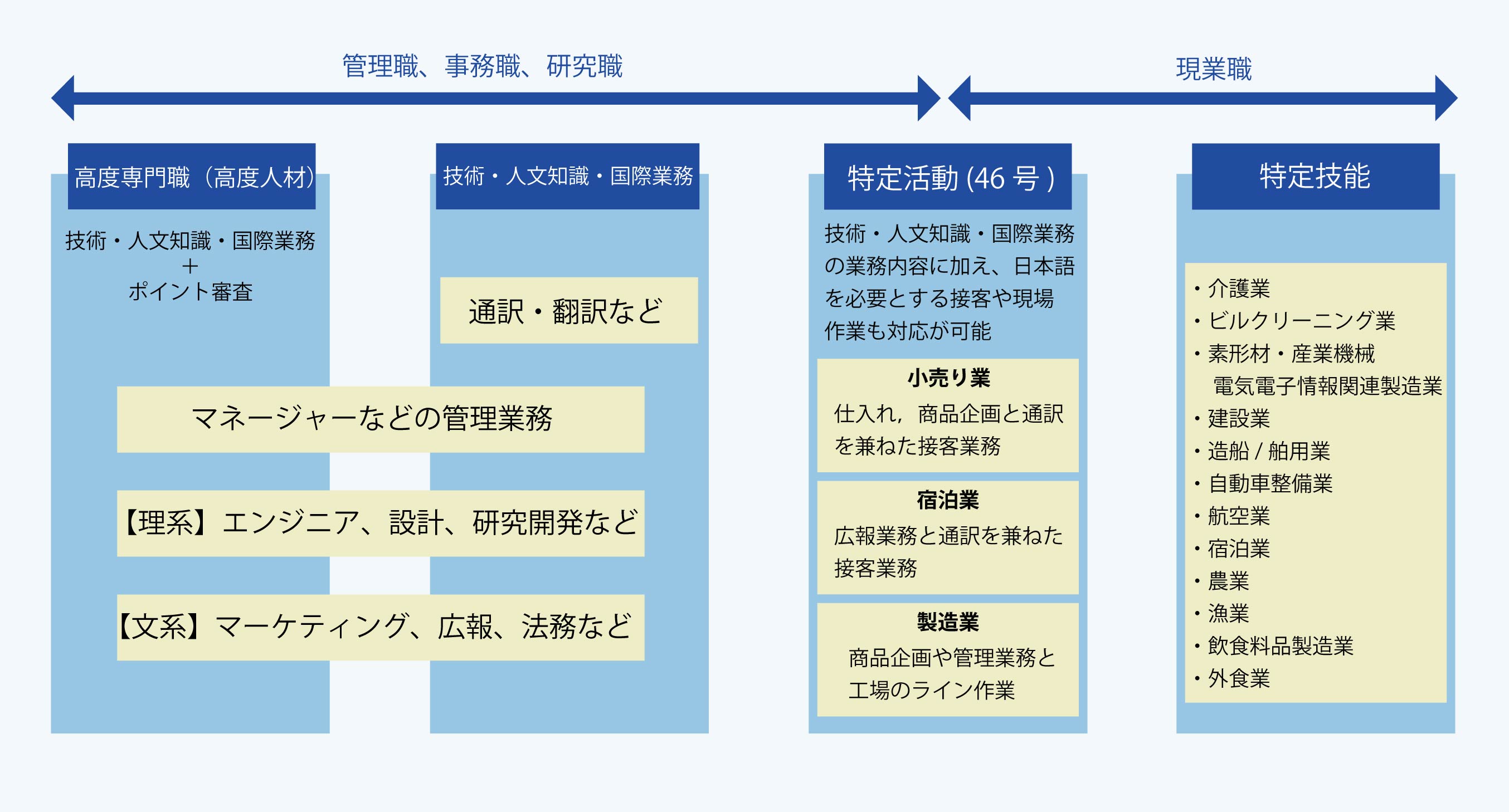
While there are currently 19 types of work-related residence statuses in Japan, the following four are most commonly applicable when hiring foreign nationals as new graduates:
• Highly Skilled Professional
• Designated Activities (Public Notice No. 46)
• Specified Skilled Worker
1. Engineer / Specialist in Humanities / International Services
This is the most common residence status used for new graduate employment in Japan. It applies to foreign nationals engaged in work requiring specialized knowledge in the natural sciences (e.g., science, engineering) or the humanities (e.g., law, economics, sociology), as well as work that requires intercultural or international expertise.
Typical eligible job categories include:
IT engineering, scientific research, architecture, product development
Corporate sales, marketing, PR, accounting, finance, management
Translation/interpretation, language instruction, international trade, culturally-informed design
For details on the requirements and conditions for obtaining the “Engineer / Specialist in Humanities / International Services” visa, please refer to the page below.
Obtaining the Engineer / Specialist in Humanities / International Services Visa
The “Engineer / Specialist in Humanities / International Services” residence status is designed for foreign nationals working in Japan under a contract with public or private organizations, engaging in activities that fall within designated professional fields.
2. Highly Skilled Professional
This status applies to advanced professionals engaged in technical or humanities-based work (but not international services such as interpretation or overseas marketing). Eligibility is based on a point-based evaluation system published by the Immigration Services Agency.
Key benefits include:
Broader job flexibility
Allows entrepreneurial activity alongside regular employmentGuaranteed 5-year visa period
Unlike other visas which may be issued for 1 or 3 yearsAccelerated path to permanent residency
Eligible in as little as 1 year of residenceSpousal work eligibility
Spouse may engage in full-time work even without typical qualificationsParental sponsorship
Under certain conditions, parents may be invited to Japan to provide childcare supportHousehold worker sponsorship
Permits the employment of foreign domestic helpers under set conditionsPriority processing
Applications are typically reviewed within 5 business daysDue to these advantages, many applicants who qualify for the Engineer / Humanities / International Services visa prefer to apply under this more favorable category.
For details on the “Highly Skilled Professional” residence status, please refer to the page below.
Obtaining the Highly Skilled Professional Visa
One of the most common inquiries we receive from corporate clients concerns the Highly Skilled Professional visa. It is not unusual for HR departments to be approached directly by foreign employees requesting this status, often leaving busy HR managers to research the requirements on their own. ACROSEED provides expert support to streamline this process and ensure smooth applications.
3. Designated Activities (Public Notice No. 46)
This residence status is available to graduates of Japanese universities who are hired as full-time employees and meet the following criteria:
・Receive compensation equal to or higher than a Japanese counterpart
・Engage in job duties aligned with their academic background
Unlike the Engineer / Humanities visa, this status allows involvement in customer-facing roles or production work, provided employees also use their Japanese proficiency and are not solely performing basic tasks such as dishwashing or shelf stocking.
Example scenarios include:
1. Working in a restaurant as both a floor manager and bilingual service staff
2. Supporting technical interns in a factory while also working on the line
3. Performing translation and marketing duties at a retail store
4. Serving as a bilingual concierge or doorman at a hotel
5. Working as a taxi driver guiding tourists while offering interpretation services
6. Supporting elderly care while mentoring foreign workers in Japanese
7. Participating in food product development while also working partially on production lines
For details on the “Designated Activities (Public Notice No. 46)” residence status, please refer to the page below.
Obtaining the Designated Activities (Public Notice No. 46) Visa
With the growth of inbound demand and the need for foreign employees who can serve as a bridge for technical intern trainees or those with limited Japanese proficiency, the hiring of international students—graduates of universities and graduate schools with broad knowledge and advanced language skills—is becoming increasingly important across a wide range of industries.
4. Specified Skilled Worker
This residence status targets foreign nationals with specialized skills who can contribute immediately in industries facing serious labor shortages. Currently, 12 sectors are eligible:
Physical assistance, hygiene care, recreational support
Interior cleaning of commercial facilities
Casting, machining, welding, electronics assembly, packaging
Carpentry, scaffolding, pipefitting, insulation, etc.
Welding, electrical assembly, painting
Inspections, repairs, parts replacement
Ground handling, aircraft maintenance
Front desk, PR, guest services
Farming, sorting, shipping
Fishing, aquaculture, processing
Food processing, packaging
Cooking, serving, restaurant operations
For details on the “Specified Skilled Worker” residence status, please refer to the page below.

Obtaining the Specified Skilled Worker Visa
Traditionally, residence statuses such as “Engineer / Specialist in Humanities / International Services” did not permit employment in industries like food service, hospitality, or nursing care. However, with the Specified Skilled Worker visa, employers can now hire in these sectors with full compliance and confidence.
4. Required Documents for Residence Status Applications
The list of required documents is subject to frequent changes due to amendments in immigration laws and regulations. Please always confirm the latest requirements on the Immigration Services Agency of Japan’s official website.
It is important to note that preparing these documents increases the likelihood that your application will be accepted for review, but does not guarantee approval.
In many cases, immigration officers may request additional documents during the examination process, even if they are not listed on the official website.
Examples include:
・Documentation proving the relevance between the applicant’s job duties and academic background
For a smooth review process, companies are encouraged to proactively prepare and submit such supporting documents at the time of application.
Companies categorized under Category 1 or 2 have simplified document requirements compared to Category 3 or 4 companies. However, “simplified” does not mean “not required” — immigration officers may still request these documents if deemed necessary. It is therefore essential to have all possible documents prepared in advance.
When you engage ACROSEED, we review the list of required documents published by the Immigration Services Agency and propose an optimized set of documents tailored to your situation — aiming for the smoothest possible application process.
1. Engineer / Specialist in Humanities / International Services
2. Highly Skilled Professional
3. Designated Activities (Public Notice No. 46)
4. Specified Skilled Worker
5. Hiring Schedule for New Graduate Foreign Nationals

The most critical aspect of hiring new graduate foreign nationals is schedule management. As a rule, before employment begins on April 1, the applicant must complete a change of status from “Student” to a work-eligible residence status and receive the new residence card.
Note: Not all graduating foreign students hold a “Student” visa at the time of hiring. Those who remain in Japan to continue job hunting after graduation may be granted a “Designated Activities” visa for a certain period.
Since “Designated Activities” visas are issued for various purposes, if a candidate holds one, you should confirm via the “Designation Letter” in their passport that it was granted specifically for job hunting.
.png)
Typical Timeline for April Employment:
-
1
- Job Offer
- Confirm current visa type and expiry date.
If necessary, apply to change from a Student visa to a Designated Activities visa.
Processing for this change generally takes 1–2 months.
-
2
- December – Mid-January
- Apply at the Immigration Services Agency to change to a work-eligible visa. Notifications of approval are typically issued between mid-February and early March.
-
3
- Mid–Late March
- Bring the required documents stated in the approval notice to the Immigration Office and receive the new residence card.
-
4
- April 1 Onwards
- Commence employment.
Timing and Considerations for Status Change
For April hires, applications to change from “Student” to a work visa such as Engineer / Specialist in Humanities / International Services can be submitted from December 1 — one month earlier than the usual 3-month window — to ease seasonal congestion.
However, approval is contingent on graduation. Immigration will require the original graduation certificate upon residence card issuance. Since many universities only issue this in late March, even December applications may not be finalized until the certificate is available.
If approval is not granted by April 1, the employee cannot legally start work, and the company must delay the start date.
To avoid this risk, it is advisable to complete the status change application within December.
6. Common Reasons for Visa Status Change Rejections
1. Mismatch Between Job Duties and Visa Category

The most common reason for rejection is that the proposed job does not fit the eligibility criteria for the desired visa category.
For example, placements in retail shops or factories for training, or job rotations, may cause issues for visas such as Engineer / Specialist in Humanities / International Services or Skilled Labor.
If such assignments occur without notifying Immigration — even temporarily — they may be considered unauthorized work, potentially exposing the employer to allegations of false application.
2. Lack of Relevance Between Employee’s Expertise and Job Duties
Another frequent reason is insufficient correlation between the applicant’s qualifications and the actual job.
Work visas generally require that the applicant’s professional skills or academic background (e.g., language skills, business management knowledge, or trade experience) directly relate to their job duties.
For example:
・Likely rejected: Fashion school graduate assigned to sales of financial products.
3. Issues with the Employer
Rejection may also result from problems on the employer’s side, such as:
・Company size too small to ensure business continuity.
・Lack of responsiveness — e.g., Immigration calls the company during business hours and no one answers, raising doubts about the company’s legitimacy.
・Misinformation — e.g., an uninformed employee tells Immigration, “We don’t have such an employee,” causing suspicion.
4. Issues with the Foreign Employee
Problems on the applicant’s side can also lead to rejection, such as:
・Working beyond the scope of permission for part-time work as a student.
These can only be disclosed honestly by the applicant. To reduce risk, employers should conduct in-depth interviews during recruitment to confirm the applicant’s past work history and any potential issues.
[Free Download | Must-Have] Complete Guide to Hiring and Visa Procedures for New Foreign Graduates (8 pages)
Tailored for April 2026 hires. This comprehensive PDF is designed for HR professionals, covering how to choose the right visa status, application schedules, and the latest updates — all in one practical reference. Download instantly.
7. Immigration Law Compliance Risks and Penalties for Employers of Foreign Nationals
Global companies competing in domestic and international markets must execute strategies with both speed and a strong commitment to compliance.
When it comes to hiring and employing foreign nationals—especially international students—compliance with immigration and labor laws is a non-negotiable requirement.
While large companies categorized as Category 1 or 2 enjoy reduced documentary requirements under current immigration regulations, the Immigration Control Act itself has not been relaxed.
In fact, compliance measures have become stricter through systems such as the revocation of residence status, the criminalization of promoting illegal employment, and the introduction of tighter residency management.
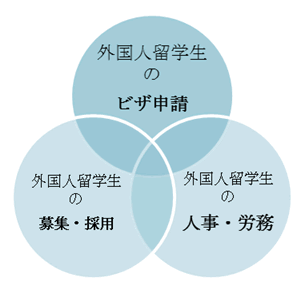
To ensure compliance while meeting business timelines, companies must establish robust acceptance systems. This requires coordinated action from three perspectives:
Recruitment and hiring procedures
HR and labor management
1. Illegal Employment
A common example of illegal employment is engaging in activities outside the scope permitted by the granted visa status. For instance, a foreign employee holding an Engineer / Specialist in Humanities / International Services visa might be authorized for work in areas such as design or process management of automobile parts, but is instead assigned to dismantling used cars or simple factory line work.
In such cases, the work exceeds the scope allowed by their visa, constituting a violation of the Immigration Control Act.
The foreign employee could face deportation, and the employer could be charged with promoting illegal employment.
2. Crime of Promoting Illegal Employment
Employers can be prosecuted for promoting illegal employment. Under Article 73-2 of the Immigration Control Act, any person who, in the course of business, employs a foreign national in unauthorized work activities—or brokers such activities—may face up to three years of imprisonment, a fine of up to JPY 3 million, or both.
This applies not only to foreigners who overstay their visas but also to those holding residence statuses that do not permit the work they are assigned. Employers must always verify the exact residence status and whether it permits the specific job duties.
3. Notification Obligations Regarding Affiliated Institutions
Foreign nationals with statuses such as Engineer / Specialist in Humanities / International Services or Highly Skilled Professional must notify the Immigration Services Agency within 14 days if there is any change regarding their affiliated institution, such as:
1. Termination of contract with the current institution (e.g., resignation, dismissal)
2. Conclusion of a new contract with a different institution (e.g., job change)
3. Change in the institution’s name
4. Change in the institution’s address
5. Dissolution of the institution
Although the notification is the foreign employee’s responsibility—not the company’s—failure to submit it may negatively affect future residence period renewals.
Employers should inform foreign staff when such notifications are required.
8. Q&A on Hiring New Graduate Foreign Nationals
- Can we leave visa procedures entirely to the foreign employee, or should HR handle them?
- While the foreign national is legally responsible for their own immigration applications, many are unfamiliar with the procedures in Japanese and may feel uncertain.
Although the company has no legal obligation, it is recommended that HR at least review the documents before submission—or consider outsourcing the process to a certified immigration specialist.
In some cases, HR representatives may register under the Application Agent System, allowing them to submit and receive results directly for the company’s foreign employees. This significantly reduces the burden on the employee.
- We applied for a status change after hiring, but the application was denied. Do we have to withdraw the job offer?
- A denial notice typically contains a brief reason, often vague (e.g., “The applicant’s conduct is not deemed appropriate”), without detailed explanation.
To understand the exact reason, you must visit the Immigration Office in person; explanations are only given once per application, and the notice is stamped “explained” afterward.
Next steps depend on the reason:
・If the issue can be corrected, reapplication may be possible.
・If the reason is unfixable (e.g., related to the applicant’s past immigration record), the company may have to terminate the offer.In the latter case, clear communication with the candidate is essential to ensure mutual understanding.
- We changed the status of residence for a new graduate hire, but by the start date the result had not been issued. How should we respond?
- Even if an application is pending, the employee cannot legally begin work without approval for the appropriate residence status and issuance of the new residence card. In practice, the start date may need to be postponed by about a month.
If only one hire is delayed, training schedules and cost efficiency may be significantly affected.
To avoid this, submit applications early enough to ensure results are received before the start date.
9. Visa Application Support Services for Hiring New Graduate Foreign Nationals
1. Service Overview

With ACROSEED’s legal support for hiring international students, you can conduct recruitment activities smoothly while ensuring full compliance and avoiding potential legal or administrative issues.
Backed by nearly 40 years of expertise and a proven track record, our wide range of services allows HR and administrative staff to reduce the time, cost, and effort involved in hiring.
Simply share your recruitment plans and requirements with us, and our experienced specialists will propose the most appropriate services and solutions.
Case Studies
We provide tailored visa support services for foreign employees, customized to meet the specific needs of each client company.
2. Services Included
1. Advice on Employment Start Schedules
2. Guidance for Prospective Hires
・Instructing on required documents
・Managing the schedules of selected candidates
3. Visa Application Procedures
Preparing application forms
Acting as application agent
Receiving results and new residence cards
4. International EMS Shipping
・Normally sent via DHL.
・With the introduction of the electronic COE, we can also send it by email.
5. Post-Application Support
Submitting additional documents when required
We also handle various other cases depending on the situation — feel free to contact us.
3.Advantages of Working with ACROSEED
- Established in 1986, with an industry-leading record of over 40,000 visa applications
- Trusted by more than 1,000 corporate clients
- No travel expenses – nationwide service at a flat rate
- Services available in English and Chinese
- ISO 27001 certified – ensuring strict compliance
40,000 Visa Applications Since 1986 – One of Japan’s Most Experienced Providers

ACROSEED has specialized in immigration services since 1990, when legal reforms allowed administrative scriveners to handle immigration procedures. As of March 2025, we have processed over 40,000 visa applications.
We currently handle 3,000–4,000 visa cases annually, with immigration visits twice a week to stay current on screening trends and regulation changes.
By choosing ACROSEED, you benefit from the most up-to-date insights and extensive hands-on experience in the industry.

Our Track Record
ACROSEED’s track record in corporate services, publications, media coverage, and seminars
Trusted by Over 1,000 Corporate Clients

ACROSEED’s dedicated corporate team handles all visa-related and licensing procedures associated with foreign employee hiring.
We offer two distinct service types:
・As a welfare benefit service for foreign employees
We customize our support based on your company’s structure, challenges, and employment needs, referencing real-world examples.
Our services are trusted by a wide range of clients, from publicly listed corporations to small and mid-sized businesses.
Case Studies
We present case studies of companies that actively promote the employment of foreign nationals by utilizing ACROSEED’s services.
Nationwide Flat-Rate Service with No Travel Costs

Our office is based in Nagatacho, Chiyoda-ku, Tokyo, but we serve immigration offices across Japan with no additional travel costs.
We also offer online consultations via Zoom or Skype, allowing face-to-face communication from any location.
English and Chinese Language Support

Our bilingual staff can communicate directly with foreign employees in English or Chinese.
We assist with application explanations, status tracking, and employee coordination — reducing the burden on HR teams and improving the applicant experience.
ISO 27001 Certified for Information Security Compliance

ISO 27001 is the international standard for information security management (ISMS).
ACROSEED was an early adopter of this certification in our field, demonstrating our commitment to secure and compliant client service.
This gives even highly regulated, publicly listed companies the confidence to trust us as their immigration partner.
4.Visa Application Service Fees (Excl. Tax)
Note: Final pricing depends on the specific service scope, application volume, and requirements. Estimates are provided free of charge. Our services are available nationwide.
| Certificate of Eligibility (COE – overseas recruitment) |
¥100,000 |
|---|---|
| Change of Status of Residence | ¥100,000 |
If you are considering ongoing outsourcing of visa management, please also see:

Outsource Your Visa Applications and Residence Status Management
From recruitment to retirement of foreign employees, ACROSEED provides strong support for HR professionals with deep expertise in all aspects of foreign employment in Japan. We customize our services to address your company’s specific challenges and deliver tailored solutions that ensure compliance and efficiency.

Administrative Scrivener Corporation ACROSEED
Managing Partner: Makoto Sano
Japan Federation of Administrative Scriveners Associations (Reg. No. 01080685)
Tokyo Administrative Scriveners Association (Member No. 4568)
Founded in 1986
Now in our 39th year specializing in foreign nationals’ legal affairs across two generations.
Registered Administrative Scrivener in 2001
23 years as an international administrative scrivener.
Appointed to the Tokyo Association’s International Division in 2023
Contributing to the development and training of administrative scriveners.
[Track record]
ACROSEED’s legal services are chosen by over 1,000 corporations including listed/global companies. We also have many engagements as lecturers/authors on foreign employment.

Why ACROSEED is Trusted by Corporations
Explore Client Case Studies
Contact Us / Free Consultation
Since our establishment in 1986, we have been supporting companies hiring foreign nationals with visa applications and immigration consulting for nearly 40 years.
We offer consultations by phone, email, online meeting, or in person at our office.
English support is also available.