Intra-company Trainee Visa
1. Training for Foreign Employees
1. Purpose of Foreign Employee Training
As more Japanese companies expand globally and recruit internationally, an increasing number of foreign employees hired overseas are being sent to Japan for training. Whereas past programs often emphasized advanced technical skills, current initiatives for white-collar employees focus more on familiarizing them with Japanese business practices and corporate culture.
2. Compliance
The legal framework for hosting foreign trainees requires compliance with immigration, labor, and tax laws. For white-collar training in particular, obligations differ significantly depending on whether the stay is considered employment or strictly temporary training. Because these boundaries are often unclear, it is essential to define the purpose of training and establish a compliant hosting framework in advance.
3. Immigration Law Amendments
Following amendments to the Immigration Control Act in 2009, the former foreign trainee system—criticized for compliance issues—was abolished. It was replaced by the “Technical Intern Training” visa category, which imposes stricter labor law obligations on host companies, including mandatory employment contracts. This has blurred the distinctions between different visa types. For white-collar training, possible visa categories now include “Engineer/Specialist in Humanities/International Services,” “Engineer,” “Intra-Company Transferee,” and “Trainee.”
4. Company-Organized Training
Since government budget reviews reduced AOTS (The Association for Overseas Technical Cooperation and Sustainable Partnerships) programs, many companies now conduct foreign employee training independently. In these cases, the company bears full responsibility for compliance and must ensure accurate understanding of immigration, labor, and tax requirements when designing and implementing training schemes.
2. Company-Sponsored Training for Overseas Local Staff
1. Inbound Training for Local Staff
1. Purpose of Inbound Training
As Japanese companies expand internationally, training for locally hired overseas staff in Japan has become more common. While historically such training focused on technical skills, recent programs for white-collar staff emphasize Japanese corporate culture and business practices.
2. Compliance Obligations
Depending on how training is structured, host companies must comply with immigration, labor, and tax laws. In white-collar training outside of technical intern programs, obligations differ depending on whether the stay is treated as employment or as training only. Because the distinctions are often ambiguous, companies should define the training’s purpose and framework clearly in advance.
3. Increasing Complexity of Immigration Rules
Frequent amendments to immigration law have made visa selection for inbound training increasingly complex. Possible visa categories include “Engineer/Specialist in Humanities/International Services,” “Engineer,” “Intra-Company Transferee,” “Trainee,” and “Technical Intern Training.” As the distinctions between these categories become less clear, companies managing training programs independently must assume full responsibility for compliance.
2. Methods of Hosting Inbound Training
1. Hosting as a Trainee
With a “Trainee” visa, training of up to one year is possible. However, no on-the-job practical training is allowed—activities must be limited to classroom instruction (“zashaku”) and facility tours. In principle, no salary may be paid.
2. Hosting as a Technical Intern Trainee
A “Technical Intern Training” visa permits up to three years of training, including practical on-the-job training. However, eligible job categories for the second and third years are limited, and an employment contract is required from the first year. While less cost-effective for highly skilled professionals, this route is often used in industries unable to secure work visas for simple labor positions.
3. Hosting as a Seconded or Transferred Employee
With an “Intra-Company Transferee” visa, there are no academic requirements, but the employee must have worked for the sending company for at least one year prior to transfer. Duties in Japan must fall under “Engineer/Specialist in Humanities/International Services.” Salary can be paid in Japan or abroad, offering flexibility for complex compensation structures.
4. Hosting via Direct Employment
An “Engineer/Specialist in Humanities/International Services” visa requires certain educational or professional experience. Immigration authorities also review whether the training satisfies legal criteria. Direct employment in Japan may involve additional administrative costs and obligations for payroll and insurance.
5. Hosting with a Temporary Visitor Visa
A “Temporary Visitor” visa allows stays of up to 90 days. No practical on-the-job training is permitted. As the Ministry of Foreign Affairs oversees this category, reasons for refusals are not disclosed, and in some countries issuance can be difficult. This makes it unsuitable for companies with strict or time-sensitive training schedules.
3. Labor Management in Foreign Employee Training
1. Language Support
Even if the stay is classified as training, Japanese labor laws may still apply, requiring documentation and procedures to be provided in a language the trainee understands. Many inbound trainees have limited Japanese ability, which can lead to misunderstandings or disputes. Employment rules and contracts should, where possible, be prepared in the trainee’s native language or another mutually understood language.
2. Enrollment in Insurance Schemes
Whether trainees must enroll in Japan’s insurance systems depends on the nature of their engagement. Direct employees are generally required to join employment insurance and social insurance programs, and immigration authorities may confirm this during visa review.
3. Wage Levels and Payment Methods
Wages and payment methods are critical factors when hosting trainees, as they affect visa eligibility. Finalizing these details too late may require a redesign of the training plan. Significant changes after arrival may be viewed as non-compliance by immigration authorities and could negatively impact future visa applications by the company.
4. Mental Health Support
Foreign trainees often face cultural adjustment challenges and workplace stress, particularly when language barriers hinder communication. Small issues can escalate if left unaddressed. HR and administrative staff should schedule regular meetings with trainees to identify concerns early and provide appropriate support.
4. Foreign Employee Training and Taxation
1. Withholding Tax
The method of withholding tax depends on whether a foreign national staying in Japan is classified as a resident or non-resident. The taxable income scope also differs accordingly. In many cases, foreign employees participating in training programs in Japan are considered residents (non-permanent residents). In such cases, the following are generally subject to taxation: (1) all domestic-source income, (2) foreign-source income paid within Japan, and (3) foreign-source income remitted to Japan.
2. Resident Tax
Resident tax obligations also depend on whether the individual is a resident or non-resident. For residents, those who have an address in Japan as of January 1 of the relevant year—or who, even if residing in Japan for less than one year, clearly intend to reside for more than one year—are generally subject to taxation. If an individual with resident tax obligations leaves Japan by the end of December, they must settle any unpaid tax before departure.
3. Dependent Deductions
If family members residing in the employee’s home country receive financial support from the foreign employee working in Japan, those relatives may be claimed as dependents for income tax and resident tax purposes. Proof of remittances—such as copies of overseas remittance request forms—should be kept. In some cases, this may also affect work visa applications, so careful handling is essential.
4. Economic Benefits and Tax Treatment
For foreign employees, certain economic benefits provided by the employer may be treated as non-taxable. These may include home leave travel expenses, family travel expenses to Japan, employer payment of taxes and social security contributions, and company-covered housing and utilities. However, detailed regulations apply to each category, and careful compliance is required to maintain non-taxable status.
5. Frequently Asked Questions on Building Foreign Employee Training Schemes
Our company has expanded overseas and will be conducting training in Japan for local staff for the first time. However, there are many options, and we are unsure which one to choose.
The most suitable method for implementing inbound training will vary depending on the purpose, policies, and hosting arrangements for the program. First, clarify the purpose and duration of the training in Japan, and then assess which hosting options are feasible based on these factors.
We are planning inbound training for local staff and want to prioritize compliance. What should we pay attention to?
Inbound training for local staff requires compliance with multiple legal areas, including immigration law, labor law, and tax law. It is important not only to understand each field in detail, but also to take an integrated approach that considers how these areas interact.
Until now, we relied on AOTS, but in the future our company will take the lead in running training programs. However, there are many options, and we are unsure which to choose.
The most suitable approach to foreign employee training depends entirely on the program’s purpose, policies, and hosting arrangements. As with inbound training, it is best to first clarify the objective and duration, and then examine which hosting methods are possible.
When conducting foreign employee training, we want to make compliance our top priority. What should we be aware of?
Conducting foreign employee training requires compliance with multiple legal frameworks, including immigration, labor, and tax law. While a thorough understanding of each area is essential, it is equally important to coordinate across these fields and make decisions from a holistic perspective.
6.Why Choose ACROSEED
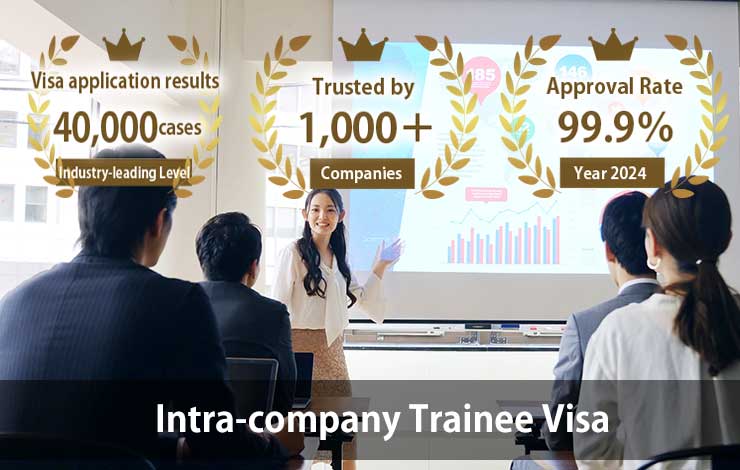
- Established in 1986, with an industry-leading record of over 40,000 visa applications
- Trusted by more than 1,000 corporate clients
- No travel expenses – nationwide service at a flat rate
- Services available in English and Chinese
- ISO 27001 certified – ensuring strict compliance
40,000 Visa Applications Since 1986 – One of Japan’s Most Experienced Providers

ACROSEED has specialized in immigration services since 1990, when legal reforms allowed administrative scriveners to handle immigration procedures. As of March 2025, we have processed over 40,000 visa applications.
We currently handle 3,000–4,000 visa cases annually, with immigration visits twice a week to stay current on screening trends and regulation changes.
By choosing ACROSEED, you benefit from the most up-to-date insights and extensive hands-on experience in the industry.

Our Track Record
ACROSEED’s track record in corporate services, publications, media coverage, and seminars
Trusted by Over 1,000 Corporate Clients

ACROSEED’s dedicated corporate team handles all visa-related and licensing procedures associated with foreign employee hiring.
We offer two distinct service types:
・As a welfare benefit service for foreign employees
We customize our support based on your company’s structure, challenges, and employment needs, referencing real-world examples.
Our services are trusted by a wide range of clients, from publicly listed corporations to small and mid-sized businesses.

Case Studies
We present case studies of companies that actively promote the employment of foreign nationals by utilizing ACROSEED’s services.
Nationwide Flat-Rate Service with No Travel Costs

Our office is based in Nagatacho, Chiyoda-ku, Tokyo, but we serve immigration offices across Japan with no additional travel costs.
We also offer online consultations via Zoom or Skype, allowing face-to-face communication from any location.
English and Chinese Language Support

Our bilingual staff can communicate directly with foreign employees in English or Chinese.
We assist with application explanations, status tracking, and employee coordination — reducing the burden on HR teams and improving the applicant experience.
ISO 27001 Certified for Information Security Compliance

ISO 27001 is the international standard for information security management (ISMS).
ACROSEED was an early adopter of this certification in our field, demonstrating our commitment to secure and compliant client service.
This gives even highly regulated, publicly listed companies the confidence to trust us as their immigration partner.
7. Our Services
1. Scope of Services
Our team of certified immigration lawyers (Gyoseishoshi), labor and social security attorneys (Shakai Hoken Roumushi), and tax accountants design foreign employee training schemes tailored to your company’s needs.
| 1. Needs Assessment | We review your requirements—including employment conditions, salary arrangements, training content, participant numbers, and program duration—and assess the current situation. |
|---|---|
| 2. Compliance | Compliance is our top priority when formulating proposals. |
| 3. Areas of Review |
① Salary levels and payment methods for foreign employees ② Housing arrangements ③ International taxation ④ Labor management and insurance procedures ⑤ Immigration status and visa categories We evaluate these comprehensively from a legal and compliance perspective. |
| 4. Proposal |
・We propose the most suitable scheme for implementing foreign employee training at your company. ・Our proposals are prepared jointly by specialists in each field, with a clear explanation of both advantages and disadvantages. (1) Immigration lawyer – visa applications (2) Labor and social security attorney – labor management (3) Tax accountant – international taxation |
2. Service Fees (Excluding Tax)
・Fees vary depending on the services requested, scope of work, and application details. We are happy to provide detailed descriptions and quotations free of charge—please feel free to contact us.
*ACROSEED’s services are available nationwide.
| Hosting as a Trainee | Approx. ¥120,000 |
|---|---|
| Hosting as a Technical Intern Trainee | Approx. ¥50,000 |
| Technical Intern Training Plan Certification Application | Approx. ¥150,000 |
| Hosting under Intra-Company Transferee Visa | Approx. ¥100,000 |
| Hosting under Temporary Visitor Visa | Approx. ¥50,000 |
If you are considering outsourcing ongoing visa applications and residence status management, please see the following page:
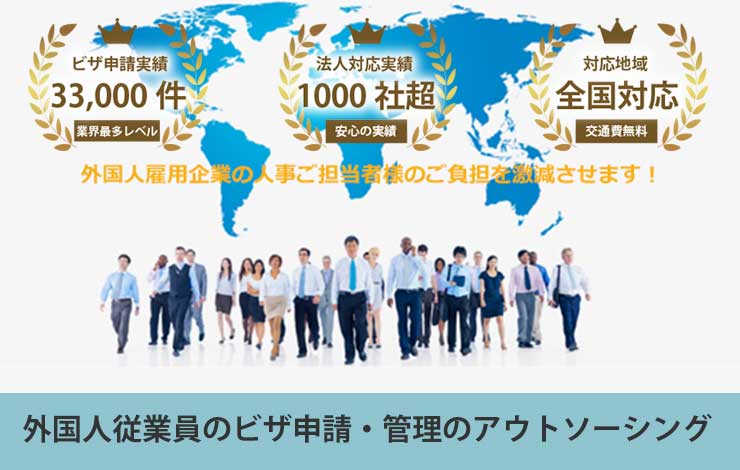
Outsourcing Visa Applications and Residence Status Management
From recruitment to retirement, ACROSEED provides comprehensive HR support backed by deep expertise in foreign workforce management. Our services are customized to address your company’s specific challenges and ensure compliance.

Why ACROSEED is Trusted by Corporations
Explore Client Case Studies
Contact Us / Free Consultation
Since our establishment in 1986, we have been supporting companies hiring foreign nationals with visa applications and immigration consulting for nearly 40 years.
We offer consultations by phone, email, online meeting, or in person at our office.
English support is also available.