[For Employers] Specified Skilled Worker (SSW) Visa Application Support | A Guide for HR Managers
Last updated:
- What is the Specified Skilled Worker Visa? Essential Information for Employers
- Features and Requirements by Sector (16 Industries)
- SSW Type 1 vs. SSW Type 2
- Eligibility Criteria for Foreign Employees
- Requirements for Hiring Companies
- Employment Contract Standards under SSW
- What is a Support Plan for SSW Workers?
- Mandatory Employer Notifications
- Common Challenges in SSW Applications
- Why Use Our SSW Visa Application Support Service
- Service Details and Application Process
1. What is the Specified Skilled Worker Visa? Essential Information for Employers
For HR managers evaluating the “Specified Skilled Worker” (SSW) visa for hiring foreign employees:
The SSW visa framework is highly complex. Documentation and compliance requirements vary by industry, making it challenging for in-house HR teams to manage applications without specialized expertise.
This guide outlines the essential knowledge HR and compliance staff should have, explains the application process, and highlights the benefits of working with a professional support provider.
1. Overview of the SSW System
The SSW system enables Japan to accept foreign workers with proven expertise and technical skills as part of the workforce in industries experiencing severe labor shortages—even after domestic recruitment and productivity measures have been exhausted.
Introduced under the 2018 amendment to the Immigration Control and Refugee Recognition Act and the Ministry of Justice Establishment Act, the system responds to the challenges posed by Japan’s declining birthrate and aging population.
Historically, Japan’s immigration policy admitted foreign professionals primarily into white-collar or managerial roles, while limiting access to blue-collar positions (with exceptions such as the Technical Intern Training Program). This restriction was partly due to public concerns about protecting domestic employment opportunities.
However, as labor shortages threatened the sustainability of key industries, the government launched the SSW status of residence—marking a major policy shift. Although sometimes described as “Japan’s first step toward accepting immigrants,” the framework is tightly regulated to avoid potential social issues.
2. Connection with the Technical Intern Training Program
Before the SSW system, the primary pathway for foreign nationals in blue-collar roles was the Technical Intern Training Program. However, the program faced significant challenges:
1. Gap Between Official Purpose and Actual Use
Officially designed as an international cooperation initiative to transfer Japanese skills abroad, in practice it was often used as a labor supply channel.
2. Poor Working Conditions and Human Rights Issues
Some employers exploited restrictions preventing trainees from changing jobs, forcing them to work under unfavorable conditions. Reports of harassment and abuse further raised human rights concerns domestically and internationally.
3. Disappearance of Trainees
Cases were reported where trainees left employers without permission, became overstayers, or faced further legal issues. During the COVID-19 pandemic, disputes even arose among groups of missing trainees.
The SSW system was designed to address these shortcomings, introducing stronger protections and compliance mechanisms. It also provides a pathway for those who have successfully completed up to five years in the Technical Intern Training Program to transition into SSW—though the two systems remain fundamentally distinct.
3. Key Differences Between Technical Intern Training and SSW
| Technical Intern Training (Monitored by Supervising Organizations) | Specified Skilled Worker (Type 1) | |
|---|---|---|
| 1. Governing Laws | Act on Proper Technical Intern Training and Protection of Technical Intern Trainees Immigration Control and Refugee Recognition Act |
Immigration Control and Refugee Recognition Act |
| 2. Residence Status | “Technical Intern Training” (Types 1, 2, 3) | “Specified Skilled Worker” |
| 3. Maximum Duration of Stay | Type 1: up to 1 year Type 2: up to 2 years Type 3: up to 2 years (Maximum: 5 years total) |
Maximum: 5 years |
| 4. Skill Requirements | None | Requires demonstrated knowledge or experience |
| 5. Entry Examinations | None *For caregiving: N4 Japanese required at entry |
Skills and Japanese proficiency confirmed through testing *Exemption for those completing Technical Intern Training Type 2 |
| 6. Sending Organizations | Organizations accredited by foreign governments | Not required |
| 7. Supervising Organizations | Yes *Non-profit cooperatives or other bodies monitoring host companies |
Not required |
| 8. Registered Support Organizations | Not applicable | Yes *Accredited providers registered with the Immigration Services Agency to support SSW workers (e.g., housing, lifestyle assistance) |
| 9. Recruitment Channels | Primarily through supervising and sending organizations | Employers may recruit directly overseas or through approved domestic/international agencies |
| 10. Hiring Quotas | Quota tied to number of full-time employees | No quota (except in caregiving and construction sectors) |
| 11. Nature of Activities | Type 1: Training through lectures and practical work Type 2/3: Skilled work under training plan |
Work requiring technical or specialized skills with verified experience |
| 12. Job Mobility | Not permitted in principle Allowed only in exceptional cases (e.g., employer bankruptcy) or transition from Type 2 to Type 3 |
Permitted Only within the same industry sector or across sectors with confirmed equivalency |
4. Benefits of Hiring Specified Skilled Workers
The primary advantage of hiring under the Specified Skilled Worker (SSW) framework is the ability to legally employ foreign nationals in operational (non-managerial) roles that were historically difficult to fill under the Immigration Control and Refugee Recognition Act. Under conventional work visa categories such as “Engineer/Specialist in Humanities/International Services,” employment in sectors like food service, hospitality, or nursing care was generally not permitted. With SSW, employers can confidently hire foreign talent in these industries while remaining fully compliant.
Under the former Technical Intern Training Program, foreign nationals could typically work for a maximum of five years. As a result, many trainees returned home just as they became fully proficient, leading to a loss of accumulated on-the-job expertise. By contrast, the SSW framework allows qualified workers to transition to “Specified Skilled Worker (Type 2),” which permits long-term—potentially indefinite—employment in eligible sectors. This enables companies to invest in foreign employees with the same long-range perspective as Japanese full-time staff, including development into future supervisory or managerial candidates where appropriate.
Additionally, while the Technical Intern Training Program was premised on “technology transfer,” limiting foreign workers to tasks pre-defined in a training plan, SSW does not impose the same constraints. Employers can assign duties more flexibly, according to actual operational needs and job descriptions defined for each sector.
5. Challenges and Drawbacks of Hiring Specified Skilled Workers
The most significant challenge is administrative complexity. Beyond immigration procedures to obtain the SSW status, employers must submit various notifications and reports to the Immigration Services Agency and provide a defined set of support measures to foreign employees. These obligations are comparable to the assistance large organizations offer to staff on international assignments. For small and medium-sized enterprises without dedicated HR or general affairs functions, fulfilling these requirements often necessitates cross-functional cooperation and, where appropriate, support from Registered Support Organizations (RSOs).
Unlike the Technical Intern Training Program—where supervising organizations (e.g., cooperatives) provided first-line support to host companies—the SSW scheme requires direct employment by the company. RSOs can bridge capability gaps, but their services involve additional cost, so employers are encouraged to handle feasible components in-house to control expenses while maintaining compliance.
Some companies accustomed to the Technical Intern Training model view job mobility under SSW as a drawback. Even after investing significant time and resources in recruitment and training, a worker may transfer to another employer offering better conditions. However, this risk is inherent to standard employment markets and equally applies to Japanese employees. Organizations with high turnover among domestic staff are likely to encounter similar retention challenges with foreign employees unless they proactively improve workplace conditions, career pathways, and total rewards.
In short, the SSW framework rewards employers that take the initiative to integrate, develop, and retain foreign employees as valued, long-term members of their workforce.
2. Characteristics and Requirements of the Specified Skilled Worker Visa by Industry (16 Sectors)
1. Nursing Care
| 1. Job Description |
Provision of physical care services (e.g., bathing, feeding, toileting assistance) tailored to the recipient’s physical and mental condition, plus related support activities (e.g., recreational activities, assistance with functional training) [1 examination category]. * Home-visit care is excluded. |
|---|---|
| 2. Candidate Requirements |
① Skills Test Care Worker Skills Evaluation Test ② Japanese Language Test Japan Foundation Test for Basic Japanese (JFT-Basic) or JLPT N4 or higher, plus the Nursing Care Japanese Language Evaluation Test |
| 3. Employment Type | Direct employment |
| 4. Additional Requirements for Accepting Organizations |
・Participate in councils convened by the Ministry of Health, Labour and Welfare (MHLW) and cooperate as required. ・Cooperate with MHLW surveys and guidance. ・Comply with facility-level quotas on accepted workers. |
| 5. Projected Number of Accepted Workers (5-Year Maximum) | 135,000 |
| 6. Responsible Ministry | Ministry of Health, Labour and Welfare |
2. Building Cleaning
| 1. Job Description | Interior cleaning of buildings [1 examination category] |
|---|---|
| 2. Candidate Requirements |
① Skills Test Building Cleaning Sector SSW (Type 1) Evaluation Test ② Japanese Language Test JFT-Basic or JLPT N4 or higher |
| 3. Employment Type | Direct employment |
| 4. Additional Requirements for Accepting Organizations |
・Participate in MHLW councils and cooperate as required. ・Cooperate with MHLW surveys and guidance. ・Be registered as a “Building Cleaning Business” or “Comprehensive Building Environmental Sanitation Management Business.” |
| 5. Projected Number of Accepted Workers (5-Year Maximum) | 37,000 |
| 6. Responsible Ministry | Ministry of Health, Labour and Welfare |
3. Foundry, Industrial Machinery, and Electrical/Electronic Information-Related Manufacturing
| 1. Job Description | Metal machining; assembly of electrical/electronic equipment; metal surface treatment; paper container and corrugated box manufacturing; concrete product manufacturing; RPF (Refuse Paper & Plastic Fuel) production; ceramic product manufacturing; printing and bookbinding; textile manufacturing; garment manufacturing [10 job categories] |
|---|---|
| 2. Candidate Requirements |
① Skills Test Manufacturing Sector SSW (Type 1) Evaluation Test ② Japanese Language Test JFT-Basic or JLPT N4 or higher |
| 3. Employment Type | Direct employment |
| 4. Additional Requirements for Accepting Organizations |
・Participate in councils convened by the Ministry of Economy, Trade and Industry (METI) and cooperate as required. ・Cooperate with METI surveys and guidance. |
| 5. Projected Number of Accepted Workers (5-Year Maximum) | 173,300 |
| 6. Responsible Ministry | Ministry of Economy, Trade and Industry |
4. Construction
| 1. Job Description | Civil engineering, building construction, and infrastructure/utilities installation [3 job categories] |
|---|---|
| 2. Candidate Requirements |
① Skills Test Construction Sector SSW (Type 1) Evaluation Test, etc. ② Japanese Language Test JFT-Basic or JLPT N4 or higher |
| 3. Employment Type | Direct employment |
| 4. Additional Requirements for Accepting Organizations |
・Be a member of a construction industry association that accepts foreign workers. ・Cooperate with surveys and guidance from the Ministry of Land, Infrastructure, Transport and Tourism (MLIT). ・Hold a construction business license under the Construction Business Act. ・Offer wages equal to or higher than those of comparable Japanese workers and provide increases aligned with skill development. ・Provide key employment contract terms in writing in the worker’s native language. ・Comply with company-level quotas on accepted workers. ・Obtain MLIT approval for a “Construction SSW Acceptance Plan” (including compensation details). ・Undergo inspections verifying proper implementation of the approved plan. ・Register workers in the Construction Career Up System. |
| 5. Projected Number of Accepted Workers (5-Year Maximum) | 80,000 |
| 6. Responsible Ministry | Ministry of Land, Infrastructure, Transport and Tourism |
5. Shipbuilding and Marine Industries
| 1. Job Description | Shipbuilding; marine machinery; marine electrical/electronic equipment [3 job categories] |
|---|---|
| 2. Candidate Requirements |
① Skills Test Shipbuilding and Marine Industry SSW (Type 1) Examination, etc. ② Japanese Language Test JFT-Basic or JLPT N4 or higher |
| 3. Employment Type | Direct employment |
| 4. Additional Requirements for Accepting Organizations |
・Participate in MLIT councils and cooperate as required. ・Cooperate with MLIT surveys and guidance. ・If outsourcing support plan implementation to an RSO, ensure the RSO meets sector-specific requirements. |
| 5. Projected Number of Accepted Workers (5-Year Maximum) | 36,000 |
| 6. Responsible Ministry | Ministry of Land, Infrastructure, Transport and Tourism |
6. Automobile Maintenance
| 1. Job Description | Routine inspections and maintenance, periodic inspections, designated repairs, and basic work incidental to designated repairs [1 job category] |
|---|---|
| 2. Candidate Requirements |
① Skills Test Automobile Maintenance Sector SSW (Type 1) Evaluation Test, etc. ② Japanese Language Test JFT-Basic or JLPT N4 or higher |
| 3. Employment Type | Direct employment |
| 4. Additional Requirements for Accepting Organizations |
・Participate in MLIT councils and cooperate as required. ・Cooperate with MLIT surveys and guidance. ・If outsourcing support plan implementation to an RSO, ensure the RSO meets sector-specific requirements. ・Be a certified business site under the Road Transport Vehicle Act. |
| 5. Projected Number of Accepted Workers (5-Year Maximum) | 10,000 |
| 6. Responsible Ministry | Ministry of Land, Infrastructure, Transport and Tourism |
7. Aviation
| 1. Job Description | Airport ground handling (e.g., towing assistance, baggage/cargo handling) and aircraft maintenance (airframe and equipment maintenance) [2 job categories] |
|---|---|
| 2. Candidate Requirements |
① Skills Test Aviation Sector SSW (Type 1) Evaluation Test ② Japanese Language Test JFT-Basic or JLPT N4 or higher |
| 3. Employment Type | Direct employment |
| 4. Additional Requirements for Accepting Organizations |
・Participate in MLIT councils and cooperate as required. ・Cooperate with MLIT surveys and guidance. ・If outsourcing support plan implementation to an RSO, ensure the RSO meets sector-specific requirements. ・Hold premises operation approval under airport management regulations, or be a certified aircraft maintenance facility under the Civil Aeronautics Act. |
| 5. Projected Number of Accepted Workers (5-Year Maximum) | 4,400 |
| 6. Responsible Ministry | Ministry of Land, Infrastructure, Transport and Tourism |
8. Hospitality
| 1. Job Description | Front desk operations, planning/public relations, guest services, and restaurant services at lodging facilities [1 job category] |
|---|---|
| 2. Candidate Requirements |
① Skills Test Hospitality Sector SSW (Type 1) Test ② Japanese Language Test JFT-Basic or JLPT N4 or higher |
| 3. Employment Type | Direct employment |
| 4. Additional Requirements for Accepting Organizations |
・Participate in MLIT councils and cooperate as required. ・Cooperate with MLIT surveys and guidance. ・If outsourcing support plan implementation to an RSO, ensure the RSO meets sector-specific requirements. ・Hold a “Hotel/Inn Business” license. ・Not be classified as an adult entertainment business. ・Do not assign workers to adult entertainment-related hospitality. |
| 5. Projected Number of Accepted Workers (5-Year Maximum) | 23,000 |
| 6. Responsible Ministry | Ministry of Land, Infrastructure, Transport and Tourism |
9. Automobile Transportation
| 1. Job Description | Truck, taxi, and bus drivers [3 job categories] |
|---|---|
| 2. Candidate Requirements |
① Skills Test Automobile Transportation Sector SSW (Type 1) Evaluation Test, etc. ② Japanese Language Test JFT-Basic or JLPT N4 or higher (*Certain job types require JLPT N3 or higher) |
| 3. Employment Type | Direct employment, dispatch |
| 4. Projected Number of Accepted Workers (5-Year Maximum) | 24,500 |
| 5. Responsible Ministry | Ministry of Land, Infrastructure, Transport and Tourism |
10. Railways
| 1. Job Description | Track maintenance; electrical facility maintenance; rolling stock maintenance and manufacturing; transportation staff (station staff, conductors, drivers) [5 job categories] |
|---|---|
| 2. Candidate Requirements |
① Skills Test Railway Sector SSW (Type 1) Evaluation Test, etc. ② Japanese Language Test JFT-Basic or JLPT N4 or higher (*Certain job types require JLPT N3 or higher) |
| 3. Employment Type | Direct employment, dispatch |
| 4. Projected Number of Accepted Workers (5-Year Maximum) | 3,800 |
| 6. Responsible Ministry | Ministry of Land, Infrastructure, Transport and Tourism |
11. Agriculture
| 1. Job Description | Crop farming (cultivation management, sorting/shipping of produce, etc.) and livestock farming (feeding management, sorting/shipping of livestock products, etc.) [2 job categories] |
|---|---|
| 2. Candidate Requirements |
① Skills Test Agriculture Skills Measurement Test (Type 1) ② Japanese Language Test JFT-Basic or JLPT N4 or higher |
| 3. Employment Type | Direct employment, dispatch |
| 4. Additional Requirements for Accepting Organizations |
・Participate in councils convened by the Ministry of Agriculture, Forestry and Fisheries (MAFF) and cooperate as required. ・Cooperate with MAFF surveys and guidance. ・If outsourcing support plan implementation, select an RSO that cooperates with the council. ・Be an agricultural business entity with proven experience employing workers for a defined period. |
| 5. Projected Number of Accepted Workers (5-Year Maximum) | 78,000 |
| 6. Responsible Ministry | Ministry of Agriculture, Forestry and Fisheries |
12. Fisheries
| 1. Job Description | Fishing (gear making/repair, resource search, gear/machinery operation, harvesting/processing/storage, safety and hygiene) and aquaculture (equipment making/repair, cultivation/harvesting/processing of farmed aquatic resources, safety and hygiene) [2 job categories] |
|---|---|
| 2. Candidate Requirements |
① Skills Test Fisheries Skills Measurement Test (Type 1) ② Japanese Language Test JFT-Basic or JLPT N4 or higher |
| 3. Employment Type | Direct employment, dispatch |
| 4. Additional Requirements for Accepting Organizations |
・Participate in MAFF councils and cooperate as required. ・Cooperate with MAFF surveys and guidance. ・Implement measures adopted by the council as applicable. ・If outsourcing support plan implementation, select an RSO that meets industry-specific criteria. |
| 5. Projected Number of Accepted Workers (5-Year Maximum) | 17,000 |
| 6. Responsible Ministry | Ministry of Agriculture, Forestry and Fisheries |
13. Food and Beverage Manufacturing
| 1. Job Description | Manufacturing and processing of food and non-alcoholic beverages, with associated safety and hygiene controls [1 job category] |
|---|---|
| 2. Candidate Requirements |
① Skills Test Food and Beverage Manufacturing SSW (Type 1) Skills Measurement Test ② Japanese Language Test JFT-Basic or JLPT N4 or higher |
| 3. Employment Type | Direct employment |
| 4. Additional Requirements for Accepting Organizations |
・Participate in MAFF councils and cooperate as required. ・Cooperate with MAFF surveys and guidance. |
| 5. Projected Number of Accepted Workers (5-Year Maximum) | 139,000 |
| 6. Responsible Ministry | Ministry of Agriculture, Forestry and Fisheries |
14. Food Service Industry
| 1. Job Description | Food preparation, customer service, and store operations in the food service industry [1 job category] |
|---|---|
| 2. Candidate Requirements |
① Skills Test Food Service Industry SSW (Type 1) Skills Measurement Test ② Japanese Language Test JFT-Basic or JLPT N4 or higher |
| 3. Employment Type | Direct employment |
| 4. Additional Requirements for Accepting Organizations |
・Participate in MAFF councils and cooperate as required. ・Cooperate with MAFF surveys and guidance. ・Do not employ workers in adult entertainment-related establishments. ・Do not assign workers to adult entertainment-related hospitality. |
| 5. Projected Number of Accepted Workers (5-Year Maximum) | 53,000 |
| 6. Responsible Ministry | Ministry of Agriculture, Forestry and Fisheries |
15. Forestry
| 1. Job Description | Forestry operations including silviculture and timber production [1 job category] |
|---|---|
| 2. Candidate Requirements |
① Skills Test Forestry Skills Measurement Test ② Japanese Language Test JFT-Basic or JLPT N4 or higher |
| 3. Employment Type | Direct employment |
| 4. Additional Requirements for Accepting Organizations |
・Participate in MAFF councils and cooperate as required. ・Cooperate with MAFF surveys and guidance. ・Do not employ workers in adult entertainment-related establishments. ・Do not assign workers to adult entertainment-related hospitality. |
| 5. Projected Number of Accepted Workers (5-Year Maximum) | 1,000 |
| 6. Responsible Ministry | Ministry of Agriculture, Forestry and Fisheries |
16. Wood Industry
3. Specified Skilled Worker Visa: Type 1 and Type 2
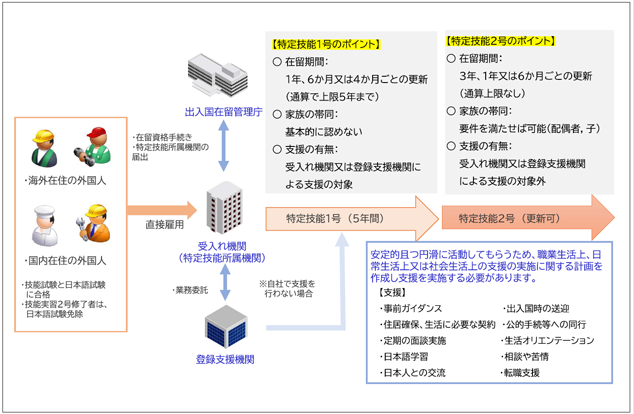
Specified Skilled Worker (Type 1)
Foreign nationals under the Specified Skilled Worker (Type 1) status must possess “skills requiring a certain level of knowledge or experience.” In practice, this means capabilities gained through substantial hands-on experience that enable the worker to perform assigned tasks with minimal additional training. Whether this standard is met is verified through sector-specific examinations.
Regarding Japanese proficiency, candidates must have language skills sufficient for daily life and for performing the relevant work. Proficiency is confirmed through tests designated by the competent authority for each industry. Candidates who have satisfactorily completed Technical Intern Training (TIT) Level 2 are generally exempt from the language test, except in the nursing care sector.
Employing organizations are required to develop and implement a “Support Plan for Specified Skilled Worker (Type 1)” to provide necessary assistance for daily life and integration in Japan.
Specified Skilled Worker (Type 2)
Foreign nationals under the Specified Skilled Worker (Type 2) status must demonstrate “advanced skills,” meaning highly specialized capabilities acquired through many years of practical experience—comparable to or exceeding those of foreign nationals in professional/technical roles. Individuals who can independently perform highly specialized work or supervise and train others with advanced skills generally meet this standard. Achievement is verified through examinations aligned to the job category.
Type 2 status permits dependent family accompaniment, supporting a stable family life in Japan.
After completing the five-year maximum under Type 1, eligible individuals may apply to change to Type 2, which allows indefinite renewals of the period of stay. In addition, as a general matter, foreign nationals who have lived in Japan for 10 years or more and meet statutory criteria may apply for permanent residency.
4. Eligibility Criteria for Specified Skilled Workers
The following criteria apply to applicants for the Specified Skilled Worker (SSW) status.
1. The applicant must meet all of the following. However, if the applicant has satisfactorily completed Technical Intern Training (TIT) Category 2 (single-employer or group supervision) and the skills acquired are relevant to the intended work, then conditions (c) and (d) may be waived.
a. Be at least 18 years of age.
b. Be in good health.
c. Possess skills requiring a reasonable level of knowledge or experience for the intended work, as verified by examinations or other evaluation methods.
d. Have Japanese proficiency necessary for daily life and the intended work, verified by examinations or other evaluation methods.
e. Hold a valid passport issued by a competent authority of the applicant’s home country or region, as designated by the Minister of Justice.
f. If the applicant has previously held SSW status in Japan, the total period of stay under SSW must not exceed five years (for Type 1).
2. Neither the applicant nor their spouse, cohabiting lineal relatives, or other persons with close social ties may be subject to money/property management by third parties connected to the SSW employment contract, nor be bound by contracts imposing penalties or unjust transfers of money or property related to breach of the employment contract.
3. If the applicant or spouse has paid fees to an overseas organization for placement or preparatory activities related to the SSW contract, the applicant must fully understand and consent to the fee amounts and itemization.
4. If procedures are required in the applicant’s home country/region for activities related to working in Japan, such procedures must be completed.
5. For regular expenses borne by the applicant (e.g., meals, accommodation), the applicant must fully understand the scope of benefits provided; costs must be reasonable and properly documented.
6. For certain industries designated by the Minister of Justice, the competent authority must confirm—after consultation with the Minister of Justice—that the applicant meets sector-specific standards.
5. Standards for Employing Organizations
Standards for SSW employing organizations are requirements that employers must meet under Article 2-5 of the Immigration Control and Refugee Recognition Act and the Act on the Establishment of the Ministry of Justice.
(1) Proper execution of the SSW employment contract
(2) Proper implementation of the SSW (Type 1) support plan
The “Ordinance on Standards for Specified Skilled Worker Employment Contracts and Type 1 Support Plans” details these requirements, summarized below.
1. Proper Execution of the SSW Employment Contract
① Compliance with labor, social insurance, and tax laws and regulations.
② Within one year before or after the contract date, the employer has not conducted dismissals in the same job category for which the SSW worker is hired (subject to statutory exceptions).
③ Within one year before or after the contract date, the employer has not caused the disappearance/absconding of a foreign worker due to reasons attributable to the organization.
④ The employer and its officers/employees must not fall under any of the following:
a. Persons sentenced to imprisonment (or equivalent) whose sentence ended less than five years ago.
b. Persons fined under laws related to labor standards, organized crime control, health insurance, etc., whose sentence ended less than five years ago.
⑤ Prepare and retain on-site documents regarding the foreign worker’s activities for at least one year after contract termination.
⑥ Do not engage in collection of deposits or other unjust financial control related to the employment contract with the worker or their close relations.
⑦ Do not enter into contracts imposing penalties or unjust financial obligations linked to non-fulfillment of the employment contract.
⑧ Do not require foreign workers to bear costs directly or indirectly related to implementing the Type 1 support plan.
⑨ When dispatching foreign workers, meet the statutory conditions and obtain approval by the relevant administrative authority for the sector involved.
⑩ Properly register for workers’ accident compensation insurance and take necessary related measures.
⑪ Maintain systems that enable continuous fulfillment of the employment contract.
⑫ Pay remuneration by bank transfer to the worker’s designated account or by another verifiable method; if not by bank transfer, submit appropriate documentation to immigration authorities.
⑬ For certain sectors, compliance with specific standards must be confirmed by the relevant authority in consultation with the Minister of Justice.
2. Proper Implementation of the Support Plan
① The organization must meet one of the following:
a. Have, within the past two years, a proven record of appropriately managing mid- to long-term residents engaged in work with remuneration, and appoint responsible officers and support staff for implementation.
b. Appoint responsible officers and support staff with experience within the past two years in providing living support to mid- to long-term residents.
c. Alternatively, appoint officers and support staff recognized as capable of appropriately implementing support duties.
② Maintain a system to provide occupational, daily life, and social support in languages the foreign worker can adequately understand.
③ Prepare and retain documents related to support activities for at least one year after contract termination.
④ Responsible officers and support staff must be neutral (not the worker’s direct supervisors) and have no history of violations of labor or related laws.
⑤ The organization must not have neglected support obligations under a Type 1 support plan within five years before or after the contract date.
⑥ Maintain a system that enables responsible officers and support staff to hold regular meetings with the foreign worker and their supervisors.
⑦ For designated sectors, compliance with sector-specific standards must be confirmed by the relevant authority in consultation with the Minister of Justice.
6. Standards for Specified Skilled Worker Employment Contracts
The Specified Skilled Worker employment contract is the agreement between a foreign national under SSW and the accepting Japanese organization. Its contents must comply with standards prescribed by Ministry of Justice ordinances under the Immigration Control and Refugee Recognition Act.
① Matters concerning the foreign national’s activities, remuneration, and other employment terms.
② Measures to ensure departure upon contract termination and other matters necessary for proper residence management.
Discriminatory treatment based on nationality is prohibited with respect to wage determination, training, use of welfare facilities, and other working conditions. Key elements from the “Ordinance on Standards for Specified Skilled Worker Employment Contracts and Type 1 Support Plans” are summarized below.
1. Employment Relationship Matters
Employment must comply with the Labor Standards Act and related laws, subject to the following:
① The foreign national must engage in work requiring a reasonable level of knowledge or experience specific to the sector, or in skilled work as defined by ordinance.
② Prescribed working hours must be equivalent to those of regular employees at the accepting organization.
③ Remuneration must be equal to or exceed that of Japanese workers performing the same work.
④ No discriminatory treatment may be applied based on foreign nationality regarding wages, training, use of welfare facilities, or other working conditions.
⑤ Paid leave should be granted for temporary return to the home country when requested.
⑥ When dispatching to other entities, specify the name, address, and dispatch period.
⑦ For designated industries, compliance with sector-specific standards confirmed by the competent authority is required.
2. Matters Contributing to Proper Residence of Foreign Nationals
The following standards apply:
① If the foreign national cannot afford return travel expenses after contract termination, the accepting organization must cover these costs and take necessary measures to ensure smooth departure.
② The accepting organization must take necessary measures to monitor the foreign national’s health and living conditions.
③ For designated industries, compliance with sector-specific standards confirmed by the competent authority is required.
7. What is the Support Plan for Specified Skilled Workers?
1. Overview of the Support Plan
Accepting organizations must develop and implement a “Specified Skilled Worker (Type 1) Support Plan” to ensure that Type 1 foreign nationals can engage in work, daily life, and social activities smoothly and stably. There is no support obligation for Type 2 visa holders.
Support comprises mandatory services—which must be fully provided and included in the plan—and optional services that may be offered at the organization’s discretion.
Failure to provide all mandatory support constitutes improper implementation of the plan, unless objectively unnecessary (e.g., where a foreign national transfers from TIT Level 2 to Type 1 and certain elements are not required).
Accepting organizations may delegate all or part of plan implementation to Registered Support Organizations (RSOs) under contract. RSOs may use interpreters within the scope of delegated duties but may not further subcontract support tasks.
2. Specific Support Services
1. Pre-arrival Guidance
Explain labor conditions, permitted activities, immigration procedures, and prohibition of deposit collection before application submission, via in-person or online sessions.
2. Airport Reception and Transportation
Arrange transportation from the airport to the workplace or residence upon arrival; accompany the worker through departure procedures when leaving Japan.
3. Housing and Contract Support
Provide guarantor support, company housing where applicable, and assistance with opening bank accounts, mobile phone and utilities contracts, and other procedures.
4. Life Orientation
Explain local rules and manners, use of public institutions, emergency contacts, and disaster response to facilitate smooth integration.
5. Accompaniment to Public Procedures
Accompany workers for residency, social insurance, and tax procedures, and assist with document preparation as needed.
6. Japanese Language Learning Opportunities
Provide information on Japanese classes and learning resources.
7. Consultation and Complaint Handling
Respond to workplace and daily life inquiries in a language the worker understands, and provide advice or guidance as necessary.
8. Promotion of Interaction with Japanese People
Facilitate participation in community events, neighborhood associations, festivals, and other social exchanges.
9. Job-change Support (in case of restructuring, etc.)
Assist with job search, prepare recommendation letters, grant paid leave for interviews, and provide information on administrative procedures.
10. Regular Interviews and Reporting
Support staff must interview workers and supervisors at least quarterly and report any suspected labor law violations.
3. What is a Registered Support Organization?
A Registered Support Organization (RSO) is authorized to provide the 10 mandatory support services on behalf of accepting organizations for Type 1 foreign nationals. Private companies and administrative scriveners can register; as of October 3, 2024, approximately 10,000 entities were registered.
Outsourcing to an RSO typically involves recurring fees of ¥20,000–50,000 per worker per month, plus additional charges per ad hoc service.
Model Case
Where feasible, providing these services in-house can eliminate external costs. Many tasks—such as orientation sessions and airport pickup—are operationally straightforward and can be handled by general staff with appropriate guidance. Consider internal provision before outsourcing.
8. Notifications Required from the Employer
1. Notification of Contract Changes
If the employment contract for a Specified Skilled Worker is modified, the employer must notify the nearest Regional Immigration Services Bureau within 14 days of the change. Notifications may be submitted in writing or via the online system.
Attach supporting documents corresponding to the amended items:
① Contract period ② Workplace location ③ Job description ④ Working hours ⑤ Days off ⑥ Leave
⑦ Wages ⑧ Termination clauses ⑨ Other (e.g., insurance coverage)
2. Notification of Contract Termination
If an SSW employment contract is terminated, the employer must notify the nearest Regional Immigration Services Bureau within 14 days of the termination date, in writing or online.
・Notice of termination
・Date of termination
・Reason for termination
3. Notification of New Contract Conclusion
When a new SSW employment contract is concluded, notify the nearest Regional Immigration Services Bureau within 14 days of conclusion, in writing or online.
・Date of contract conclusion
・Contract details
4. Notification of Changes to the Support Plan for Type 1 Specified Skilled Workers
If the Type 1 Support Plan is amended, notify the nearest Regional Immigration Services Bureau within 14 days of the change. Attach a written statement outlining the revised plan. Submission may be in writing or via the online system.
・Statement indicating the plan has been amended
・Date of amendment
・Details of the revised plan
5. Notification of Contract with a Registered Support Organization
Notify the nearest Regional Immigration Services Bureau within 14 days of the following events, in writing or online:
① Conclusion of a Support Outsourcing Contract with a Registered Support Organization (RSO) to delegate Type 1 support duties
② Amendments to the Support Outsourcing Contract with an RSO
③ Termination of the Support Outsourcing Contract with an RSO
6. Notification of Inability to Continue Engagement
If the employer becomes unable to continue engaging the SSW worker, notify the nearest Regional Immigration Services Bureau within 14 days of the relevant decision or event, in writing or online.
① Reason, timing, and cause of the inability to continue engagement
② Current status of the SSW worker
③ Measures taken to enable continued SSW activities, if applicable
Typical reasons and occurrence dates include:
・Notice of dismissal due to business circumstances
・Failure to meet employer eligibility requirements
・Decision to dissolve the corporation
・Disciplinary dismissal attributable to the worker, or voluntary resignation
・Change to a residence status other than “Specified Skilled Worker”
・Termination due to illness or injury
・Absconding of the SSW worker
・Death of the individual employer or the SSW worker, etc.
7. Notification of Misconduct
Upon becoming aware of misconduct by an SSW worker in relation to immigration or labor laws, the employer must notify the nearest Regional Immigration Services Bureau within 14 days of recognition. Attach a written statement detailing the facts. Submission may be in writing or via the online system.
・Statement of the facts
・Date of occurrence
・Date of recognition
・Measures taken in response
・Details of the misconduct
8. Notification Regarding Activity Status
On a quarterly basis, submit a report to the nearest Regional Immigration Services Bureau within 14 days from the first day of the following quarter. Submission may be in writing or via the online system.
① Total number of SSW workers engaged during the reporting period
② Name, date of birth, gender, nationality/region, residential address, and residence card number of each SSW worker
③ Number of days engaged in SSW activities, work location, and job description
④ If dispatched, name and address of the host organization
⑤ Wage payment status for the SSW worker and for comparison employees used to determine remuneration
⑥ Number of employees; number of new hires and separations in the same job category as the SSW worker; number of missing persons; breakdown by Japanese and foreign nationals
⑦ Enrollment status in health insurance, employees’ pension insurance, and employment insurance; status of workers’ accident compensation insurance procedures
⑧ Health and safety conditions of the SSW worker
⑨ Total costs incurred for accepting the SSW worker and a breakdown of such costs
9. Notification on the Implementation Status of Support
If a Type 1 Support Plan is in place, submit a quarterly report within 14 days from the first day of the following quarter to the nearest Regional Immigration Services Bureau.
・Documents describing implementation status of support
・Status of implementation of the applicable Type 1 Support Plan
9. Common Challenges Faced by Companies When Applying for the Specified Skilled Worker Visa
The Specified Skilled Worker (SSW) framework enables employers to hire job-ready foreign talent. However, the volume and complexity of procedural requirements can place a substantial burden on HR teams.
The principal challenges include:
1. Sector-Specific Requirements Are Hard to Navigate
SSW spans multiple sectors with differing skills assessments and Japanese language tests. The necessity, content, and verification methods vary by sector, making it time-consuming for first-time applicants to map end-to-end requirements.
2. Obligation to Prepare and Execute a Type 1 Support Plan
For Type 1, the employer or an RSO must prepare and implement a Support Plan covering daily life and employment support. The plan is evidence-based and includes items such as orientation, housing, consultation systems, and (where applicable) job-change assistance. Incomplete plans risk rejection.
3. High Document Volume and Complex Formats
Beyond the applicant’s history and test certificates, corporate documents (financials, work rules, employment contracts, certificate of registered matters, etc.) must be compiled and formatted to immigration specifications. Managing this alongside routine HR duties is often impractical.
4. Ongoing Correspondence and Timeline Control
Post-submission, additional information or corrections are frequently requested. HR must also track exam windows, visa expirations, and status-change timelines—creating a continuous coordination load.
10. Benefits of Using an SSW Visa Application Support Service
Partnering with a professional provider helps alleviate these challenges:
1. Strategy and Execution by Specialists
Licensed immigration professionals (Gyoseishoshi/Administrative Scriveners) design optimal strategies by sector and candidate profile and handle end-to-end preparation and filing—reducing internal research time and improving application accuracy.
2. Support Plan Design and Operationalization
We provide compliant templates, tailor them to your operations, and prepare documentation acceptable to immigration authorities. We also advise on RSO contracts and role allocation, ensuring full-cycle compliance.
3. Error Prevention and Screening Risk Reduction
Expert review resolves inconsistencies and omissions in forms and contracts in advance—lowering rejection risk and helping keep screening timelines on track.
4. Centralized Follow-ups and Deadline Management
We manage correction requests, liaise with immigration, and complete post-issuance card procedures. For multi-hire cohorts, we centralize schedules to minimize operational impact.
SSW applications are not only about obtaining status—they reinforce organizational compliance and trust. Accurate, timely filings streamline onboarding and support long-term retention. For first-time or large-scale hiring, a reliable application partner is critical to success.
11. SSW Visa Application Support Service
SSW applications require extensive, complex documentation from employers. Compliance and ethical handling of foreign employees are fundamental obligations.
The Immigration Services Agency of Japan provides the following guidance:
※1 Except for attorneys and Gyoseishoshi (Administrative Scriveners), any person who, for compensation, prepares application documents—including those for submission to public offices such as immigration—may be in violation of the Gyoseishoshi Act.
(Source: Immigration Services Agency of Japan)
Since the SSW status was introduced in April 2019, many intermediaries have appeared across industries. However, entities other than qualified professionals falling under note ※1 may not prepare application documents on behalf of companies.
ACROSEED Immigration Lawyer’s Corporation ensures that submissions are prepared by licensed Gyoseishoshi with specialized expertise, in strict legal compliance, and can also act as your representative before immigration authorities.
1. Key Benefits of Entrusting Document Preparation to ACROSEED
1. Legal Compliance and Corporate Ethics
We operate as a trusted partner. As legal professionals, we uphold both client commitments and applicable laws, providing holistic consulting that balances immediate outcomes with long-term implications.
2. Efficient Use of HR Time
Application preparation demands significant effort and communication—especially where candidates have limited Japanese proficiency. On request, we directly support candidates in English, reducing HR workload.
3. Faster Onboarding
SSW timelines must align with start dates. With 3,000–4,000 annual immigration matters handled, ACROSEED understands current processing trends and helps keep onboarding on schedule.
4. Nationwide Coverage
Headquartered in Chiyoda-ku, Tokyo, we provide nationwide services. Consultations are available in person or remotely (phone/Zoom/Skype).
2. Types of Documents We Prepare
Documents related to the applicant (foreign national)
Documents related to the host organization (company)
Documents specific to the relevant industry sector
*In addition to preparing documents, we handle filing with the Immigration Services Agency and support required post-acceptance notifications. Please feel free to contact us.
3. Service Fees (excluding tax)
| Service Fee (excluding tax) | 50,000 yen per applicant – 200,000 yen per applicant |
|---|
*Fees and required documents vary by current residence status, application type, company size, and industry sector. Please contact us for details.
*We also provide representation before the Immigration Services Agency and support for post-acceptance notifications.
If you are considering continuous outsourcing, please see the following page for cost-effective options:
Outsourcing Visa Applications and Status of Residence Management
From hiring to separation, ACROSEED—experienced across all aspects of foreign employee management—provides robust support to HR departments. We tailor services to your company’s specific challenges.
Since our founding in 1986, we have specialized in visa applications and have provided consulting services to companies employing foreign nationals for nearly 40 years.
Consultations are available via telephone, email, online, or in person. English support is also available.