Engineer/Specialist in Humanities/International Services Visa Support (For Employers Hiring Foreign Nationals)
Last Updated:
- What is the Engineer/Specialist in Humanities/International Services Visa?
- Eligible Occupations
- Technical Field (STEM/Engineering)
- Humanities Field (Specialized Professions)
- International Services Field (Language/Global Roles)
- Eligibility Requirements
- Treatment of Practical Training at Onboarding
- Rules on Side Jobs and Secondary Employment
- Procedures for Hiring Mid-Career Workers Who Already Hold This Status
- Visa Renewal Procedures
- Common Reasons for Application Denial
- Required Documents
- Application Process and Processing Times
- Changing Status for Foreign Nationals Already in Japan
- Inviting and Hiring from Overseas
- Processing Times (as of June 2025)
- Q&A for Employers
- When should we start the application process for an international student after graduation?
- If a foreign employee is transferred to a different department, what procedures are required?
- Can fixed-term, dispatch, or part-time employees qualify for this visa?
- ACROSEED’s Service Overview
1. What is the Engineer/Specialist in Humanities/International Services Visa?
The Engineer/Specialist in Humanities/International Services visa is the most common among the 19 employment-related residence statuses in Japan.
This visa category allows foreign nationals to work in Japan under a contract with a public or private institution in one of three fields:
1. Work requiring knowledge in the natural sciences (STEM/engineering fields)
2. Work requiring knowledge in the humanities (liberal arts/professional fields)
3. Work requiring cultural expertise or sensitivity based on a foreign culture
The visa covers professions requiring academic knowledge in areas such as law, economics, engineering, and sociology, as well as roles requiring cultural skills unique to non-Japanese nationals. However, if the role clearly falls under another visa category—such as Professor, Artist, Journalist, Business Manager, Legal/Accounting Services, Medical Services, Researcher, Instructor, Intra-company Transferee, or Entertainer—the corresponding status will apply instead.
Eligible “institutions” include government agencies, local authorities, public corporations, private companies, incorporated associations, and even certain unincorporated associations or foreign corporations with offices in Japan. Individuals maintaining a place of business in Japan may also qualify as contracting entities.
Contracts may include employment, outsourcing, or advisory agreements, provided they are continuous and institution-specific. The activities must be lawful in Japan and expected to continue over time.
“Work requiring knowledge in the natural sciences” refers to professional-level work based on academic training, which cannot be carried out without specialized expertise.
Representative fields include:
“Work requiring knowledge in the humanities” also refers to professional-level work based on academic education, not solely practical experience.
Representative fields include:
Applicants must demonstrate specialized knowledge through academic training such as a university degree or equivalent. Practical experience alone is insufficient; the knowledge must be systematic and academically grounded.
The “International Services” element applies to work requiring cultural sensitivity unique to foreign nationals—skills and perspectives rooted in their cultural background, history, and traditions. To qualify, the work must require a specialized level of ability not ordinarily available among Japanese nationals.
2. Eligible Occupations under the Engineer/Specialist in Humanities/International Services Visa
Among the work-related residence statuses we frequently receive inquiries about, the following four are most common:
・Highly Skilled Professional
・Designated Activities (Public Notice No. 46)
・Specified Skilled Worker
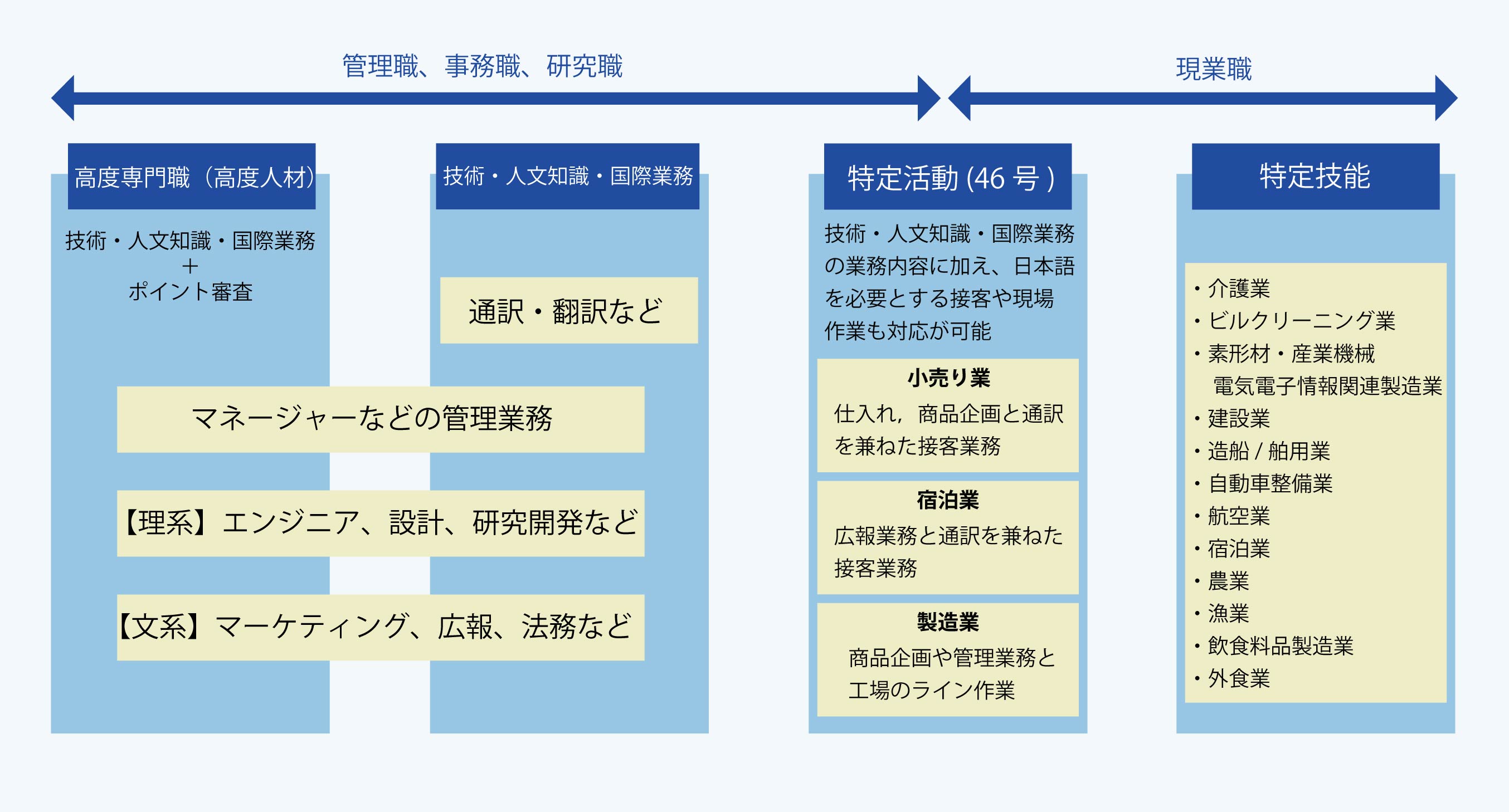
The Engineer/Specialist in Humanities/International Services visa is designed for foreign nationals working under a contract with a Japanese company or institution in roles requiring (i) academic knowledge in natural sciences (STEM/engineering), (ii) academic knowledge in the humanities, or (iii) cultural expertise based on a foreign background. It is one of the most common residence statuses for white-collar professionals in Japan.
1. Technical Field (STEM/Engineering Roles)
Applies to positions requiring specialized knowledge in science or engineering, such as:
Mechanical/Electrical Design Engineers
Architectural Designers, CAD Operators
R&D and Design Specialists in manufacturing industries
Typically requires a relevant university degree or equivalent practical expertise.
2. Humanities Field (Specialized Professional Roles)
Applies to roles requiring knowledge in economics, law, management, or sociology. A university degree in a related field is generally required.
General Office Roles (Sales, Marketing, Planning)
Legal Affairs, Contract Management
Public Relations, Investor Relations, Publishing
3. International Services Field (Language/Global Roles)
Applies to positions requiring language skills or international cultural expertise, including:
Trade Operations (import/export documentation and logistics)
Overseas Sales
Customer Support for Foreign Clients
3. Key Requirements for the Engineer/Specialist in Humanities/International Services Visa
Applicants must meet the following requirements:
1. Technical/Humanities Roles
Candidates must possess the necessary academic background in science, engineering, or humanities, demonstrated by one of the following:
(ii) Completion of a specialized vocational school course in Japan (meeting Ministry of Justice criteria)
(iii) At least 10 years of relevant professional experience (including study years in related fields)
* For IT-related roles, passing an officially designated information technology exam may substitute for the academic requirement.
2. International Services Roles
Candidates must meet both of the following:
(ii) Have at least three years of relevant experience (waived for university graduates in translation, interpretation, or language instruction)
3. Common Requirements
Salary refers to compensation for services rendered. Reimbursements such as commuting, housing, or family allowances are excluded. The standard is evaluated based on the company’s pay scale and market benchmarks for similar positions.
The relationship between major and job is interpreted more flexibly for university graduates, but more strictly for vocational school graduates, as vocational programs are considered more narrowly specialized.
Ministry of Justice Notification No. 330 (2011) further specifies requirements for vocational school graduates, including eligibility for the titles “Specialist” or “Advanced Specialist” under Ministry of Education regulations.
4. Treatment of Practical Training at the Start of Employment
Basic Principle
Foreign employees must engage in qualifying activities under this visa category. However, many companies provide an initial period of practical training.
If the training is part of a standard onboarding program also required of Japanese graduates, and does not occupy the majority of the visa holder’s stay, immigration authorities may consider it acceptable.
Training Duration
Authorities assess the entire planned period of stay when determining eligibility, not just the initial visa validity. For example, if a one-year visa is issued but the first year is entirely training, approval may still be granted provided the employee transitions into qualifying duties thereafter.
However, if the employment contract is only three years and two years are spent in training, approval is unlikely. Training longer than one year requires submission of a formal training plan for review.
Training Plan and Documentation
Employers may be asked to submit documents outlining career progression, training content, and job duties at each stage. If training is only provided to foreign hires—or differs significantly from programs for Japanese employees—it may not be considered reasonable unless a valid justification (e.g., Japanese language training) is provided.
This principle also applies to mid-career training programs, not just initial onboarding.
Visa Period of Stay
When practical training is included, immigration authorities generally grant an initial one-year period of stay to confirm that the employee transitions into qualifying duties thereafter.
5. Side Jobs and Part-Time Work under the Engineer/Specialist in Humanities/International Services Visa
HR managers often ask whether foreign employees holding this visa may engage in side jobs or part-time work.
In short: side jobs are possible, but depending on the nature of the work, prior permission from the Immigration Services Agency (“Permission to Engage in an Activity Other Than That Permitted”) may be required.
Cases Where Permission Is Not Required
If the side job falls within the same scope of activities already permitted under this visa, no additional permission is necessary.
Example: An employee hired as a full-time interpreter who also takes occasional part-time interpreting work remains within the visa category.
Even if compensation is paid, permission is not required when activities fall under the following categories:
・Temporary, one-off remuneration (e.g., helping a friend move)
・Activities clearly within the scope of the current visa status
・Employees holding Permanent Resident, Long-Term Resident, or spousal status
Cases Where Permission Is Required
If the side job falls outside the permitted scope of the visa, prior permission is required. There are two types:
Individual Permission: Required for each specific activity outside the current work visa.
For work outside the visa scope, individual permission must be obtained for each job. Comprehensive permission may occasionally apply (e.g., roles contracted with a local government).
Conditions for approval generally include:
・Primary employment must be maintained and continuous
・Side job must not involve “unskilled labor”
・Work must not conflict with law or public order
・Applicant must have no immigration compliance issues
・Employer consent must be obtained
Important: “Unskilled labor” (e.g., convenience store or fast-food customer service) is not permitted. In addition, since corporate policies vary, HR should confirm whether the employer allows side jobs before proceeding.
6. Hiring Mid-Career Employees Holding This Visa
1. Status of Residence Procedures
If the employee’s existing visa matches the duties at your company, no immediate application is required until the current period of stay expires.
However, if duties do not clearly match the visa scope, a change of status is required. This is not always easy to judge, and mismatches are sometimes only discovered at renewal.
Example: A company hires someone with a 3-year visa, but renewal is denied after 2 years because actual duties did not align with the visa category. The company then faces re-recruitment and retraining costs, while the employee loses their job and livelihood. To avoid such risks, companies can use the Certificate of Authorized Employment (see below).
2. Certificate of Authorized Employment
This certificate, issued by the Immigration Services Agency, confirms in advance that an employee’s duties match their visa category. It is optional but highly recommended for risk management.
Applying for the certificate provides assurance until the next renewal. If denied, adjustments such as job reassignments can be made early. This minimizes disruption compared to discovering issues years later at renewal.
3. Notification of Affiliated Institution
Foreign employees must notify the Immigration Services Agency within 14 days when changing employers, joining a new company, or if the company name changes (e.g., due to merger). This is called the “Notification of Affiliated Institution.”
While the responsibility lies with the employee, failure to notify can result in shorter visa durations at renewal. HR should proactively remind employees to submit this notification to ensure compliance.
7. Renewal of the Engineer/Specialist in Humanities/International Services Visa
At renewal, immigration authorities confirm that the applicant will continue activities permitted under this visa, reviewing:
- Employer, position, and job description
- Salary level compared with Japanese employees in similar roles
- Tax certificates proving salary payment and tax compliance
Failure to meet obligations such as tax payment may result in denial or shorter visa durations.
Requirements for a 5-Year Visa
Applicant must meet all of (i), (ii), and (v), plus either (iii) or (iv):
① Compliance with all reporting obligations under the Immigration Act
② If school-age children, they must be enrolled in school (including international schools)
③ Employer classified as Category 1 or 2
④ If not in (iii), applicant has previously held a 3- or 5-year visa and engaged in eligible work in Japan for at least 5 consecutive years
⑤ Planned employment exceeds 3 years
Requirements for a 3-Year Visa
Applicants must meet one of the following:
① Meets (i) and (ii) above, plus (iii) or (iv), with employment planned for over 1 year but less than 3 years
② Previously held a 5-year visa but now fails (i) or (ii), while still meeting (iii) or (iv), with employment exceeding 1 year
③ Does not meet conditions for 5 years, 1 year, or 3 months
Requirements for a 1-Year Visa
Applicants must meet one of the following (unless qualifying for 3 months):
① Employer is Category 4
② Previously held a 3- or 1-year visa but now fails (i) or (ii)
③ Immigration authorities deem annual review necessary based on employer/employee record
④ Planned employment period is 1 year or less
8. Common Reasons for Visa Denial
1. Mismatch Between Job Duties and Visa Status

The most frequent reason for denial is that actual duties do not fall within the Engineer/Specialist in Humanities/International Services scope. For example, assigning visa holders to factory or retail work during training may be considered unauthorized employment, even if temporary.
Such cases may be treated as false applications, putting both company and employee at risk.
2. Mismatch Between Specialization and Duties
Applications are often denied when the employee’s academic background does not align with job duties. For example, an economics graduate hired into a bank is consistent, while a fashion graduate in financial sales is not.
3. Employer-Side Issues
Denials may also occur due to employer concerns, such as weak financials, very small company size, or lack of business continuity. Even failing to answer ISA verification calls during business hours has led to suspicion and denial.
4. Applicant-Side Issues
Past immigration violations, such as overstaying or working beyond permitted hours as a student, can cause denial. Employers should thoroughly confirm past visa history and part-time work compliance during interviews.
9. Required Documents for the Engineer/Specialist in Humanities/International Services Visa
Required documents are subject to change due to revisions in immigration law. HR teams should always check the Immigration Services Agency (ISA) website for the latest requirements.
When you engage ACROSEED, we prepare documentation tailored to your company’s situation, fully aligned with the latest ISA requirements and drawing on our decades of experience as registered application agents.
10. Application Process and Processing Time
1. Hiring a Foreign National Already in Japan (Change of Status)
The steps for changing status of residence are as follows:
-
1
- Prepare Documents
- Collect the required supporting documents and complete the ISA application forms.
-
2
- Submit to ISA
- Review normally takes around 1–2 months, provided there are no deficiencies.
-
3
-
4
- Residence Card Issuance
- Bring the postcard and supporting documents to ISA. If approved, a new residence card is issued immediately.
2. Hiring from Overseas (COE Application)
When hiring from abroad, the employer submits a Certificate of Eligibility (COE) application to the ISA office with jurisdiction over the company’s location. The company (or its immigration lawyer) acts as the applicant’s proxy.
Steps for COE Application
-
1
- Prepare Application Documents
- Gather all required documents and complete the COE forms.
-
2
- Submit to ISA
- Review typically takes 1–3 months.
-
3
- COE Issuance
- Once approved, the COE is issued and mailed to the employer (or to the attorney).
-
4
- Send to Overseas Applicant
- The COE is forwarded to the applicant abroad by secure courier (EMS) or transmitted electronically under the new COE digitalization process.
-
5
-
6
- Entry into Japan
- At the port of entry, the COE and visa are presented for landing inspection. If approved, the applicant receives the residence status and may begin work.
3. Current Processing Times (as of June 2025)
| Application Type | Average Processing Time |
|---|---|
| COE (Engineer/Specialist in Humanities/International Services) | Approx. 62.8 days |
| Change of Status | Approx. 39.9 days |
| Renewal | Approx. 48.3 days |
11. Q&A for Employers
- When should we start the visa process for an international student we plan to hire after graduation?
- A change of status application is required. Begin preparations 2–3 months before graduation and submit 1–2 months in advance. As ISA reviews typically take 1–1.5 months, prepare documents (employment contract, graduation certificate, hiring rationale, etc.) immediately after making the offer.
- What if an employee’s duties change after an internal transfer?
- Visas are granted based on job duties. If the new duties remain within the same category (e.g., HR to accounting), no major issue arises. If duties change significantly, a change of status may be necessary. Always confirm alignment with visa requirements before transferring roles.
- Can we employ someone on a contract or dispatch basis?
- Yes, provided the duties fit the visa requirements. However, job stability, relevance, and appropriate salary must be demonstrated. Dispatch arrangements require proper contracts between sending and receiving companies. Short-term or part-time work is generally not permitted under this visa.
12. ACROSEED’s Visa Application Support Services
1. Service Overview

ACROSEED provides end-to-end support for obtaining the Engineer/Specialist in Humanities/International Services visa from the Immigration Services Agency.
Our goal is to maximize approval rates while reducing the HR and administrative burden on your company.
We regularly assist with:
・Onboarding mid-career hires already residing in Japan
With over 30 years of experience, our immigration specialists streamline the process, saving HR teams both time and cost. Contact us with your hiring plans—our consultants will recommend the optimal approach.
2. Services Included
1. Strategic Advice on Employment Start Date
2. Guidance for New Hires
(Monitoring departure schedules, document requirements, timeline management)3. Visa Application Procedures
(Document preparation, submission, communication with examiners, receipt of results)4. Secure Document Delivery
(Overseas COE dispatch via EMS or digital transfer)5. Post-Application Support
(Status checks, liaison with ISA officers, submission of additional documents)Other cases are handled individually—please contact us for details.
3.Why Choose ACROSEED
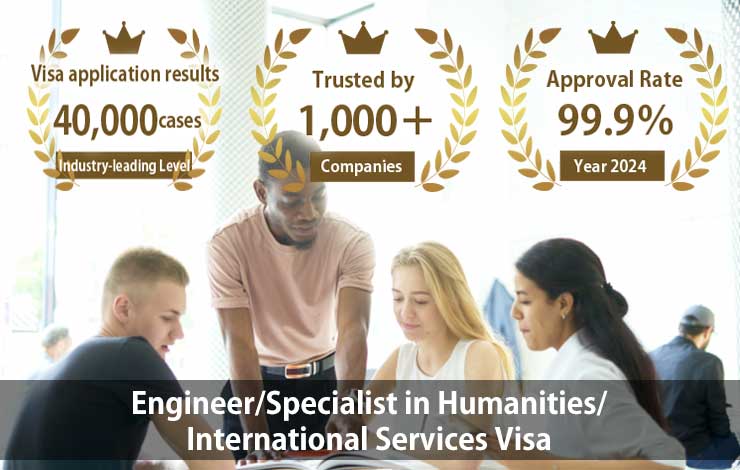
- Established in 1986, with an industry-leading record of over 40,000 visa applications
- Trusted by more than 1,000 corporate clients
- No travel expenses – nationwide service at a flat rate
- Services available in English and Chinese
- ISO 27001 certified – ensuring strict compliance
40,000 Visa Applications Since 1986 – One of Japan’s Most Experienced Providers

ACROSEED has specialized in immigration services since 1990, when legal reforms allowed administrative scriveners to handle immigration procedures. As of March 2025, we have processed over 40,000 visa applications.
We currently handle 3,000–4,000 visa cases annually, with immigration visits twice a week to stay current on screening trends and regulation changes.
By choosing ACROSEED, you benefit from the most up-to-date insights and extensive hands-on experience in the industry.

Our Track Record
ACROSEED’s track record in corporate services, publications, media coverage, and seminars
Trusted by Over 1,000 Corporate Clients

ACROSEED’s dedicated corporate team handles all visa-related and licensing procedures associated with foreign employee hiring.
We offer two distinct service types:
・As a welfare benefit service for foreign employees
We customize our support based on your company’s structure, challenges, and employment needs, referencing real-world examples.
Our services are trusted by a wide range of clients, from publicly listed corporations to small and mid-sized businesses.
Case Studies
We present case studies of companies that actively promote the employment of foreign nationals by utilizing ACROSEED’s services.
Nationwide Flat-Rate Service with No Travel Costs

Our office is based in Nagatacho, Chiyoda-ku, Tokyo, but we serve immigration offices across Japan with no additional travel costs.
We also offer online consultations via Zoom or Skype, allowing face-to-face communication from any location.
English and Chinese Language Support

Our bilingual staff can communicate directly with foreign employees in English or Chinese.
We assist with application explanations, status tracking, and employee coordination — reducing the burden on HR teams and improving the applicant experience.
ISO 27001 Certified for Information Security Compliance

ISO 27001 is the international standard for information security management (ISMS).
ACROSEED was an early adopter of this certification in our field, demonstrating our commitment to secure and compliant client service.
This gives even highly regulated, publicly listed companies the confidence to trust us as their immigration partner.
4. Application Support Fees for Engineer/Specialist in Humanities/International Services (Excluding Tax)
・Fees vary depending on the scope of service, workload, and case complexity. Please contact us for a free consultation and customized quotation.
*ACROSEED’s services are available nationwide.
| Certificate of Eligibility (COE) Application (Hiring from Overseas) |
Approx. ¥100,000 |
|---|---|
| Change of Status of Residence Application (Hiring in Japan) |
Approx. ¥100,000 |
| Extension of Period of Stay Application (Visa Renewal) |
Approx. ¥80,000 |
If your company is considering outsourcing not only individual applications but also the ongoing management of visa renewals and residence status, please refer to the following page:

Outsource Your Visa Applications and Residency Management
From initial hiring to employee offboarding, ACROSEED’s specialists—experienced in all aspects of foreign employee administration—provide comprehensive support tailored to your HR team’s needs. Our services help reduce risk, save time, and improve efficiency in corporate immigration management.

Why ACROSEED is Trusted by Corporations
Explore Client Case Studies
Contact Us / Free Consultation
Since our establishment in 1986, we have been supporting companies hiring foreign nationals with visa applications and immigration consulting for nearly 40 years.
We offer consultations by phone, email, online meeting, or in person at our office.
English support is also available.