[2025 Edition] Guide to Intra-Company Transferee Visa Applications
Last Updated:
- What is the Intra-Company Transferee Visa?
- Screening Criteria for the Intra-Company Transferee Visa
- Period of Stay for the Intra-Company Transferee Visa
- Required Documents for the Intra-Company Transferee Visa Application
- Common Requests for Intra-Company Transferee Visa Applications
- Intra-Company Transferee Visa Q&A
- In the case of an “intra-company transfer,” the stay in Japan is defined as a temporary personnel reassignment. Is it mandatory to adhere strictly to the originally determined transfer period?
- We are transferring an employee from our subsidiary in Vietnam and intend to pay them based on local salary standards. Will this cause any issues?
- When transferring between subsidiaries, to what extent does this fall under “intra-company transfer”?
- What are the main reasons an Intra-Company Transferee Visa application may be denied?
- What are the differences between the Intra-Company Transferee Visa and the Engineer/Specialist in Humanities/International Services Visa?
- How should we prove the employee’s work history at the overseas entity?
- Can foreign employees holding an Intra-Company Transferee Visa change their scope of work or transfer to another employer?
- Application Process and Processing Time for the Intra-Company Transferee Visa
- Advantages of Working with ACROSEED
- Service Fees for the Intra-Company Transferee Visa
1. What is the Intra-Company Transferee Visa?
An Intra-Company Transferee Visa is required when employees of a foreign-based company are transferred to a branch or office in Japan.
It is also required when foreign employees of a Japanese company’s overseas subsidiary or affiliate are reassigned to the Japanese headquarters.
In this context, “transfer” generally refers to movement within the same company, but also includes assignments within corporate groups (such as parent, subsidiary, or affiliated companies).
Eligibility is limited to employees who, immediately prior to the transfer, have worked continuously for at least one year at a foreign headquarters, branch, or other business office, and whose job duties correspond to those permitted under the “Engineer/Specialist in Humanities/International Services” visa category. Therefore, even though it is a personnel transfer within the same corporate group, employees engaged in simple labor are not eligible.
Unlike the Engineer/Specialist in Humanities/International Services Visa, a university degree is not a requirement for obtaining the Intra-Company Transferee Visa. Accordingly, even individuals without a university degree may be eligible, provided they meet the other criteria.
Advantages and Disadvantages of Selecting the Intra-Company Transferee Visa
Advantages
Flexibility of Duties: The visa allows employees to engage in the same types of work as those under the “Engineer/Specialist in Humanities/International Services” category. This includes specialized roles such as IT engineering or project management.
Relaxed Eligibility Requirements: Compared to the Engineer/Specialist in Humanities/International Services Visa, the educational and professional experience requirements are less stringent. For example, even if a candidate lacks a university degree, proven expertise and achievements at the overseas entity may allow the company to transfer the employee to Japan.
Flexible Salary Arrangements: Compensation may continue to be paid from overseas. However, the salary must be equal to or greater than that received by a Japanese national performing the same or similar role in Japan.
Disadvantages
Clarification of Shareholding Relationships: In order to obtain an Intra-Company Transferee Visa, it is necessary to clearly demonstrate the capital relationship between the overseas entity and the Japanese entity. For large multinational corporations, the documentation required to establish these relationships may be complex and time-consuming. For example, in a global IT company with numerous subsidiaries and affiliates, preparing evidence of these corporate relationships can be cumbersome.
In conclusion, the Intra-Company Transferee Visa offers significant advantages for specific corporate needs. However, obtaining and maintaining this visa involves certain complexities, making it important for employers to carefully evaluate whether this visa type best aligns with their business requirements.
2. Screening Criteria for the Intra-Company Transferee Visa

Applicants for the Intra-Company Transferee Visa must meet all of the following conditions:
1. The applicant must have been engaged in duties equivalent to “Engineer/Specialist in Humanities/International Services” at the foreign headquarters, branch, or other business office for a continuous period of at least one year immediately prior to the transfer. (Any period spent in Japan under an Intra-Company Transferee Visa is also counted toward this one-year requirement.)
2. The applicant must receive compensation equivalent to or greater than that of a Japanese national performing the same work.
1. Job Duties
Job duties performed in Japan under this visa must correspond to those classified as “Humanities/International Services” or “Engineering.” Therefore, positions such as “Interpreter/Translator,” “Trade Specialist,” or “Technical Development” are eligible, provided they require advanced knowledge.
It is not necessary for the work performed in Japan to be identical or directly related to the duties carried out abroad, as long as they fall within these professional categories.
2. Applicant’s Work Experience
Eligible employees must have worked at the overseas entity for at least one continuous year immediately prior to the transfer. Accordingly, it is not possible to immediately transfer a newly hired employee to Japan under this visa. In such cases, the Engineer/Specialist in Humanities/International Services Visa should be considered instead.
3. Scope of Companies Eligible for Intra-Company Transfers
The Intra-Company Transferee Visa applies to transfers between overseas companies and their related entities in Japan. Below are examples to illustrate the scope:
1. Transfers between Headquarters and Branches
Explanation: This is the most typical case of an intra-company transfer.
2. Transfers between Parent Company and Subsidiary
Note: A “parent company” is defined as one holding more than 50% of the voting rights of another company. In some cases, ownership of more than 40% may also qualify. Subsidiaries of subsidiaries (“grandchild companies”) are also recognized as subsidiaries for the purpose of this visa.
3. Transfers between Subsidiaries
Important: Transfers involving “great-grandchild companies” are generally not eligible. However, if a parent company owns 100% of its subsidiaries and further sub-subsidiaries, transfers involving such entities may be considered eligible.
4. Transfers to Affiliates
Note: An “affiliate company” refers to a company in which another entity (excluding subsidiaries) holds at least 20% of voting rights. Ownership of 15% or more may also qualify under certain conditions. However, transfers between affiliates, or between parent/subsidiary companies and affiliates, are not eligible under this visa category.
As shown above, the Intra-Company Transferee Visa is highly useful for specific types of transfers. However, employers must carefully confirm which corporate relationships qualify under this category before applying.
3. Period of Stay for the Intra-Company Transferee Visa
Five-Year Period of Stay
Applicants must meet items ①, ②, and ⑤ below, and also satisfy either ③ or ④.
① The applicant has fulfilled all notification obligations under the Immigration Control Act (e.g., notification of place of residence, changes of residence, changes to the affiliated organization). (Not applicable at the time of initial landing and residence period determination.)
② For parents with school-age children (i.e., compulsory education), the child is attending an elementary school, junior high school, or compulsory education school in Japan (includes so-called international schools). (Not applicable at the time of initial landing and residence period determination.)
③ The contracting organization falls under Category 1 or Category 2.
④ If ③ does not apply: the applicant has previously been granted a three-year period of stay under the “Intra-Company Transferee” status and has continuously engaged in qualifying “Intra-Company Transferee” activities in Japan for five years or more.
⑤ The planned period of employment exceeds three years.
Three-Year Period of Stay
Applicants who meet any of the following:
① Applicants who satisfy all of the following:
A. They meet items ① and ② under the “Five-Year Period of Stay” section above, and also satisfy either ③ or ④; and
B. The planned period of employment is more than one year and up to three years.
② Applicants who had previously been granted a five-year period of stay and, at the time of renewal, satisfy all of the following:
A. They do not satisfy either item ① or ② under the “Five-Year Period of Stay” section, but do satisfy either ③ or ④; and
B. The planned period of employment exceeds one year.
③ Applicants who do not fall under any of the provisions for five years, one year, or three months.
One-Year Period of Stay
Applicants who meet any of the following:
① The contracting organization falls under Category 4 (i.e., not Category 1, 2, or 3; includes certain organizations or individuals).
② Applicants who had previously been granted a three-year period of stay and, at the time of renewal, do not satisfy either item ① or ② under the “Five-Year Period of Stay” section.
③ Based on job position, performance record, or the performance of the affiliated organization, the applicant’s residence situation needs to be reviewed annually.
④ The planned period of employment is one year or less.
Three-Month Period of Stay
The planned period of employment is three months or less.
4. Required Documents for Obtaining the Intra-Company Transferee Visa
Because required documents are subject to frequent changes due to legal revisions, please confirm the latest information on the Immigration Services Agency website.
Application for Certificate of Eligibility (COE) for “Intra-Company Transferee”
• Document Checklist (All Categories) — Immigration Services Agency Website
• Document Checklist (Categories 3 & 4 Only) — Immigration Services Agency Website
Application for Change of Status to “Intra-Company Transferee”
• Document Checklist (All Categories) — Immigration Services Agency Website
• Document Checklist (Categories 3 & 4 Only) — Immigration Services Agency Website
Application for Extension of Period of Stay (“Intra-Company Transferee”)
• Document Checklist (All Categories) — Immigration Services Agency Website
Please note that the above are the minimum required documents for obtaining the Intra-Company Transferee Visa. Depending on the specifics of your case, additional documents may be required, and in some cases applications may still be denied even if the above are submitted. If you are uncertain about the submission materials, please consult a qualified professional.
5. Common Employer Requests for Intra-Company Transferee Visa Applications
We want to transfer an employee from our overseas headquarters to our Japan branch under the Intra-Company Transferee Visa.
Transfers from an overseas headquarters to a Japan branch generally fall under the Intra-Company Transferee Visa. However, the duties to be performed in Japan must fall under those permitted by the Engineer/Specialist in Humanities/International Services categories; employees cannot be invited to perform simple clerical or miscellaneous tasks.
In principle, the duties performed overseas need not be identical to the duties in Japan. For example, an employee who worked as an engineer overseas may obtain an Intra-Company Transferee Visa and work in Japan as a translator/interpreter without issue.
We want to transfer a high school graduate currently employed at our overseas branch to Japan.
When inviting an employee under the Intra-Company Transferee Visa, there is no academic degree requirement. Although the duties in Japan must qualify under the Engineer or Specialist in Humanities/International Services categories, the degree requirement (e.g., university graduation) applicable to those categories does not apply to the Intra-Company Transferee Visa. Therefore, high school graduates may be transferred to Japan under this status.
We want to transfer an employee between “grandchild” subsidiaries (subsidiaries of a subsidiary) under the Intra-Company Transferee Visa.
Transfers between a parent company and its “grandchild” subsidiaries, or between a subsidiary and a grandchild subsidiary, may be covered because grandchild subsidiaries are treated as subsidiaries for this purpose. However, transfers involving “great-grandchild” companies are generally not eligible under the Intra-Company Transferee Visa and require caution.
We also offer free consultations for other Intra-Company Transferee Visa scenarios.
For inquiries, please contact us at TEL:03-6272-6755 or via email.
6. Intra-Company Transferee Visa Q&A
- For an “intra-company transfer,” the stay in Japan is a time-limited personnel reassignment. Must we strictly adhere to the original transfer period once set?
- The transfer period can be changed. When applying to extend the period of stay, it is common to attach a transfer order or similar document; even if the stated period has changed, extensions are generally approved. However, if circumstances differ from the previous application, it is advisable—also with future applications in mind—to explain and substantiate the changes.
- We plan to bring an employee from our subsidiary in Vietnam and pay based on local salary standards. Is this acceptable?
- Under the “Intra-Company Transferee” status, the overseas entity may be the salary payer and payment at local rates is permissible. However, please note that “compensation equivalent to that of a Japanese national” is required. In some Southeast Asian countries, even a locally high salary may not be equivalent when converted to Japanese yen. In such cases, the compensation arrangement should be reviewed.
- To what extent do transfers between subsidiaries qualify as “intra-company transfers”?
- Transfers between subsidiaries qualify, and transfers between a subsidiary and a grandchild subsidiary also qualify because grandchild subsidiaries are treated as subsidiaries for this purpose.
The issue arises with subsidiaries of grandchild companies (i.e., great-grandchild companies from the parent’s perspective). As a rule, transfers within the vertical chain of parent → subsidiary → grandchild qualify; however, except for limited cases such as 100% ownership at each layer, transfers involving great-grandchild companies generally do not qualify as “intra-company transfers.” - What are the main reasons for denial of an Intra-Company Transferee Visa?
- Common reasons include:
① Unclear relationships within the corporate group;
② Inability to prove continuous employment of at least one year;
③ Vague dispatch rationale or inconsistency with duties in Japan;
④ Incomplete or false documentation.In particular, if the relationship between the sending and receiving entities cannot be clearly demonstrated through corporate registrations or contracts, the application may be deemed ineligible. Also, if the overseas tenure is less than one year, or the transfer is merely for training, it may be considered inappropriate.
Building an application strategy that precisely matches the visa requirements is the key to approval.
- How does this differ from the Engineer/Specialist in Humanities/International Services visa?
- The Engineer/Specialist in Humanities/International Services visa (commonly “Engineer/Humanities/Intl. Services”) applies when hiring foreign nationals directly in Japan or employing those already residing in Japan.
By contrast, the Intra-Company Transferee Visa applies to transfers from overseas parent/subsidiary entities, where tenure and inter-company relationships are emphasized more than the individual’s academic credentials.
There is no explicit academic requirement for the Intra-Company Transferee Visa, and—provided there is at least one year of prior continuous employment—transfer is generally possible. As such, it is a useful framework for globally active companies to place experienced talent in Japan flexibly.
- How should continuous employment at the overseas entity be evidenced?
- The visa requires “at least one year of continuous employment” at the overseas entity. Evidence typically includes a combination of: (i) certificate of employment (in English or Japanese), (ii) payslips, (iii) HR records or work reports, and (iv) a detailed CV/resume with employment history.
If the overseas entity cannot issue Japanese-language documents, attach a proper translation (certified translation is not strictly required). Note that gaps in employment or lengthy secondments/business trips may raise questions for examiners.
Organize records chronologically to clearly demonstrate continuity, and submit them in a manner that is convincing to a third party.
- Can employees holding an Intra-Company Transferee Visa change their scope of work or transfer to another employer?
- This status presumes employment at a specified Japanese entity; therefore, transfers to other companies or subcontracting-type assignments are generally not allowed. If the contractual relationship with the original employer ends during the period of stay, the basis for the visa no longer holds and a change of status will be required.
Further, duties must align with the role indicated at the time of application; otherwise there is a risk of being deemed to engage in unauthorized activities.
If the employee wishes to change employers within Japan, they must apply to change to another appropriate status (e.g., Engineer/Specialist in Humanities/International Services). Mismanagement of visa status can expose the company to legal risk; careful control and record-keeping of job duties are essential.
- [Intra-Company Transfer vs. Secondment]
Our headquarters is in Japan and we also have an overseas subsidiary (or vice versa). We plan to dispatch an employee from the overseas entity to our Japanese entity under the “Intra-Company Transferee” status, but the individual will actually work on-site at a client of the Japanese entity. Is this permissible? - [Intra-Company Transfer and Salary]
We would like to apply for “Intra-Company Transferee” status for an employee at our overseas subsidiary. After arrival in Japan, should their salary be paid by our Japanese entity, or should the overseas entity remain the payer? - [Intra-Company Transfer and Changing Employers]
We hired a foreign national as an IT engineer who currently holds “Intra-Company Transferee” status. Their current period of stay has not yet expired. Can they continue working at our company as is? - [Intra-Company Transfer and Employment Contracts]
We are a Japan-based company. When arranging “Intra-Company Transferee” status for an employee of our foreign subsidiary, how should the employment contract be structured? - [Intra-Company Transfer and Training]
We would like to provide non-practical (classroom) training in Japan to an employee of our overseas subsidiary. Is applying under “Intra-Company Transferee” the correct approach?
7. Application Process / Processing Time for the Intra-Company Transferee Visa
1. Application Process
-
1
- Free Consultation
- We assess the expected approval likelihood for the Certificate of Eligibility (COE) and identify potential issues. Consultations are available via (i) phone, (ii) email, (iii) online (Skype, Zoom, LINE, WeChat), or (iv) in person. Please contact us first by phone or email.
-
2
- Engagement
- If you decide to proceed, we execute an engagement agreement and commence work upon receipt of payment.
-
3
- Preparation of Application Documents
- Drawing on prior experience, we prepare documentation optimized to maximize approval probability. After your review of our drafts, you will provide signatures where required.
-
4
- Filing with the Immigration Services Agency
- On your behalf, ACROSEED’s certified immigration specialists submit the application to the Immigration Services Agency. (Standard processing time is approximately 1 to 3 months.)
-
5
- Receipt of the COE
- Upon completion of the review, the Immigration Services Agency mails the Certificate of Eligibility (COE) to ACROSEED.
-
6
- Dispatch to the Foreign National Overseas
- After receiving the COE, you send it to the foreign national residing overseas via EMS or a similar courier.
-
7
-
8
- Entry into Japan
- At the immigration checkpoint in Japan, the applicant presents the visa and is granted the intended status of residence upon entry. (*1)
*1 The COE is valid for 90 days from the date of issuance. If the holder does not enter Japan within this period, the COE becomes invalid.
2. Processing Time for the Intra-Company Transferee Visa (as of March 2025)
| Certificate of Eligibility (COE) | Extension | Change of Status |
|---|---|---|
| 30.8 days | 44 days | 1.7 days |
8. Why Choose ACROSEED
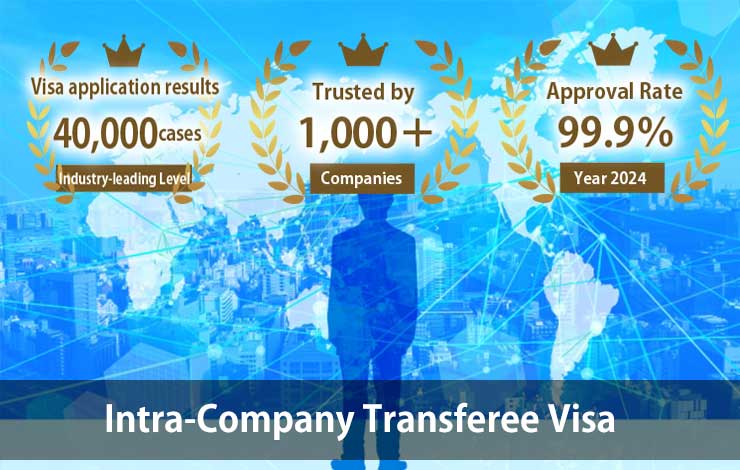
- Established in 1986 with an industry-leading record of 40,000+ visa applications
- Trusted by more than 1,000 corporate clients
- No travel expenses — nationwide coverage at a flat rate
- Support available in English and Chinese
- ISO 27001 certified — rigorous compliance assured
40,000+ Visa Applications Since 1986 — Among the Most Experienced in the Industry

ACROSEED (Administrative Scrivener Corporation) was founded in 1986. Since the 1990 legal reform that opened immigration procedures to administrative scriveners, we have specialized exclusively in immigration filings as registered application agents. Our cumulative filings exceed 40,000 (as of March 2025).
We currently handle 3,000–4,000 visa applications annually. We submit to immigration twice a week to monitor review trends and respond promptly to regulatory changes.
By partnering with ACROSEED, you gain access to service backed by the industry’s most extensive hands-on experience and up-to-date insight into examination practices.

ACROSEED Track Record
Corporate client engagements, publications, media features, and seminar history
A Trusted Service Used by 1,000+ Corporate Clients

At ACROSEED, corporate requests are handled by a dedicated team specializing in work visa applications and permits associated with foreign national employment.
We offer two service lines: “HR-Facing Services” and “Employee-Facing Benefits Services.”
Corporate needs vary widely depending on the scale and profile of foreign national employment. We listen carefully to your challenges and objectives and propose optimal solutions with relevant benchmarks from other clients.
Consultations and estimates are provided free of charge. Please feel free to contact us.
Our services are trusted by a broad client base—from TSE Prime–listed companies to SMEs.
Implementation Case Studies
Examples of companies that actively advance foreign talent hiring with ACROSEED’s services
Nationwide Coverage at a Flat Rate — No Travel Expenses

Our office is located in Nagatacho, Chiyoda-ku, Tokyo, yet we handle immigration matters nationwide without charging travel expenses—our fees are uniform across Japan.
For distant clients, we offer online consultations via Skype or Zoom, enabling face-to-face discussions and seamless engagement equivalent to in-person visits.
Support in English and Chinese

Upon request, our bilingual staff can communicate directly with foreign employees and students throughout the application process.
Inbound inquiries from foreign nationals often place a heavy burden on HR teams.
By entrusting applicant guidance and application progress management to ACROSEED, HR managers can significantly reduce workload.
ISO 27001 Certified — Robust Compliance

ISO 27001 is the international ISMS standard for managing risks related to organizational information and enhancing corporate value.
ACROSEED obtained ISO 27001 ahead of many peers. We are committed to preventing information leaks and continuously strengthening our capabilities as a trusted partner.
Our certification enables compliance-focused enterprises—including large listed companies—to use our services with confidence.
9. Service Fees for Intra-Company Transferee Visa Support (Excl. Tax)
• Fees vary depending on the services requested, scope, and application details. We provide proposals and estimates free of charge—please contact us.
* ACROSEED provides nationwide coverage.
| Certificate of Eligibility (COE) Application (Inviting from Overseas) |
Around JPY 100,000 |
|---|
If you are considering ongoing outsourcing, please also refer to the following page for cost-effective options.

Outsource Visa Applications and Status Management
From hiring to offboarding, ACROSEED supports HR teams with deep expertise in all aspects of foreign talent management. We customize services to resolve your organization’s specific challenges.

Why ACROSEED is Chosen by Many Corporations
See Our Service Implementation Examples
ACROSEED Workflow
Contact Us / Free Consultation
Since our establishment in 1986, ACROSEED has specialized in visa applications for foreign nationals and has provided consulting services to corporations employing foreign talent for nearly 40 years.
Consultations are available by phone, email, online meeting, or in-person at our office. English-language support is also available.