[2025 Edition] Short-Term Visa Application Support Service (For Corporations)
Last updated:
- Overview of Short-Term Visas
- List of Visa-Exempt Countries/Regions (as of Dec. 10, 2024)
- Key Points for Obtaining a Short-Term Visa
- Application Procedures
- Advantages of Outsourcing to an Immigration Lawyer
- Application Process & Estimated Timeline
- Frequently Asked Questions
- Why Choose ACROSEED
- Service Fees for Short-Term Visa Applications
1. Overview of Short-Term Visas
1. Definition of a Short-Term Visa
A Short-Term Visa (Temporary Visitor Visa) is required for foreign nationals entering Japan for a limited period for purposes such as tourism, family visits, or short-term business activities. It allows stays of 15, 30, or 90 days and is strictly limited to non-remunerative activities.
As of December 10, 2024, Japan grants visa exemption to 71 countries and regions. Nationals of these countries generally do not need to apply for a Short-Term Visa prior to entry. However, citizens of other countries must apply and obtain a Short-Term Visa before travel.
Even for nationals of visa-exempt countries, a visa may still be required depending on the purpose and length of stay. Advance confirmation is essential for corporate HR teams arranging business travel.
- Philippines
- Vietnam
- China
- Russia
- CIS countries, Ukraine, Georgia
- Other countries/regions
2. Typical Business Use Cases
A Short-Term Visa is appropriate for non-remunerative business-related activities. Common corporate use cases include:
1. Business Meetings and Negotiations
- Pre-transaction discussions for new ventures or partnerships.
2. Participation in Trade Shows and Exhibitions
- Delivering presentations on company products.
3. Internal Training and Orientation
- Technical product or service training (non-remunerative).
4. Equipment Installation or Maintenance Supervision
- Temporary technical supervision not falling under work visa categories such as “Engineer/Specialist in Humanities/International Services.”
5. International Conferences and Seminars
- Delivering presentations or engaging in panel discussions (without compensation).
6. Visits by Overseas Executives or Directors
- Short-term stays for annual reporting and decision-making.
3. Duration and Types of Short-Term Visas
Short-Term Visa durations are as follows:
Up to 15 days
Up to 30 days
Up to 90 days
Single-Entry Visa: Valid for one entry only
Double-Entry Visa: Valid for two entries
Multiple-Entry Visa: Valid for multiple entries during the validity period (issued under specific conditions)
A multiple-entry visa is granted only when the applicant meets specific eligibility requirements.
2. List of Visa-Exempt Countries and Regions (as of December 10, 2024)
Japan grants short-term visa exemptions to nationals of the following 71 countries and regions.
* Length of Stay: Upon landing, the permitted stay is “15 days” for Indonesia and Thailand, “14 days” for Brunei, “30 days” for the United Arab Emirates, and “90 days” for all other countries and regions unless otherwise specified.
List of Visa-Exempt Countries and Regions (Asia) |
|
|---|---|
| Singapore | Indonesia (Note 1) |
| Brunei (up to 14 days) | Thailand (Note 2, up to 15 days) |
| Republic of Korea | Malaysia (Note 3) |
| Taiwan (Note 4) | Hong Kong (Note 5) |
| Macao (Note 6) | |
List of Visa-Exempt Countries and Regions (North America) |
|
|---|---|
| United States | Canada |
List of Visa-Exempt Countries and Regions (Central and South America) |
|
|---|---|
| Argentina | Chile |
| Uruguay | Dominican Republic |
| El Salvador | Bahamas |
| Guatemala | Honduras |
| Costa Rica | Mexico (Note 8) |
| Suriname | Barbados (Note 7) |
| Panama (Note 2) | Brazil (Note 2) |
List of Visa-Exempt Countries and Regions (Oceania) |
|
|---|---|
| Australia | New Zealand |
List of Visa-Exempt Countries and Regions (Middle East) |
|
|---|---|
| Israel | Qatar (Note 9) |
| United Arab Emirates (Note 2, up to 30 days) | Turkey (Note 7) |
List of Visa-Exempt Countries and Regions (Europe) |
|
|---|---|
| Iceland | Germany (Note 8) |
| Ireland (Note 8) | Norway |
| Andorra | Hungary |
| Italy | Finland |
| Estonia | France |
| Austria (Note 8) | Bulgaria |
| Netherlands | Belgium |
| Cyprus | Poland |
| Greece | Portugal |
| Croatia | North Macedonia |
| San Marino | Malta |
| Switzerland (Note 8) | Monaco |
| Sweden | Latvia |
| Spain | Lithuania |
| Slovakia | Liechtenstein (Note 8) |
| Slovenia | Romania |
| Serbia (Note 2) | Luxembourg |
| Czech Republic | United Kingdom (Note 8) |
| Denmark | |
List of Visa-Exempt Countries and Regions (Africa) |
|
|---|---|
| Tunisia | Lesotho (Note 7) |
| Mauritius | |
(Note 1) Indonesia – Exemption applies only to holders of an ICAO-compliant IC passport pre-registered at a Japanese embassy/consulate in Indonesia. Registration is valid for 3 years or until passport expiry, whichever comes first.
(Note 2) Panama, Brazil, UAE, Thailand, and Serbia – Exemption applies only to holders of an ICAO-compliant IC passport. Others must obtain a visa in advance.
(Note 3) Malaysia – Same as above; without an IC passport, advance visa application is strongly recommended. Strict entry inspections may result in denial of entry.
(Note 4) Taiwan – Only for passport holders with a personal ID number indicated.
(Note 5) Hong Kong – Only for SAR passport holders or BNO passport holders with Hong Kong right of abode.
(Note 6) Macao – Only for SAR passport holders.
(Note 7) Barbados, Turkey, Lesotho – Exemption applies only to holders of an ICAO-compliant machine-readable passport (MRP). Without it, advance visa application is recommended.
(Note 8) These countries allow stays of up to six months. For stays exceeding 90 days, an extension of status must be filed before expiry.
(Note 9) Qatar – Same requirements as Indonesia regarding pre-registration of an ICAO-compliant IC passport.
(Note 10) Peru and Colombia – Strongly advised to obtain a visa before travel, due to strict entry inspections.
3. Key Points for Obtaining a Short-Term Visa
1. No Remunerative Activities
A Short-Term Visa does not permit activities involving compensation or income-generating business operations.
2. Extensions Are Rarely Granted
Extensions of stay are generally not permitted, except under unavoidable circumstances such as medical emergencies.
3. No Residence Card Issued
Foreign nationals entering Japan on a Short-Term Visa are not issued a residence card.
4. Credibility of the Inviting Company
When inviting overseas business partners, Immigration may review the credibility of the inviting company. A history of compliance issues may result in visa denial. A clear business purpose—such as meetings or site visits—must be demonstrated.
5. Schedule of Stay
The length of stay is determined by the schedule submitted at the time of application. For example, a three-day visit may result in a 15-day visa, while schedules exceeding two months may receive a 90-day visa. Accommodation details must also be listed accurately.
6. Requirement for a Guarantor
In most cases, the Japanese inviting company must act as guarantor, ensuring living expenses, return travel costs, and legal compliance. Without a strong business relationship or history of trust, it may be difficult to secure approval.
4. How to Apply for a Short-Term Visa
1. Application at a Japanese Embassy or Consulate
The inviting Japanese company prepares the necessary documents and sends them to the overseas applicant, who then submits them at the local Japanese embassy or consulate. The Japanese company itself cannot apply directly.
2. Submission Method
Depending on the country, applications may be submitted directly to the embassy or must go through an embassy-approved travel agency. Some embassies also require advance appointments. Procedures vary by location, so HR teams should confirm requirements in advance.
3. If the Application is Denied
Short-Term Visas fall under the jurisdiction of the Ministry of Foreign Affairs. If denied, reasons are not disclosed, and there is no formal appeal process. In practice, a new application must be prepared and submitted at a later date.
5. Benefits of Hiring an Immigration Lawyer for Short-Term Visa Applications
Engaging an experienced immigration lawyer (gyoseishoshi) provides corporate HR teams with the following advantages:
1. Improved Approval Certainty
Specialized knowledge and extensive experience ensure that application documents are prepared accurately, minimizing the risk of rejection and reducing HR workload.
2. Time and Resource Savings
Visa procedures are time-consuming. Outsourcing allows HR staff to focus on core operations while the lawyer manages documentation, submission, and communication with authorities.
3. Risk Management and Quick Response
Lawyers can identify potential issues in advance and respond quickly if additional documentation or clarification is requested during screening.
4. Reduced Stress for HR Teams
By delegating the complex application process, companies can avoid unnecessary stress and ensure a smoother overall experience.
5. Continuous Support and Advisory
Professional advisors can also provide support for future applications, renewals, or status changes, ensuring long-term compliance and efficiency.
For these reasons, outsourcing short-term visa applications to an immigration lawyer is highly recommended for companies that frequently host overseas business visitors.
6. Application Process and Timeline
-
1
- Free Consultation
- Assessment of approval likelihood and identification of potential issues.
-
2
- Document Preparation
- Preparation of supporting documents designed to maximize approval probability.
-
3
- Sending Documents
- ACROSEED sends the prepared documents to the applicant overseas.
-
4
- Visa Application at the Embassy
- The applicant submits the documents to the local Japanese embassy or consulate (screening time: approximately 1–2 weeks).
-
5
- Visa Issuance
- The applicant receives the visa from the embassy or consulate.
-
6
7. Frequently Asked Questions
- I obtained a Short-Term Visa but was refused entry at the airport. Why?
- Even with a valid visa, entry may be refused at immigration if doubts arise regarding the purpose of stay. This often occurs when the traveler makes frequent short-term visits or cannot answer basic questions during inspection.
- The immigration office called our company while it was closed. What should we do?
- When acting as the inviting party, Japanese companies may receive confirmation calls from immigration inspectors. For important business guests, HR should arrange arrivals on weekdays or ensure staff availability to respond promptly.
- Our business meetings are taking longer than expected. Can we extend the stay?
- Extensions of Short-Term Visas are generally not granted, except for emergencies such as illness or accidents. Business-related schedule changes do not qualify, so HR should plan visits carefully in advance.
8. Benefits of Choosing ACROSEED
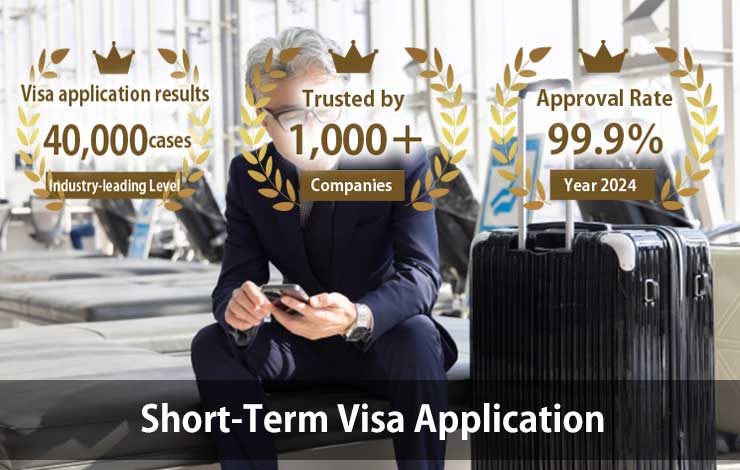
- Established in 1986, with an industry-leading record of over 40,000 visa applications
- Trusted by more than 1,000 corporate clients
- No travel expenses – nationwide service at a flat rate
- Services available in English and Chinese
- ISO 27001 certified – ensuring strict compliance
40,000 Visa Applications Since 1986 – One of Japan’s Most Experienced Providers

ACROSEED has specialized in immigration services since 1990, when legal reforms allowed administrative scriveners to handle immigration procedures. As of March 2025, we have processed over 40,000 visa applications.
We currently handle 3,000–4,000 visa cases annually, with immigration visits twice a week to stay current on screening trends and regulation changes.
By choosing ACROSEED, you benefit from the most up-to-date insights and extensive hands-on experience in the industry.

Our Track Record
ACROSEED’s track record in corporate services, publications, media coverage, and seminars
Trusted by Over 1,000 Corporate Clients

ACROSEED’s dedicated corporate team handles all visa-related and licensing procedures associated with foreign employee hiring.
We offer two distinct service types:
・As a welfare benefit service for foreign employees
We customize our support based on your company’s structure, challenges, and employment needs, referencing real-world examples.
Our services are trusted by a wide range of clients, from publicly listed corporations to small and mid-sized businesses.
Case Studies
We present case studies of companies that actively promote the employment of foreign nationals by utilizing ACROSEED’s services.
Nationwide Flat-Rate Service with No Travel Costs

Our office is based in Nagatacho, Chiyoda-ku, Tokyo, but we serve immigration offices across Japan with no additional travel costs.
We also offer online consultations via Zoom or Skype, allowing face-to-face communication from any location.
English and Chinese Language Support

Our bilingual staff can communicate directly with foreign employees in English or Chinese.
We assist with application explanations, status tracking, and employee coordination — reducing the burden on HR teams and improving the applicant experience.
ISO 27001 Certified for Information Security Compliance

ISO 27001 is the international standard for information security management (ISMS).
ACROSEED was an early adopter of this certification in our field, demonstrating our commitment to secure and compliant client service.
This gives even highly regulated, publicly listed companies the confidence to trust us as their immigration partner.
9. Document Preparation Service Fee for Short-Term Visa Applications (Excluding Tax)
Since short-term visa applications must be submitted to a Japanese embassy located overseas, ACROSEED cannot directly apply on your behalf. Therefore, our service is limited to preparing the application documents and communicating with the applicant residing overseas.
| Short-Term Visa Application | 50,000 yen (excluding tax) |
|---|
* If you plan to invite a large number of participants to Japan on short-term visas for events such as international conferences or in-house training, please refer to the following page.

Procedures for Inviting Participants to International Conferences or In-House Training
This is a support service for companies hosting international conferences, in-house training, and other events by inviting a large number of participants from overseas on short-term visas.
Since our establishment in 1986, we have been engaged for nearly 40 years in consulting for companies hiring foreign employees, specializing in visa applications for foreign nationals.
Consultations are available by phone, email, online meeting, or in person at our office. English support is also available.