[2025 Edition] Internship Visa Application Guide for International Students
Last Updated:
- Overview of Internships for International Students
- Definition of International Student Internships
- How Companies Can Host Foreign Interns
- Compensation and Allowances
- Tax Obligations for Internships
- Insurance and Social Security Considerations
- Visa Procedures for Hosting Interns
- Visa Categories for Internship Programs
- Duration of Internship Programs
- Requirements for Internship Visa Applications
- Application Process & Examination Timeline (As of June 2025)
- Required Documentation for Internship Visa Applications
- Key Compliance Considerations for Employers
- Typical Examples of Internship Visa Requests
- Q&A on Internship Visas for International Students
- Benefits of Using ACROSEED for Internship Visa Applications
- Service Fees for Internship Visa Support
1. Overview of International Student Internships
1. Definition of an Internship for International Students
An internship is a structured program conducted as part of a university’s academic curriculum, allowing foreign university students to gain professional experience at Japanese companies for a fixed period. The objective is to reduce mismatches in recruiting foreign graduates and to strengthen students’ career development and employability skills.
A “summer job” or “short-term internship” is similar in format but usually takes place during vacation periods and is not formally part of the academic curriculum.
In both cases, students gain practical workplace experience and may receive remuneration under a contractual arrangement between the host company and the university. In today’s globalized recruitment environment, many companies use internships to promote their brand and engage with top-performing international students before graduation.
Benefits of Internships
・Provide high-performing students with hands-on work experience, increasing the likelihood of future hiring
・Strengthen a corporate culture of diversity and inclusion by welcoming foreign talent
・Serve as part of employee training, enhancing language skills and intercultural management capabilities
・Gain professional work experience and exposure to Japanese corporate culture
・Build connections with potential future employers
・Develop professional skills and cross-cultural awareness prior to graduation
It is important to note that internships are designed as academic training opportunities. In principle, they should not be conducted solely for recruitment purposes, and most companies treat internships and hiring activities as separate processes.
2. How Companies Can Host Foreign Interns

1. Accepting Students from Overseas Universities
In this arrangement, Japanese companies partner with overseas universities to accept students as part of their formal curriculum. These interns are often considered “highly skilled talent” and may be graduates of top universities. Many are assigned to technical or specialized roles such as programming, engineering, or research.
To invite overseas students to Japan for an internship, there must be a formal agreement between the host company and the sending university. The student must be enrolled in a recognized degree program (associate’s, bachelor’s, or higher), and correspondence courses are excluded.
For detailed requirements on accepting students from overseas universities, please refer to the following page:

Requirements for Hosting Students from Overseas Universities
Practical details on obtaining a “Designated Activities” visa for foreign student interns.
2. Accepting Students from Japanese Universities
This method involves hosting international students already in Japan on a “Student” visa. Since they generally have Japanese language ability and basic workplace knowledge, hosting them is relatively straightforward—even for companies accepting foreign nationals for the first time. Some employers also use this as a short-term trial before offering full-time positions, helping them assess organizational readiness and identify challenges.
3. Internships and Remuneration
Internships are carried out as part of a foreign university’s official curriculum, based on a formal agreement between the university and a Japanese host company. While students perform actual work during the internship, remuneration is optional—there are no restrictions on whether payment is made or on the amount. Some interns receive competitive compensation, while others may participate without pay.
If the company covers expenses such as housing, meals, or transportation, these are generally not regarded as “remuneration.” However, during visa screening, authorities review each case individually to determine whether such benefits could be considered compensation.
4. Internships and Taxation

If an internship is paid, the compensation is treated as salary income, and the host company is required to withhold income tax at source. For short-term internships of one to two weeks, employers must use the “Daily Table – Category B” in the Withholding Tax Table. For monthly payments, the “Monthly Table – Category A” applies.
To apply the lower Category A tax rate for monthly payments, companies must obtain a “Declaration of Exemption for Dependents, etc.” from the student. If the student has multiple employers, an income tax return may be required. In cases where the total annual income is JPY 1.03 million or less and tax has been withheld, the student may be eligible for a refund.
5. Internships and Social Insurance
Even for internships, if the student’s working hours are at least three-quarters of a full-time employee’s schedule, enrollment in Japan’s social insurance system may be required. Whether Workers’ Accident Compensation Insurance (Rōsai Hoken) applies depends on whether the internship is deemed an employment relationship. Where public insurance does not apply, companies are strongly advised to arrange private insurance to mitigate risks.
Potential risks associated with internships typically fall into three categories:
1. Accidents Involving the Intern
・Traffic accidents during commuting ・Workplace accidents during assigned duties ・Slips, trips, or falls inside the office2. Damage Caused by the Intern
・Damage to company property ・Injury to employees or customers ・Loss of revenue due to disruption of operations3. Information Leaks
・Disclosure of confidential business information such as product development plans, HR data, or financial recordsFor more details on how social insurance applies to internships, please refer to the following page:
How Social Insurance Applies to Foreign Internships
Detailed explanation of the conditions under which paid internships are subject to Japan’s social insurance requirements.
2. Visa Procedures for Hosting Foreign Interns
To host foreign interns at a Japanese company, the appropriate visa must be obtained. This section outlines the available visa types, application process, and compliance considerations for HR and host organizations.
1. Types of Visas for Internship Programs
1. For Students Enrolled at a Japanese University
When the student is already enrolled at a Japanese university and holds a “Student” visa or “Designated Activities” visa (Job-Hunting or Job Offer Holder), and the internship includes remuneration, they must obtain permission to engage in activities outside their current status.
| Visa Type | Comprehensive Permission | Individual Permission | No Permission Required |
|---|---|---|---|
| Work Hours | Up to 28 hours/week | Over 28 hours/week | — |
| Remuneration | Yes | Yes | No |
International students in Japan on a “Student” visa may work part-time up to 28 hours per week (or 8 hours per day during official long breaks) with valid comprehensive permission. Internships must comply with this limit. Exceeding the allowance constitutes a violation and may result in deportation, making strict compliance essential.
Exceptions exist where more than 28 hours per week are permitted, including:
Eligible Cases:
1. Undergraduate students (excluding junior colleges) who have completed their final academic year and nearly all required credits by the internship period
2. Graduate students in their final year
3. Students on a “Designated Activities” visa for job-hunting
4. Students on a “Designated Activities” visa as a job-offer holder
In other situations, internships may still be permitted if directly related to the student’s major and required for academic credit.
2. For Students Enrolled at an Overseas University
When hosting students from overseas universities, the visa type depends on three main factors:
1. Whether the internship is credit-bearing
2. Whether remuneration will be provided
3. Duration of stay
No Credit Awarded
If the internship does not provide university credit, it generally falls under the “Designated Activities (Summer Job)” category. The maximum internship period is typically three months during the student’s vacation period, and remuneration from the host company is required.
Credit Awarded
If the internship is credit-based, it must be part of the university’s formal curriculum, supported by an internship agreement between the university and the host company. Internship duties must be relevant to the student’s field of study.
Depending on remuneration and duration, the applicable visa may be a “Designated Activities” visa, a “Cultural Activities” visa, or a “Temporary Visitor” visa.
| Visa Type | Designated Activities | Temporary Visitor | Cultural Activities |
|---|---|---|---|
| Duration of Stay | Over 90 days (up to 1 year) | Up to 90 days | Over 90 days |
| Remuneration | Yes | No | No |
2. Internship Duration
The duration of stay for an internship must be “no more than one year, and in total, no more than half of the standard period required to complete the degree program.”
“Standard period” refers to the minimum number of years required to obtain the degree under the education system of the student’s country (e.g., 2 years for a 2-year program, 4 years for a 4-year program).
The maximum duration for a single internship is one year. For example, a student in a four-year program may complete one internship, return home, and later reapply for another one-year internship. However, leaving Japan temporarily under the “deemed re-entry” system does not reset the internship. A new Certificate of Eligibility must be obtained for each internship period.
3. Requirements for an Internship Visa Application
1. Enrollment in a University or Graduate School
The applicant must be enrolled in a recognized university or graduate school, either overseas or in Japan. Since the internship must form part of an academic program, post-graduation internships are not eligible (a different visa status would be required).
2. Internship Duties Must Relate to the Field of Study
The internship must be directly relevant to the student’s major. For example, a computer science major may intern at an IT company, but engaging in unrelated manual labor (e.g., food service, factory work) is not permitted.
Although not explicitly stated in law, immigration authorities review the relationship between the student’s major and the internship duties when assessing eligibility. Even if the link appears weak, approval may still be possible if the university can clearly demonstrate how the internship will be academically evaluated.
3. Conditions Based on Remuneration
Unpaid Internships
→ Generally easier to obtain. Applicants must show proof of sufficient funds to cover living expenses in Japan.Paid Internships
→ Stricter review applies, as activities may be classified closer to employment. Immigration authorities will check whether compensation and working conditions comply with Japanese labor standards, including minimum wage and working hours.4. Internship Duration
Internships are usually limited to one year. For unpaid internships, the common period is several months to six months. Longer durations require specific academic justification.
5. Suitability of the Host Company
The host company will also be reviewed. Companies with labor law violations, “paper companies,” or insufficient training capacity will not be accepted. Immigration authorities examine whether the company can provide an appropriate work environment, including training, supervision, and job content aligned with the internship agreement.
For more details on the Designated Activities visa requirements, please see the following page:
Requirements for a Designated Activities Visa (Internship)
Explains how remuneration, duration, and curriculum requirements determine the type of visa granted for international student internships.
4. Application Process and Examination Timeline
1. Application Process
When inviting overseas students for internships, the process is as follows:
1
- Initial Consultation
- We review internship details (job content, schedule, remuneration) and confirm whether the internship qualifies for the appropriate visa. Consultations can be conducted by phone, email, online (Zoom, Teams, Line, WeChat), or in person.
2
- Collection of Application Materials
- ・Communication with the student and university (as needed)
・Provision of required document lists and responses to questions
3
- Preparation of Application Documents
- Our immigration specialists prepare all required documentation on behalf of your company.
4
- Submission to the Immigration Services Agency
- ACROSEED submits the application directly to the Immigration Services Agency. Your HR team does not need to visit the office.
5
- Receipt of Results
- The Immigration Services Agency issues the decision. Results are communicated to both the company and the student, with further instructions for entry to Japan.
2. Examination Timeline (As of June 2025)
Immigration Services Agency – Processing Times (June 2025)5. Required Documents for Internship Visa Applications
Because requirements are subject to frequent legal revisions, always check the Immigration Services Agency website for the latest information.
Designated Activities Visa (Paid Internships)
Certificate of Eligibility Application
Change of Status of Residence Application
Extension of Period of Stay Application
Cultural Activities Visa (Unpaid Internships Over 90 Days)
Certificate of Eligibility Application
Change of Status of Residence Application
Extension of Period of Stay Application
Temporary Visitor Visa (Unpaid Internships Up to 90 Days)
Temporary Visitor Visa Application – Ministry of Foreign Affairs
6. Important Considerations for Internship Visas
Because the internship system can be misused as a source of low-cost labor, immigration authorities carefully review applications for compliance. They assess:
- Whether duties are consistent with the student’s major field of study
- Compliance with Japanese labor standards (minimum wage, working hours, workplace safety)
- Whether the host company has the ability to provide training and supervision
If the internship duties generate profit directly for the company and an employment relationship is recognized, the intern may be treated as a worker rather than a trainee. The stronger the link to the student’s major, the greater the chance of approval. Internships involving work in the adult entertainment industry are strictly prohibited.
For more information on compliance considerations when inviting overseas students for internships, see the following page:
Key Compliance Points for Hosting International Student Interns
Outlines the legal requirements and precautions Japanese companies must take when hosting students from overseas universities.
3. Case Examples: Internship Visa Applications for Foreign Students
At ACROSEED, we handle visa applications for a wide range of corporate clients—from SMEs to publicly listed companies. Among these, requests for internship visa applications are particularly common. Below are typical cases where HR departments seek our support.
General understanding of internship requirements, but lack of capacity to manage details internally.
Many HR managers are familiar with the general framework of internship programs and visa requirements, yet prefer to rely on experts to ensure smooth and compliant processing. HR and General Affairs teams often operate with limited staffing, making it difficult to handle unexpected or urgent internship arrangements. In such situations, ACROSEED frequently acts as a trusted partner, working closely with your team to ensure the successful onboarding of international interns.
First-time internship visa application requiring expert support.
When hosting an international intern for the first time, companies often find visa procedures and immigration compliance to be unclear. In these cases, ACROSEED collaborates with HR teams to design the entire process—from establishing the proper scheme, preparing application documents, and creating a timeline—providing reliable, end-to-end support until the intern’s arrival in Japan.
Urgent arrival due to last-minute schedule changes requiring expedited expert handling.
This situation typically arises when the number of interns increases unexpectedly or schedules are accelerated. Leveraging experience from numerous past cases, ACROSEED can advise on the feasibility of meeting immigration timelines and provide practical solutions. We also offer free initial consultations, so please feel free to reach out to us at any stage.

View All Case Studies
Explore our tailored visa solutions for corporate clients managing international employees and interns.
4. Q&A on Internship Visas for Foreign Students
- [2025 Edition] Internship Visa Q&A for HR Professionals
A concise collection of frequently asked questions from HR managers regarding internship visa applications for foreign students. - [Hosting Interns Directly from Overseas Universities]
We are considering hosting interns directly from overseas universities. What visa procedures and compliance points should we be aware of? - [Changing the Host Organization During the Internship]
If we accept an intern but later need to transfer them to another company, is such a change permissible? - [Social Insurance for International Student Interns]
When hosting international students as interns, how should we handle social insurance obligations? - [Requirements for Hosting Foreign Interns]
What are the eligibility and visa requirements when inviting foreign students for an internship in Japan? - [Precautions When Hosting Foreign Students Enrolled in Japanese Universities]
We are planning to host summer interns, including foreign students enrolled in Japanese universities. What compliance issues should our company be mindful of?
5.Why Choose ACROSEED
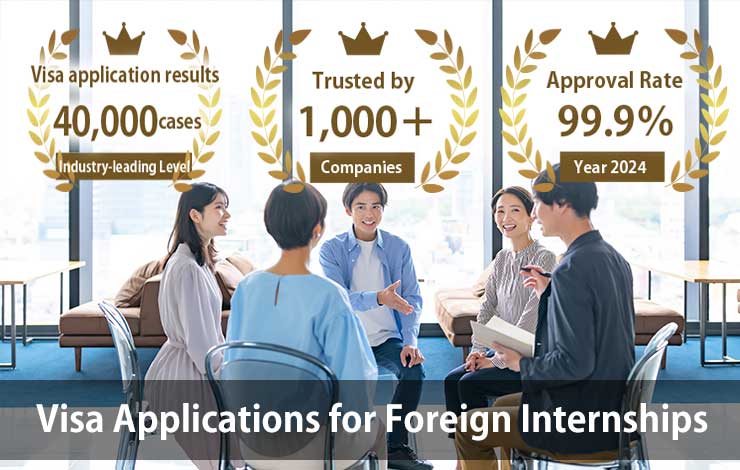
- Established in 1986, with an industry-leading record of over 40,000 visa applications
- Trusted by more than 1,000 corporate clients
- No travel expenses – nationwide service at a flat rate
- Services available in English and Chinese
- ISO 27001 certified – ensuring strict compliance
40,000 Visa Applications Since 1986 – One of Japan’s Most Experienced Providers

ACROSEED has specialized in immigration services since 1990, when legal reforms allowed administrative scriveners to handle immigration procedures. As of March 2025, we have processed over 40,000 visa applications.
We currently handle 3,000–4,000 visa cases annually, with immigration visits twice a week to stay current on screening trends and regulation changes.
By choosing ACROSEED, you benefit from the most up-to-date insights and extensive hands-on experience in the industry.

Our Track Record
ACROSEED’s track record in corporate services, publications, media coverage, and seminars
Trusted by Over 1,000 Corporate Clients

ACROSEED’s dedicated corporate team handles all visa-related and licensing procedures associated with foreign employee hiring.
We offer two distinct service types:
・As a welfare benefit service for foreign employees
We customize our support based on your company’s structure, challenges, and employment needs, referencing real-world examples.
Our services are trusted by a wide range of clients, from publicly listed corporations to small and mid-sized businesses.
Case Studies
We present case studies of companies that actively promote the employment of foreign nationals by utilizing ACROSEED’s services.
Nationwide Flat-Rate Service with No Travel Costs

Our office is based in Nagatacho, Chiyoda-ku, Tokyo, but we serve immigration offices across Japan with no additional travel costs.
We also offer online consultations via Zoom or Skype, allowing face-to-face communication from any location.
English and Chinese Language Support

Our bilingual staff can communicate directly with foreign employees in English or Chinese.
We assist with application explanations, status tracking, and employee coordination — reducing the burden on HR teams and improving the applicant experience.
ISO 27001 Certified for Information Security Compliance

ISO 27001 is the international standard for information security management (ISMS).
ACROSEED was an early adopter of this certification in our field, demonstrating our commitment to secure and compliant client service.
This gives even highly regulated, publicly listed companies the confidence to trust us as their immigration partner.
6. Internship Visa Application Fees (Excluding Tax)
・Fees vary depending on the services required, the scope of work, and the details of the application. We are happy to provide detailed service information and quotations free of charge—please feel free to contact us.
*ACROSEED’s services are available nationwide.
| Certificate of Eligibility Application (Inviting a Student from Overseas) | Approx. 120,000 JPY |
|---|---|
| Change of Status of Residence Application | Approx. 120,000 JPY |
| Extension of Period of Stay Application | Approx. 80,000 JPY |
If you are considering ongoing outsourcing of visa and residence status management, please also refer to the following page:

Outsourcing Visa Applications and Residence Status Management
From hiring to resignation, ACROSEED offers strong HR support backed by expertise in all aspects of foreign employee management. We customize our services to address the specific challenges faced by your company.

Why ACROSEED is Trusted by Corporations
Explore Client Case Studies
Contact Us / Free Consultation
Since our establishment in 1986, we have been supporting companies hiring foreign nationals with visa applications and immigration consulting for nearly 40 years.
We offer consultations by phone, email, online meeting, or in person at our office.
English support is also available.