POLO and POEA Procedures When Employing Filipino Nationals
1. For Companies Planning to Employ Filipino Nationals
When hiring foreign employees in Japan, companies must first ensure the individual holds a valid work-permitting status of residence under Japan’s Immigration Control Act. For Filipino nationals, however, additional requirements under Philippine law also apply. Exceptions include those with Japanese permanent residency or spousal residence status.
Although not widely recognized until recent years, Philippine regulations are strictly enforced, and compliance is mandatory for employers. Since enforcement has tightened, inquiries from companies have increased significantly.
Employers should understand that, in addition to Japan’s immigration requirements, Philippine law mandates compliance with procedures collectively referred to as “POLO/POEA.”
POLO and POEA (see Glossary below) are Philippine government agencies originally established under a Presidential Decree in 1982. Their mandate is to promote overseas employment opportunities for Filipino nationals and safeguard their labor rights.
Because these procedures are rooted in Philippine domestic law, companies requiring legal interpretation should consult with a qualified Philippine attorney or law firm. As an administrative scrivener corporation specializing in applications to Japan’s Immigration Services Agency, ACROSEED provides practical, Japan-side support to ensure smooth compliance and HR operational efficiency.
2. Overview of “POLO” and “POEA”
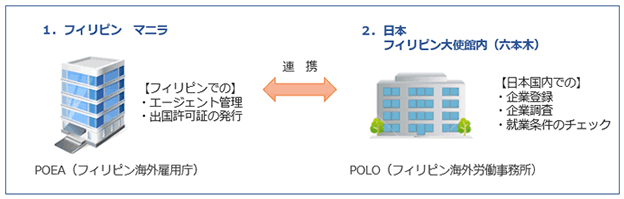
Both POLO and POEA were established to manage overseas employment and protect the rights of Filipino workers abroad. They create and oversee compliance programs in partnership with relevant organizations.
1. POEA (Philippine Overseas Employment Administration)
POEA was established to safeguard Filipinos employed overseas against exploitative conditions. Following government restructuring in 2023, POEA was integrated into the Department of Migrant Workers.
POEA operates through accredited overseas recruitment agencies specializing in the placement of Filipino nationals. All applications must be submitted through these accredited agencies—Japanese employers cannot directly hire Filipino nationals without this channel.
For example, if a Filipino employee working overseas (including seafarers) becomes involved in a labor dispute, POEA has original and exclusive jurisdiction to represent the worker at the initial stage.
Within Japan’s Technical Intern Training Program, more than 300 accredited Philippine sending organizations act as POEA’s recognized agencies. Their fees, services, and track records vary widely, making careful selection essential for employers.
 |
 |
 |
2. POLO (Philippine Overseas Labor Office)
 POLO functions as the overseas labor office of POEA in Japan. Its primary role is to verify that the working conditions of Filipino employees in Japan meet POEA standards and do not disadvantage the worker.
POLO is located within the Philippine Embassy in Roppongi, Tokyo. While some staff can communicate in Japanese, English is the main language used in official correspondence.
Employers must comply with POEA’s standard employment conditions. Some of these differ from common Japanese HR practices, but Japanese employers must formally agree to them in order to employ Filipino nationals.
Following the 2023 restructuring, POLO has been officially rebranded as the Migrant Workers Office (MWO).
3. Who Is Subject to These Procedures?
1. Who Is Subject
In principle, all Filipino nationals working in Japan under a work-permitting status of residence are subject to these procedures.
Individuals whose primary status of residence is not employment-based (e.g., Spouse or Child of Japanese National, Permanent Resident, or Long-Term Resident) are generally exempt from POLO/POEA compliance.
2. Consequences of Non-Compliance
Philippine law requires all overseas employers—including those in Japan—to complete these procedures properly. Failure to do so can create serious compliance risks and disrupt HR operations, even if the employee is highly skilled and both parties wish to maintain long-term employment.
Examples of Potential Issues
・The Philippine Department of Migrant Workers issues a formal warning to the Japanese employer for non-compliance.
・The employer’s name is published on the DMW’s website as a non-compliant company.
・Future recruitment of Filipino nationals becomes significantly more difficult.
3. Exemption from the Direct-Hiring Ban
As a rule, Japanese companies must hire Filipino nationals through a POEA/DMW-accredited recruitment agency. However, for certain specialized professions—such as IT engineers or teachers—direct hiring may be permitted by applying for an exemption from the direct-hiring ban.
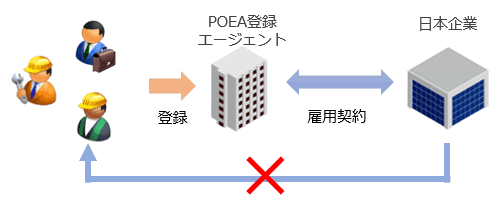
The list of occupations eligible for exemption is subject to revision. Employers should always confirm eligibility and requirements on a case-by-case basis before proceeding.
4. Employment Process for Filipino Nationals
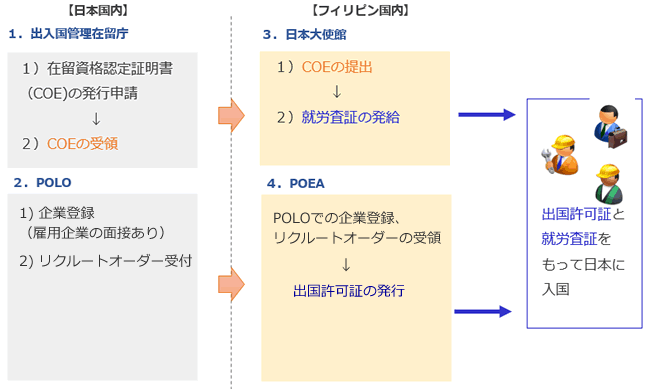
The process varies depending on the status of residence being obtained or currently held. Below is an outline of the standard procedure for one of the most common work-related categories: “Engineer/Specialist in Humanities/International Services.”
If your company is already employing a Filipino national without having completed these procedures, we strongly recommend initiating them immediately. Note that Step 6 usually occurs when the employee temporarily returns to the Philippines, while Steps 1–5 must be completed in advance by the employer.
-
1
- Select a Licensed Recruitment Agency
- The first step is to select a Licensed Recruitment Agency (LRA)※ in the Philippines.
※ LRAs are accredited by the Department of Migrant Workers (DMW, formerly POEA). As of January 2024, there were 252 accredited agencies authorized to handle employment procedures for Filipino nationals in Japan.
Reference:
① Immigration Services Agency of Japan (list provided by the Philippine government):
https://www.moj.go.jp/isa/content/930004710.pdf
② DMW’s official database of licensed agencies:
https://dmw.gov.ph/licensed-recruitment-agenciesSince the relationship with the agency typically continues for as long as the Filipino employee remains hired, HR should carefully evaluate service scope, fees, and compliance history before entering into an agreement. Reputation and license status are critical factors in selection.
-
2
- Conclude the Recruitment Agreement
- Execute a formal Recruitment Agreement with the selected Licensed Recruitment Agency.
-
3
- Apply for Approval with the MWO (formerly POLO)
- Submit an application for company accreditation and a job order to the Migrant Workers Office (MWO, formerly POLO) located within the Philippine Embassy or Consulate in Japan.
-
4
- MWO Document Screening
- Estimated screening time: approximately 7 business days (as of June 2022).
If documents are incomplete or fail to meet requirements, the application will be returned for correction and resubmission. If documents pass review, the employer will be asked to schedule an interview (conducted in English). The attendance of a company representative is usually required. If the company already employs Filipino nationals, the MWO may conduct a site inspection to verify that working conditions align with submitted documentation.
Once screening and the interview are successfully completed, the MWO issues a Memorandum with officially stamped documents, which must then be sent to the Licensed Recruitment Agency in the Philippines.
-
5
- Apply for Company Accreditation with the DMW (formerly POEA)
- Through the Licensed Recruitment Agency, submit the company accreditation application and manpower request to the DMW in the Philippines. (Typical processing time: 2–3 weeks, as of June 2022)
-
6
- Employment Contract and Deployment to Japan
- Based on the approved Recruitment Agreement and manpower request, recruitment is conducted via the Licensed Recruitment Agency (in most cases, the Japanese employer has already identified the candidate).
The employer, candidate, and agency sign the employment contract.
Once the agency secures the Overseas Employment Certificate (OEC), the employee is cleared to travel to Japan.
(Estimated processing time: approx. 5 business days, as of June 2022)
Reference:
An OEC application requires a valid Certificate of Eligibility (COE) issued by Japanese immigration. For first-time employers, obtaining MWO approval at Step 4 may take several months. We therefore recommend starting the process at least five months before the planned deployment date. Once MWO approval is expected, employers should proceed with the COE application in Japan to minimize the risk of expiration. Please note that COE processing times vary widely depending on the employer’s size and case specifics (approx. two weeks to three months).
5. Glossary of POLO/POEA-Related Terms
6. ACROSEED Services
Service Details |
Fees (Excluding Tax) |
|---|---|
| 1. Preparation of application documents for POLO/MWO submission (translation of official certificates not included) | Please contact us for details |
| 2. Referral to a Licensed Recruitment Agency in the Philippines |

Why Many Corporations Choose ACROSEED
View Case Studies
Contact Us / Free Consultation
Since our establishment in 1986, we have been providing corporate consulting services focused on visa applications for foreign nationals, with nearly 40 years of experience. We offer consultations via phone, email, online meetings, or in person at our office. English-language support is also available.